
.png)
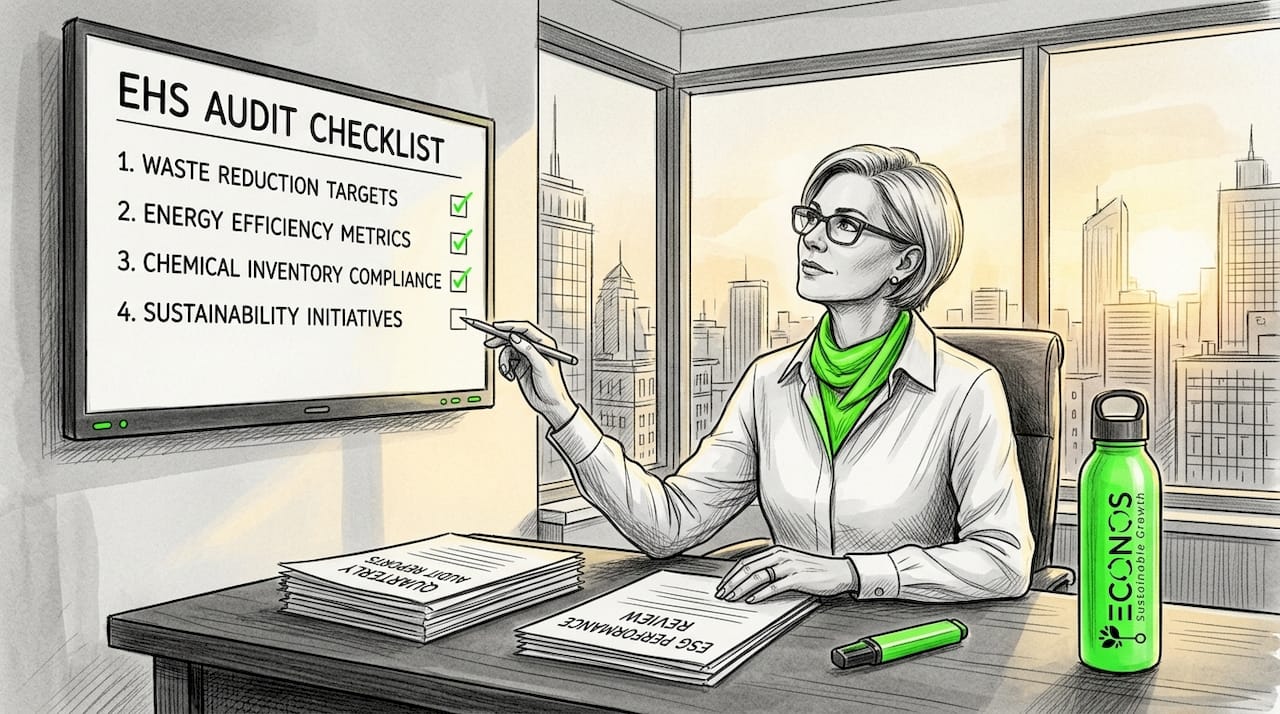
TL;DR:
- EHS audits are systematic assessments required by regulation to ensure compliance, not just routine inspections.
- Following ISO 19011 standards and ensuring auditor independence enhances audit effectiveness, while thorough follow-up mitigates organizational risk.
Most compliance professionals know they need to conduct EHS auditing. Fewer have a clear picture of what separates a genuinely effective audit program from one that generates paperwork and little else. The confusion is understandable. EHS audits overlap with inspections, safety tours, and regulatory visits in ways that blur the lines. This guide cuts through that fog. You will find the regulatory foundations that require audits, a step-by-step breakdown of the audit process grounded in ISO 19011, the pitfalls that derail even experienced teams, and the financial case for doing this work well.
Table of Contents
- Key Takeaways
- EHS auditing frameworks and regulatory context
- How the EHS audit process works
- Common pitfalls that undermine audit quality
- The measurable financial case for regular auditing
- Using audits to build continuous improvement and ESG alignment
- What I have learned about audits that most guides skip
- How Econos-esg can strengthen your audit program
- FAQ
Key Takeaways
| Point | Details |
|---|---|
| Audits differ from inspections | EHS audits are systematic, evidence-based reviews of compliance and management systems, not spot checks. |
| ISO 19011 sets the standard | Following ISO 19011 audit principles gives your program structure, repeatability, and defensibility. |
| Auditor independence is non-negotiable | Auditors must not review their own work areas; cross-functional teams deliver objective findings. |
| Follow-up drives real value | Closing findings requires verified effectiveness, not just confirmation that a fix was attempted. |
| Audits reduce measurable financial risk | Regular auditing cuts regulatory citations and insurance costs while protecting against major OSHA penalties. |
EHS auditing frameworks and regulatory context
EHS auditing is not a voluntary best practice. For many organizations, it is a legal requirement embedded directly in regulatory standards. OSHA’s Process Safety Management standard (29 CFR 1910.119) mandates compliance audits every three years for covered facilities. The Lockout/Tagout standard requires periodic inspections of energy control procedures. HAZWOPER requires site safety and health program reviews before operations begin. These are not suggestions. They are minimum safety audit requirements with documented corrective actions attached.
On the environmental side, the EPA Audit Policy provides a meaningful incentive for organizations that identify violations through voluntary environmental auditing procedures. Disclosures made within 21 days can qualify for civil penalty reductions of up to 75% or more. That is a significant financial lever for any organization willing to audit proactively rather than wait for a regulator to find the problem first.
The internationally recognized standard for managing audit programs is ISO 19011, which provides guidelines for audit principles, managing audit programs, and evaluating auditor competence. It applies to both internal and external audits across environmental and occupational health and safety management systems.
It helps to be clear about what distinguishes an audit from related activities:
- EHS audit: A systematic, documented, evidence-based process to determine whether EHS management systems, policies, and legal requirements are being met. It produces findings, graded by severity, and requires corrective action.
- Safety inspection: A routine walk-through to identify visible hazards or non-conformances. Less formal, less structured, and not a substitute for an audit.
- Safety tour: A leadership visibility exercise. Valuable for culture, but not a compliance verification tool.
Pro Tip: Document all corrective actions from audits, including the date assigned, responsible party, and verification outcome. The legal importance of this record cannot be overstated. Undocumented findings with no corrective action trail are a significant liability exposure.
How the EHS audit process works
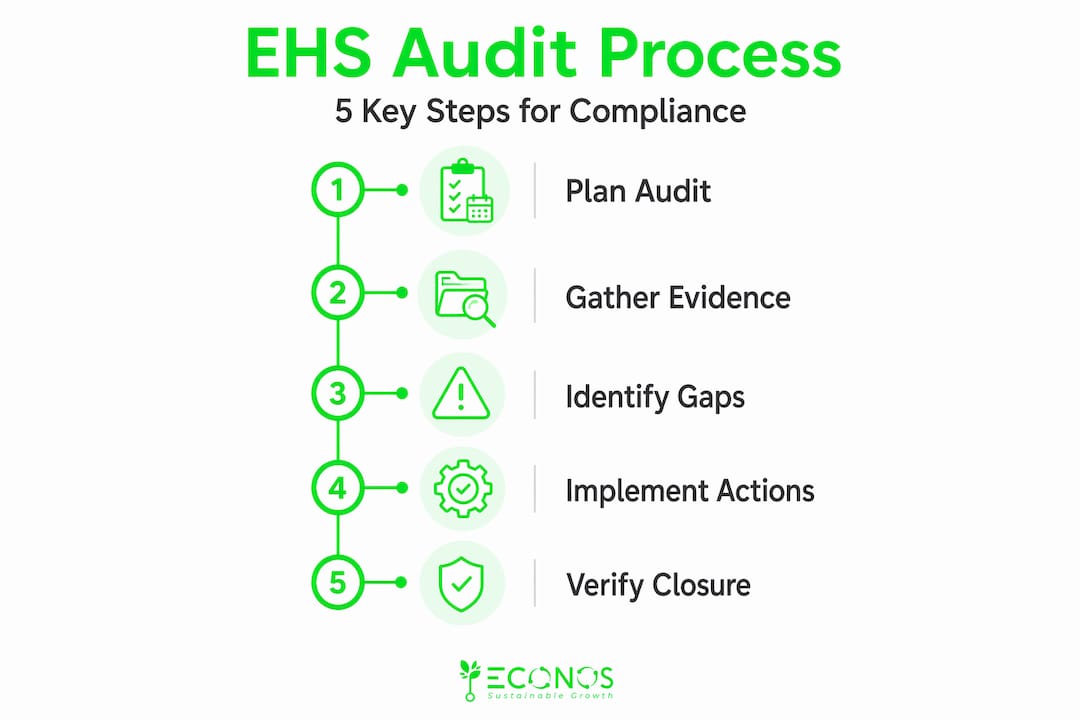
A well-designed EHS audit process follows a predictable sequence. Deviating from it is where most programs lose their rigor.
-
Define scope, objectives, and criteria. Before anything else, your team needs to know what is being audited and against what standard. Is this a regulatory compliance audit against OSHA’s PSM standard? An internal audit of your ISO 45001 management system? The criteria determine what evidence matters and what findings mean.
-
Schedule and plan the audit. A risk-based scheduling approach ensures high-hazard areas receive more frequent attention. Annual audits for low-risk administrative areas may be sufficient. Chemical processing units or confined space operations likely need quarterly attention. Build your schedule around actual risk, not calendar convenience.
-
Select and prepare the audit team. Per ISO 19011, auditor competence requires knowledge of applicable standards, ethical behavior, strong communication skills, and ongoing professional development. Auditors should have no direct responsibility for the areas they are auditing. Cross-functional auditing is the practical solution: a process engineer auditing the maintenance department, for example, while the maintenance supervisor reviews the engineering lab.
-
Collect evidence from multiple sources. Effective evidence gathering uses three streams: document review, site walkthroughs, and interviews. Reviewing procedures alone tells you what workers are supposed to do. Observations tell you what they actually do. Interviews reveal the gap between the two. All three are required for a credible audit.
-
Classify and validate findings. Not all findings carry the same weight. A missing label on a chemical container is not equivalent to a blocked emergency exit or an undocumented PSM change. Grade findings by severity (critical, major, minor) and validate each one against the specific regulatory requirement or standard criterion it violates. Avoid subjective language. Tie every finding to evidence.
-
Report findings and hold a closing meeting. The audit report should be factual, traceable, and free of opinion. The closing meeting gives facility management the opportunity to clarify factual errors before the report is finalized. This step matters for organizational trust and reduces resistance to corrective action.
-
Assign corrective actions, verify effectiveness, and track completion. This is where most programs fall short. Corrective actions need effectiveness verification, not just implementation confirmation. Monitoring periods of 90 days to 6 months are standard, depending on the nature of the finding. A root cause fix that has held for 90 days is evidence of effectiveness. A workaround that lasts two weeks is not.
Pro Tip: Build your EHS compliance checklist directly from the regulatory standards that apply to your facility. Generic checklists miss facility-specific requirements and create a false sense of coverage.
Common pitfalls that undermine audit quality
Even experienced EHS teams fall into patterns that reduce the value of their audit programs. Recognizing these early saves significant time and exposure.
-
Auditor independence failures. When supervisors audit their own departments, findings are systematically underreported. The discomfort of surfacing problems in your own area is a real psychological barrier. Cross-functional structures remove that conflict.
-
Closing findings without verifying effectiveness. The most common gap in EHS audit follow-up is marking findings “closed” when a corrective action has been implemented, rather than when it has been demonstrated to work. Failure to act on findings is the primary liability risk from audits, not the audit itself.
-
Document discoverability. Internal audit records can be subpoenaed by OSHA if identified hazards were not corrected. Some organizations work with legal counsel to conduct certain audits under attorney-client privilege, particularly in high-stakes areas like process safety. This does not mean hiding problems. It means managing the legal context of how sensitive findings are documented and communicated.
-
Treating audits as compliance checklists rather than diagnostic tools. Checking every box and scoring 100% on a form while a systemic gap in hazard communication training goes unnoticed is a real failure mode. Good audits probe root causes. They ask why a non-conformance exists, not just whether it exists.
-
Audit fatigue and infrequent scheduling. Annual audits for high-hazard areas create long windows where undetected failures can compound. Risk-based frequency is the solution, but it requires the organizational will to dedicate resources proportionally.
Pro Tip: When escalating overdue corrective actions, use a tiered system: a reminder at 30 days, a notification to the responsible manager at 60 days, and escalation to senior leadership at 90 days. Formalize this in your audit program procedure so it is consistent and defensible.
The measurable financial case for regular auditing
There is a straightforward financial argument for investing in a well-structured EHS audit program. Organizations that conduct quarterly EHS self-audits reduce regulatory citations by 60% and insurance premiums by 15 to 25%. Those numbers represent real budget line items, not theoretical savings.

On the cost side, contract EHS auditors typically charge $750 to $1,500 per audit day plus travel expenses. For organizations with fewer than three facilities, this is often more cost-effective than maintaining a full-time internal audit function. For larger multi-site operations, a combination of cross-functional internal audits and periodic external reviews provides the best balance of independence, expertise, and cost control.
The penalty exposure side of the equation makes the investment even clearer:
| Risk Category | Exposure | Mitigation Through Auditing |
|---|---|---|
| OSHA willful violation | Up to $170,181 per violation | Proactive identification before OSHA inspection |
| EPA civil penalties | Full penalty amount | Up to 75% reduction through voluntary disclosure |
| Insurance premiums | Baseline rates | 15 to 25% reduction with quarterly audits |
| Regulatory citations | Baseline frequency | Up to 60% reduction with consistent audit programs |
The math is direct. A single avoided willful OSHA citation covers years of audit program costs. When you layer in insurance savings, the return on a structured EHS management systems program is substantial and measurable.
Pro Tip: When building your business case for audit program investment, pull your organization’s OSHA citation history from the public OSHA inspection data portal. Quantify the penalty exposure from past violations and project what proactive auditing would have prevented. Leadership responds to numbers they recognize.
Using audits to build continuous improvement and ESG alignment
The most underutilized aspect of EHS auditing is its capacity to drive organizational learning rather than just compliance verification. Here is how organizations that do this well approach it:
-
Distinguish systemic gaps from isolated incidents. A single spill may be operator error. Three spills in two months across different shifts point to a training gap or a procedural failure. Audit findings analyzed at the program level reveal patterns that individual incident reports miss.
-
Share findings across sites. Multi-location organizations waste enormous value by treating audit findings as site-specific. If a contractor management gap surfaces at one facility, it almost certainly exists elsewhere. Building a mechanism to share findings and best practices across your network is a high-return activity.
-
Connect audit outcomes to ESG reporting. As ESG reporting requirements under frameworks like CSRD and ESRS expand, your EHS audit data becomes source material for disclosure. Documented improvements in workplace safety metrics, environmental performance, and regulatory compliance directly feed the social and environmental components of your ESG reporting obligations. Explore how to align audits with ESG compliance to maximize the value of the work you are already doing.
-
Invest in internal auditor development. Training employees from operations, engineering, HR, and EHS to conduct audits pays dividends far beyond audit quality. It builds a shared understanding of what compliance actually requires, which changes behavior in day-to-day work. Auditor training is one of the highest-return professional development investments an EHS department can make.
-
Involve workers directly. Audits that interview workers, not just supervisors, surface findings that formal observations miss. Workers who feel that their input shapes the audit process are more likely to trust the program and engage with corrective actions.
What I have learned about audits that most guides skip
I have seen organizations build technically rigorous audit programs and still get cited for the same violations year after year. The problem is almost never the audit itself. It is what happens afterward.
The audit is not the liability. In my experience, the liability lives in the gap between findings and resolved root causes. Organizations that close corrective actions based on “fix installed” rather than “fix verified as effective” are doing the riskiest thing possible: they know about a problem, they documented it, and then they created a paper trail showing they did not actually solve it.
I also think the compliance community undersells auditor independence as a strategic tool. Most teams think cross-functional auditing is an administrative preference. It is not. It is the single structural change that most improves finding rates. An auditor with no personal stake in the area being reviewed asks different questions. They see things a colleague would rationalize away.
The regulatory environment is only getting more demanding, not less. CSRD expansion, increasing OSHA enforcement budgets, and ESG disclosure requirements mean that organizations with strong, documented audit programs are building a defensible compliance record in real time. Those without one are accumulating unquantified risk. The practical path forward is not perfection on day one. It is a program that is honest about gaps, serious about follow-up, and committed to getting better.
— Mathieu
How Econos-esg can strengthen your audit program

Building an audit program that actually reduces risk and connects to your broader sustainability strategy takes more than a checklist. Econos-esg works with mid-size and large organizations to develop audit frameworks that are grounded in regulatory requirements, aligned with ISO 19011 principles, and integrated into their ESG reporting workflows. Whether you are building an internal auditor training program or need support connecting your EHS compliance data to your ESG reporting obligations, the team brings practical experience from over 158 projects across 17 industries. For manufacturers specifically, understanding how your audit outcomes feed into your ESG workflow for manufacturers can unlock value beyond compliance. The goal is always the same: you understand what you are doing and why, not just what the consultant told you to do.
FAQ
What is the difference between an EHS audit and a safety inspection?
An EHS audit is a systematic, documented review of whether your management systems and practices meet regulatory and internal standards. A safety inspection is a routine walkthrough to identify visible hazards, with less structure and no formal findings classification.
How often should EHS audits be conducted?
Frequency should be risk-based. High-hazard operations like process safety or confined space programs warrant quarterly audits, while lower-risk administrative areas may need only annual reviews. Risk-based scheduling is the ISO 19011-recommended approach.
Can internal audit documents be used against us by OSHA?
Yes. Internal audit records can become discoverable if identified hazards are not corrected. Organizations with significant legal exposure sometimes conduct audits under attorney-client privilege, with legal counsel directing the work, to manage this risk.
What makes a corrective action truly closed?
A corrective action is closed when the fix has been verified as effective over a monitoring period, typically 90 days to 6 months, not simply when the initial action was taken. Root cause resolution is the standard, not task completion.
How do EHS audit results connect to ESG reporting?
Documented audit outcomes, including safety performance improvements, environmental compliance data, and corrective action records, directly support the social and environmental disclosures required under frameworks like CSRD and ESRS, making your audit program a core input to your ESG reporting process.