
.png)

TL;DR:
- A carbon reduction action plan is a documented strategy that measures, reduces, and reports a company’s greenhouse gas emissions. It requires verified baseline data, science-based targets, and annual reviews to ensure credible progress toward net-zero goals.
A carbon reduction action plan is a structured, documented strategy that defines how a company will measure, reduce, and report its greenhouse gas emissions over a set timeframe. This is the industry term you will see referenced in regulatory frameworks like the UK’s PPN 006 procurement standard, which requires suppliers bidding on contracts over £5 million annually to submit a verified plan showing their net-zero commitment by 2050. Beyond compliance, market pressure from customers, investors, and rating platforms like EcoVadis makes a credible carbon footprint reduction plan a business necessity. Frameworks from the Science Based Targets initiative (SBTi) and the Energy Saving Trust give companies proven methods to translate climate ambition into real operational change. This guide walks you through every stage of building a plan that holds up to scrutiny.
What does a carbon reduction action plan guide require before you start?
The most common failure in carbon planning is starting with targets before establishing a reliable baseline. Without accurate data, any reduction claim is guesswork, and guesswork creates greenwashing risk.
Before drafting your plan, collect emissions data across three scopes:
- Scope 1: Direct emissions from sources your company owns or controls, such as company vehicles and on-site boilers.
- Scope 2: Indirect emissions from purchased electricity, heat, or steam.
- Scope 3: All other indirect emissions across your value chain, including supplier activities, employee commuting, and product end-of-life.
Defining your organizational boundary comes next. Decide whether you will use an operational control or equity share approach, and select a baseline year with reliable data. The baseline year anchors every future target and progress calculation, so it must reflect a normal operating year for your business.
Leadership commitment is not optional. Cross-functional buy-in from finance, procurement, and operations determines whether the plan gets funded and executed. The EPA’s Smart Steps tool offers free digital assessments that help smaller teams conduct initial environmental impact reviews without costly third-party audits. That is a practical starting point for companies without a dedicated sustainability team.
Pro Tip: Draft your first plan in one week using available data, then improve it quarterly. Carbon plans are iterative by nature. A foundational version beats a perfect plan that never gets published.
How do you set credible, science-aligned carbon reduction targets?
Targets without scientific grounding are marketing, not strategy. The Science Based Targets initiative (SBTi) provides the most widely recognized methodology for setting emissions reduction goals that align with the Paris Agreement’s 1.5°C pathway.
A credible target-setting process follows these steps:
- Calculate your verified baseline footprint. Use auditable data from energy bills, fuel receipts, and supplier invoices. Unverified estimates weaken your target’s credibility.
- Select a target type. Absolute targets reduce total emissions by a fixed amount. Intensity targets reduce emissions per unit of output. Absolute targets are generally preferred by SBTi and most regulatory bodies.
- Set a near-term milestone. Science-based near-term targets span 5–10 years, with a common benchmark of 50% absolute emissions reduction by 2030 compared to a 2020 baseline.
- Set a long-term net-zero target. Most frameworks align this with 2050, consistent with the UK PPN 006 requirement and SBTi’s corporate net-zero standard.
- Secure board approval. Targets approved at board level carry more weight with investors, customers, and regulators. They also create internal accountability.
Short-term milestones matter as much as the 2050 headline. A company that commits to 50% by 2030 but sets no annual checkpoints will drift. Breaking the journey into annual or biennial milestones keeps teams focused and makes progress visible.
Pro Tip: Near-term targets drive immediate action. Set a 2026 or 2027 milestone now and assign a budget to it. A target without a budget is a wish.
What are the key components of an effective carbon reduction action plan?
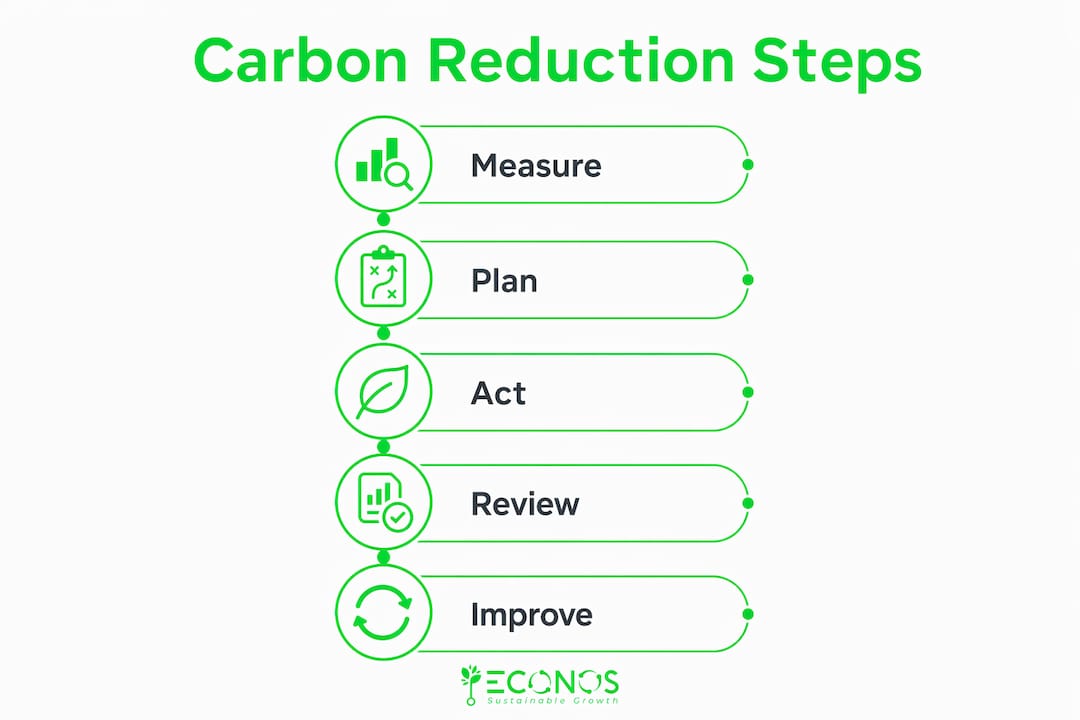
The Energy Saving Trust’s Measure, Plan, Act methodology defines what a board-ready net-zero program looks like: decision-grade data linked to costed, owned roadmaps, embedded into operations for delivery. That structure translates directly into the components every credible plan needs.

| Component | What it includes |
|---|---|
| Organizational boundary | Legal entities, sites, and operations covered by the plan |
| Baseline emissions | Verified Scope 1, 2, and 3 data for the chosen baseline year |
| Reduction targets | Absolute or intensity targets with short and long-term milestones |
| Reduction actions | Specific initiatives with owners, deadlines, and expected impact |
| Evidence and claims | Auditable data supporting every public-facing reduction claim |
| Review process | Annual rebasing schedule and governance for plan updates |
Each action item must have a named owner and a deadline. Assigning clear ownership to every reduction action is the single most reliable predictor of whether a plan gets executed. Without it, accountability dissolves across departments.
Practical reduction actions vary by sector, but common examples include energy efficiency upgrades in facilities, fleet electrification, renewable energy procurement, and supplier engagement programs that push Scope 3 reductions upstream. Each action should include an estimated emissions impact and a cost, so finance can allocate budget and track return on investment.
Avoiding greenwashing means every public claim must be backed by verifiable data. Energy bills, fuel receipts, and meter readings are the minimum standard. If the data does not exist yet, the claim should not be published. This is not overcaution. It is the difference between a credible plan and a reputational liability.
Pro Tip: Build a sustainability policy framework alongside your action plan. Policies create the governance structure that keeps actions funded and accountable year after year.
How do you monitor, review, and update your carbon reduction plan?
A carbon reduction plan is not a document you file and forget. Annual reviews are the minimum standard for any credible environmental sustainability plan.
Effective monitoring practices include:
- Annual footprint rebasing: Recalculate your full emissions inventory each year using updated activity data. This shows real progress, not just projected savings.
- Milestone tracking: Compare actual emissions against your target trajectory at each milestone date. Identify gaps early and adjust actions before they compound.
- Internal governance: Assign a senior owner, such as a Chief Sustainability Officer or equivalent, to report progress to the board quarterly.
- External reporting: Align disclosures with recognized standards. The UK’s SECR (Streamlined Energy and Carbon Reporting), the EU’s CSRD (Corporate Sustainability Reporting Directive), and India’s BRSR (Business Responsibility and Sustainability Report) each set specific disclosure requirements depending on your jurisdiction.
Adapting targets as your business evolves is not a sign of weakness. If your company acquires a new facility or enters a new market, your boundary and baseline must be updated to reflect that change. Targets set on outdated data mislead stakeholders and undermine trust.
Pro Tip: Maintain a transparent evidence folder with dated records of energy bills, fuel logs, and supplier data. When auditors or customers request proof, you will have it ready. Without verifiable data, carbon reduction claims should not be publicly disclosed.
What are the most common mistakes in carbon reduction planning?
Most carbon plan failures share the same root cause: the plan was treated as a communications exercise rather than a business management tool.
- Publishing without evidence. Many companies release carbon reduction plans before collecting auditable data. This creates greenwashing exposure. Every claim needs a receipt.
- Siloing sustainability. When the sustainability team owns the plan alone, it never gets funded or executed. Climate transition plans gain traction when finance, procurement, and operations are engaged from the start.
- Treating Scope 3 as optional. Scope 3 emissions represent the majority of most companies’ footprints. Omitting them produces a plan that looks good on paper but misses the real impact.
- Setting targets without milestones. A 2050 net-zero target with no intermediate checkpoints creates no urgency. Annual milestones are what drive quarterly decisions.
- Never updating the plan. A plan drafted in 2023 and never revised is not a living document. It is a liability.
“Successful carbon plans integrate into existing business functions like finance and procurement, enabling capital allocation, supplier engagement, and reducing organizational silos.” — WBCSD, The Business Action Guide to Climate Transition
The iterative approach to carbon planning is the most practical fix for data gaps. Start with what you have, publish a foundational version, and improve Scope 3 accuracy each quarter. Perfection is not the standard. Progress with evidence is.
Key Takeaways
A credible carbon reduction action plan requires verified baseline data, science-aligned targets, named action owners, and an annual review cycle to deliver real emissions reductions.
| Point | Details |
|---|---|
| Establish a verified baseline | Collect auditable Scope 1, 2, and 3 data before setting any targets or making public claims. |
| Set science-based targets | Use SBTi guidance to set near-term milestones and a long-term net-zero goal with board approval. |
| Assign clear ownership | Every reduction action needs a named owner and deadline to move from plan to execution. |
| Integrate with business functions | Engage finance and procurement early so the plan gets funded and embedded in operations. |
| Review and update annually | Rebase your footprint each year and adapt targets as your business and data evolve. |
Why most carbon plans stay on paper
Working with companies across Romania, France, and Vietnam, I have seen the same pattern repeat. A sustainability team produces a well-structured carbon plan. It gets approved. Then nothing happens for 18 months.
The problem is almost never ambition. It is integration. When the plan lives in a sustainability report but not in the procurement budget or the capital expenditure cycle, it has no mechanism for delivery. The Energy Saving Trust’s costed roadmap approach gets this right: every action needs a price tag and a business case, not just an emissions impact estimate.
The companies I have seen make real progress treat their carbon plan the way a CFO treats a financial forecast. They review it quarterly, update assumptions when conditions change, and hold people accountable for variances. That discipline is not natural for sustainability teams trained to think in annual reports. It has to be built deliberately.
Behavioral change is the hardest part. Data collection, target-setting, and reporting are learnable skills. Getting a procurement manager to factor carbon into supplier selection, or a facilities team to prioritize efficiency over convenience, requires sustained leadership attention. The plan is the tool. Culture is what makes it work.
My honest advice: link every major reduction action to a business case that finance can approve. If an action cannot be justified on cost, risk, or revenue grounds, it will not survive the next budget cycle. That is not a failure of sustainability. It is how organizations actually work.
— Mathieu
How Econos-esg supports your carbon reduction planning
Building a credible carbon reduction plan requires more than good intentions. It requires verified data, a clear methodology, and the organizational capacity to execute year after year. Econos-esg provides carbon footprint assessment services covering Scope 1, 2, and 3 emissions, giving companies the auditable baseline they need to set targets that hold up to regulatory and market scrutiny. For companies navigating CSRD, EcoVadis, or EU Taxonomy requirements, Econos-esg’s ESG reporting solutions connect your carbon plan to the disclosure frameworks your stakeholders actually use. With over 158 projects completed across 17 industries, and clients including Michelin, Raiffeisen Bank, and eMAG, Econos-esg brings practical experience to every stage of the process.
FAQ
What is a carbon reduction action plan?
A carbon reduction action plan is a structured document that defines a company’s emissions baseline, reduction targets, specific actions, and review process. It translates climate commitments into measurable business steps.
Who is required to submit a carbon reduction plan?
Under the UK’s PPN 006 standard, suppliers bidding on government contracts worth over £5 million annually must submit a verified carbon reduction plan showing a net-zero commitment by 2050.
What is the difference between Scope 1, 2, and 3 emissions?
Scope 1 covers direct emissions from company-owned sources. Scope 2 covers purchased energy. Scope 3 covers all indirect emissions across the value chain, including suppliers and customers.
How do you set a science-based carbon reduction target?
Use the SBTi methodology to set an absolute emissions reduction target aligned with a 1.5°C pathway. A common benchmark is a 50% reduction by 2030 compared to a 2020 baseline.
How often should a carbon reduction plan be updated?
Carbon plans should be reviewed and updated at least annually. Rebase your emissions inventory each year and adjust targets if your business boundary, data quality, or operating conditions change.