
.png)

TL;DR:
- Effective ESG teams focus on structure, clear ownership, and deliberate processes rather than headcount alone.
- A resilient, cross-functional, hybrid model with explicit roles best supports ongoing compliance and audit readiness in lean organizations.
Sustainability and compliance demands are accelerating faster than most Romanian companies can staff their way out of the problem. Many organizations still face serious resourcing and data quality challenges, relying on lean teams that are expected to cover carbon accounting, CSRD/ESRS reporting, EcoVadis preparation, and supply chain due diligence simultaneously. The good news is that building an effective sustainability team has less to do with headcount and far more to do with structure, clear ownership, and deliberate process design. This article walks you through practical models you can adapt right now, regardless of how many people are on your team today.
Table of Contents
- What makes a team ‘sustainable’ for ESG goals?
- Lean team structures: Models that actually work
- Governance and data flow: Building robust ESG processes
- The Romanian team governance model: Two-layer success
- What most sustainability articles miss: People, not platforms, are your edge
- Take your sustainable team further with expert support
- Frequently asked questions
Key Takeaways
| Point | Details |
|---|---|
| Hybrid team model works | A lean core team with cross-functional liaisons delivers both strategic oversight and operational reach efficiently. |
| Robust processes matter most | Explicit data ownership, validation, and governance processes are more impactful than additional staff or platforms. |
| Local governance fits best | A committee-task force model aligns with Romanian regulatory realities and builds practical, audit-ready capacity. |
| People before tools | Clear roles, culture, and continuous training drive sustainable teams more than any single software investment. |
What makes a team ‘sustainable’ for ESG goals?
The phrase “sustainable team” sounds like a paradox in the context of ESG work. How can a team of two or three people sustain compliance across Scope 1, 2, and 3 emissions, ESG reporting obligations, and stakeholder requests? The answer lies not in scale, but in design.
A truly sustainable ESG team is one that can maintain ongoing compliance, respond to regulatory updates, and produce audit-ready data without burning out its members or collapsing when one person leaves. It is resilient, cross-functional, and built around explicit ownership, not informal assumptions. Every team member understands what they are accountable for, and every data point has a named owner.
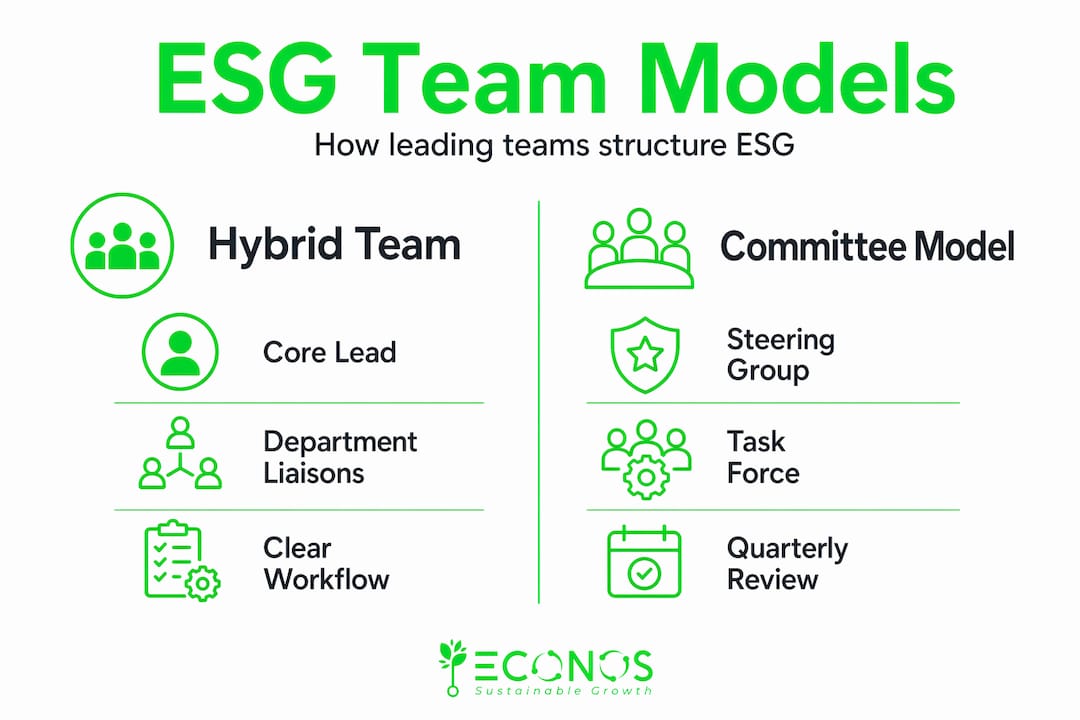
The three most common team structures you will encounter are centralized, decentralized, and hybrid. Here is how they compare:
| Model | Structure | Best for | Risk |
|---|---|---|---|
| Centralized | One core team owns all ESG functions | Uniformity and control | Bottlenecks, single point of failure |
| Decentralized | Each department handles its own ESG | Ownership in context | Inconsistency, poor coordination |
| Hybrid | Lean core team plus departmental liaisons | Flexibility and scalability | Requires clear governance to work |
As Harvard research confirms, hybrid team models with a lean central core and departmental liaisons are the most common and most effective for companies navigating multi-framework reporting requirements. This structure allows a small core team to focus on strategy, methodology, and reporting, while liaisons in finance, operations, procurement, and HR manage data collection on the ground.
Practical characteristics of a high-functioning lean ESG team include:
- Agility: Able to absorb new regulatory requirements, such as ESRS updates, without restructuring entirely
- Cross-functionality: Members come from or have relationships with finance, legal, operations, and communications
- Explicit ownership: Every data category, from energy consumption to supplier disclosures, has a named responsible person
- Documentation culture: Processes are written down, not just understood informally
For companies exploring green consultation strategies as a complement to internal capacity, this kind of structured thinking is exactly where the real gains come from.
Pro Tip: Even a two-person sustainability function can have outsized impact if you map every ESG data point to a specific owner outside the core team. Start with an ownership matrix before you write a single report or buy a single software license.
Lean team structures: Models that actually work
One of the most reassuring findings in recent corporate sustainability research is that most companies are operating with smaller teams than you might expect. Over 60% of surveyed firms have only one to five full-time sustainability employees. You are not behind the curve by being lean. You are the norm.
The question then becomes: how do you organize a small team for maximum ESG effectiveness? Two models consistently produce results for mid-sized companies.
Model 1: Core team plus liaisons (hybrid)
A central sustainability manager or small team sets the strategy, maintains the reporting framework, and manages external relationships, including auditors, certification bodies, and consultants. Departmental liaisons, often existing employees with a secondary ESG responsibility, handle data collection and validation within their business units.
Model 2: Sustainability committee plus operational task force
A cross-functional steering committee meets quarterly to review strategy and KPIs. A more agile task force, typically five to eight people drawn from operations, finance, and procurement, manages day-to-day project execution and data flow. This model adds governance credibility without requiring full-time headcount.
Here is how responsibilities typically split across these two layers:
| Function | Core team / Committee | Liaisons / Task force |
|---|---|---|
| ESG strategy and target-setting | ✓ | Advisory input |
| Data collection by business unit | Oversight | ✓ |
| Report drafting and validation | ✓ | Data provision |
| Internal training and capacity building | ✓ | Local delivery |
| Supplier engagement | Coordination | ✓ |
| Audit preparation | ✓ | Document support |
Building or adjusting your lean structure typically follows this sequence:
- Map your ESG reporting obligations first. Know which frameworks apply: CSRD/ESRS, EcoVadis, EU Taxonomy, CBAM, or sector-specific requirements.
- Identify all data categories you need to collect, such as energy, waste, water, emissions by scope, HR indicators, and procurement spend.
- Assign an owner to each category, ideally someone already responsible for that function operationally. Do not create new roles if existing roles can absorb the accountability.
- Define escalation lines clearly. If a data owner cannot provide information in time, who do they notify, and who resolves it?
- Document the process in a simple governance note or handbook, even one page per data category is sufficient to start.
- Review quarterly and adjust ownership when organizational changes happen.
As the 2025 State of Sustainability survey found, teams often need capability-building far more than additional staff. Investing in training for existing employees delivers faster, more durable results than hiring a sixth sustainability specialist. Companies managing sustainable supply chain practices or following a mid-sized company sustainability guide will recognize this pattern immediately.
Pro Tip: The most common failure in lean ESG teams is unclear escalation. When no one knows who to call if a supplier does not provide emissions data, the deadline passes and the report suffers. Map your escalation lines on day one, not the week before your audit.
Governance and data flow: Building robust ESG processes
A well-structured team without clear data governance is like a well-staffed kitchen without recipes. The team may be capable, but the outputs will be inconsistent and unreliable. When it comes to ESG compliance, inconsistent data has consequences, including failed audits, regulatory penalties, and reputational damage.
The core governance challenge for most companies is not collecting data. It is controlling data quality and ensuring a traceable flow from the source, say a factory energy meter or a procurement invoice, through to the final ESG disclosure or carbon footprint report. As recent analysis warns, without robust data management and clear ownership, compliance becomes a slog and audit readiness suffers significantly.
“Collecting, validating, and flowing ESG data requires explicit, documented processes.” This principle from Harvard’s governance research is not aspirational. It is the baseline for any company that expects to pass a CSRD audit or an EcoVadis assessment with confidence.
The must-have governance elements for smooth ESG reporting and audit readiness include:
- Data ownership register: Every metric has a named owner and a backup contact
- Collection schedule: Monthly, quarterly, or annual data pulls are locked into the calendar, not improvised
- Validation protocol: Before data enters a report, at least one second person reviews it for errors, unit mismatches, or missing values
- Audit trail: Raw data is retained in a traceable format, whether a spreadsheet, system export, or supplier documentation
- Version control on reports: Draft and final versions are clearly labeled and stored
- Escalation and exception procedure: If data is unavailable or suspect, there is a documented process for handling it
- Regular internal reviews: Quarterly or semi-annual governance reviews to catch process drift before it causes compliance risk
Companies building ESG workflows for manufacturing or operations benefit especially from formalizing these steps early, before the volume of required disclosures grows with CSRD phase-in schedules. Understanding which ESG metrics actually matter for compliance is the companion step to governance design: you need to know what you are measuring before you can govern it well.
The Romanian team governance model: Two-layer success
Theory is useful. Real examples are better. The Romanian business context offers a practical model worth examining closely, and it maps well onto what international governance research recommends.
Romanian companies that have invested in formal sustainability governance typically operate a two-layer structure: a top-management sustainability committee and an operational sustainability task force. The IULIUS Group, a Romanian real estate and retail developer, publicly describes this structure: a top-management committee sets strategies and approves major decisions, while an operational sustainability task force manages project-level implementation and progress tracking.
Here is how the two layers divide responsibilities:
| Layer | Composition | Key responsibilities |
|---|---|---|
| Sustainability Committee | C-suite executives, functional directors | Strategy, annual KPI approval, investment decisions, external commitments |
| Sustainability Task Force | Sustainability manager, finance, operations, HR, procurement leads | Project execution, data collection, reporting drafts, supplier engagement, training coordination |
The practical benefits of this model for mid-sized Romanian companies are significant:
- It creates top-down accountability without requiring a large central team
- It distributes work across departments that already own the underlying data
- It builds internal fluency in ESG topics across multiple functions, not just in one sustainability manager
- It signals seriousness to external stakeholders, including auditors, banks, and rating agencies like EcoVadis
- It aligns with CSRD expectations around governance disclosure, particularly under ESRS G1 standards
For mid-sized Romanian companies navigating ESG compliance consulting, adopting this two-layer model is often the single most impactful structural decision they can make. It does not require new headcount. It requires leadership commitment and clear role definitions, both of which cost time, not budget.
What most sustainability articles miss: People, not platforms, are your edge
Here is an uncomfortable truth from the field: a significant number of companies we encounter have spent more time evaluating ESG software platforms than they have spent clarifying who owns their Scope 3 data. The tools get selected. The governance never gets built. The software collects dust.
Technology is genuinely useful in ESG management. We believe in it enough to have built AVA, our own AI-powered carbon accounting assistant. But technology is a multiplier, not a foundation. If you multiply unclear processes by a sophisticated platform, you get faster confusion, not better compliance.
The real differentiators in effective sustainability teams are decidedly human. First, there is motivated ownership: someone who genuinely understands why the work matters, not just what needs to be filed. Second, there is cross-team accountability: sustainability outcomes require procurement to cooperate with finance, and operations to share data with legal. Without relational trust across departments, even the best governance framework fails in practice. Third, there is management support that is genuine rather than performative. When sustainability managers have to fight for access to invoices or energy bills, the problem is not process design. It is organizational culture.
The companies we have seen achieve the most progress on practical sustainability assessment have one thing in common: they treat ESG capability as something that grows over time, not something that gets installed once. They run internal training. They debrief after audits. They acknowledge gaps honestly and build improvement into their annual planning cycle.
The lesson here is not to skip the structure, governance, or tools. All of those matter. The lesson is to never mistake a platform subscription for a capability. People who understand what they are doing, why it matters, and how to work together effectively will always outperform a well-equipped team that is operating in the dark.
Take your sustainable team further with expert support
Building a lean, well-governed sustainability function is achievable, but it rarely happens in isolation. Most mid-sized companies benefit from targeted external support at key stages, whether that is structuring their first ESG reporting cycle, preparing for EcoVadis assessment, or calculating a credible carbon footprint for the first time.
At ECONOS, we work alongside your internal team rather than replacing it. Our training-first model means we build your people’s capability from the ground up, so that your team owns the process long after our engagement ends. Whether you need structured support for ESG reporting, a rigorous carbon footprint assessment covering all three scopes, or focused preparation for EcoVadis certification, our consultants and our ECONOS Academy platform are designed to meet lean teams exactly where they are. Reach out to explore how we can help you get compliant, get rated, and stay ahead.
Frequently asked questions
How many people should be on a mid-sized company’s sustainability team?
Most effective sustainability teams operate with a lean core of one to five full-time staff, supplemented by liaisons across relevant departments. Research confirms that over 60% of surveyed firms work with teams of this size and still manage meaningful ESG outcomes.
What’s the biggest obstacle to effective ESG reporting in Romanian companies?
The main challenge is consistently collecting, validating, and centralizing ESG data across multiple business units. Manual processes and unclear ownership create delays, errors, and audit exposure that could be avoided with cleaner governance design.
Does our company need expensive ESG software to succeed?
No. Many well-performing sustainability teams operate with straightforward tools when clear roles and documented processes are already in place. The 2025 State of Sustainability findings make clear that capability-building matters more than system sophistication for most mid-sized firms.
What is the value of a sustainability committee for Romanian companies?
A sustainability committee integrates ESG into top-level strategic decisions and provides the authority needed to drive cross-functional cooperation. The Romanian two-layer governance model pairs committee oversight with an operational task force, separating strategy from execution in a practical and auditable way.
How can a mid-sized company ensure audit-ready ESG reporting?
Audit readiness depends on explicit, documented governance for data collection, validation, and flow, combined with clear role assignments for every metric. Documented processes and control mechanisms are the baseline that auditors expect and that most companies underinvest in until a problem surfaces.