
.png)
Risk management is no longer a compliance task, it’s the foundation of business resilience. We see companies using it to navigate everything from choked supply chains to new climate regulations. The goal isn’t just avoiding trouble; it’s building a competitive, adaptable, and trustworthy business.
Rethinking Risk in Today's Business World
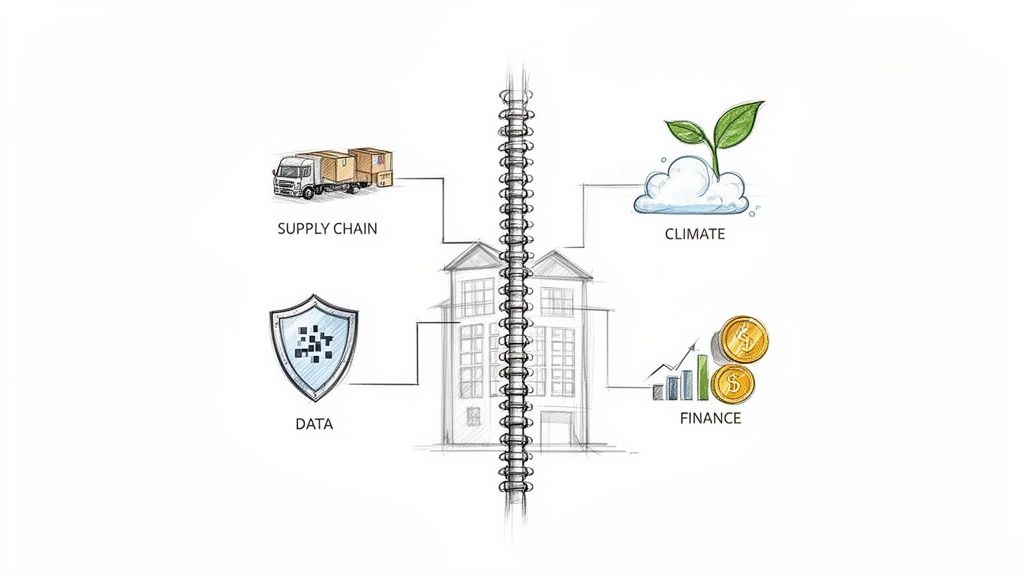
The modern business landscape is interconnected. A disruption in one area sends shockwaves across the entire organisation, making a fragmented approach to risk obsolete. It’s surprisingly easy to see how these risks cascade.
For example, a company’s carbon footprint, an Environmental, Social, and Governance (ESG) risk, now directly influences its ability to secure favourable loans, which is a financial risk. In the same way, we've seen how a data breach (an operational risk) can shut down a factory for days, torpedoing revenue and shattering customer trust.
The New Regulatory Imperative
Regulations like the Corporate Sustainability Reporting Directive (CSRD) have officially recognised this interconnected reality. The CSRD doesn't just ask for sustainability data; it demands that companies report on it through the lens of risk and opportunity. This makes an integrated framework essential for any business operating in the EU.
This shift turns risk management from a defensive chore into a proactive, strategic necessity. The key question is no longer just, "How do we avoid bad things?" but rather, "How can we use risk insights to build a stronger, more resilient business?"
To truly get ahead, it's worth digging into the principles of strategic risk management to build a framework that looks forward, not just backward. This mindset is what turns potential weaknesses into a real competitive edge.
The Four Pillars of Modern Risk Management
To manage this complex environment, businesses must focus on four interconnected areas. This table summarises the core risk categories that modern companies need to master for comprehensive resilience and regulatory compliance.
These pillars aren't independent; a failure in one can easily trigger a crisis in another. A truly effective strategy addresses them as a unified whole.
From Compliance Burden to Strategic Tool
When you start looking at risk management through this new lens, you see its real value. A solid framework doesn't just satisfy auditors; it gives leadership the clear data they need to make better decisions. It helps you anticipate market shifts, bulletproof your supply chain, and build unshakable trust with investors, customers, and regulators.
Effective risk management isn't about eliminating all risk. It's about understanding it so deeply that you can confidently take the right risks to grow and innovate. It’s about building a business that doesn't just survive disruptions but actually thrives because it was prepared.
Ultimately, the goal is to weave risk awareness into your company’s DNA. This means creating transparent data trails, assigning ownership for risk areas, and building processes for continuous monitoring. When you do that, what once felt like a regulatory burden becomes a powerful engine for scalable and affordable progress. This guide will show you how.
Understanding the Key Types of Business Risks
To manage risk well, you first have to know what you’re up against. A business is a complex system; if one part fails, the whole structure is at risk. It’s the same in business, which makes an integrated approach to risk management services absolutely essential.
Modern companies face threats from four critical, interconnected areas. Understanding these is the first step toward building operational resilience.
Operational Risk: The Gears of Your Business
Operational risk is a threat to the internal machinery of your company: the people, processes, and systems that keep everything running. These are the daily dangers that can grind production to a halt or shatter customer trust.
Common sources of operational risk include:
Supply chain disruptions: A key supplier failing to deliver can stop an entire production line. We see this across suppliers when clients suddenly can't get critical components.
Technological failures: A system crash, data breach, or cyberattack can cause immediate damage to finances and reputation.
Human error: Simple mistakes can lead to major quality control failures or safety incidents.
Managing this risk means having clear, documented procedures, investing in reliable technology, and training your team. It also means implementing modern safeguards, like reducing fraud risk with biometric authentication to protect sensitive digital operations.
Financial Risk: The Fuel for Your Operations
Financial risk is about the money flowing through your business. Any interruption to that flow can have severe consequences.
This category covers a wide territory:
Market volatility: Swings in interest rates, currency values, or commodity prices can directly squeeze your profits.
Credit risk: The simple but dangerous risk that customers or partners won’t pay what they owe, creating a serious cash flow gap.
Liquidity risk: The danger of not having enough cash on hand to cover short-term bills, even if your business looks profitable on paper.
Strong financial risk management comes down to disciplined budgeting, sharp cash flow forecasting, and building solid relationships with banks and investors who understand your business.
ESG and Climate Risk: The Changing Weather Patterns
Environmental, Social, and Governance (ESG) and climate risks are not a distant threat; they are here now. Think of them as the shifting weather patterns your business has to navigate. Some are sudden storms, others are slow-moving but just as powerful.
A company's exposure to climate change is no longer just an environmental issue, it's a core financial and strategic challenge. We see in bank discussions that regulators, investors, and customers now demand clear accountability.
These risks are usually split into two main types:
Physical Risks: These are the direct hits from climate change, like facilities damaged by floods, or supply chains disrupted by extreme heatwaves.
Transition Risks: These emerge as the world shifts to a low-carbon economy. Think new carbon taxes, customers demanding sustainable products, or your fossil fuel-based equipment suddenly becoming obsolete.
Tackling these risks demands a proactive plan, starting with measuring your carbon footprint (Scopes 1, 2, and 3) and understanding how different climate scenarios could impact your long-term strategy.
Regulatory and Compliance Risk: The Rules of the Road
Finally, there’s the risk of failing to follow the laws and standards governing your industry. Ignoring them can lead to fines, legal battles, and a damaged reputation.
The regulatory landscape is always changing, especially in sustainability. Key frameworks companies now have to master include:
The Corporate Sustainability Reporting Directive (CSRD): This EU rule demands detailed reporting on sustainability risks and impacts.
The Carbon Border Adjustment Mechanism (CBAM): This puts a price on certain carbon-heavy goods imported into the EU, which can directly inflate supply chain costs.
Staying compliant requires constant vigilance and a systematic way to collect and report data. And because these risks are connected, a regulatory change like CBAM can create new financial and operational headaches overnight. A comprehensive strategy tackles all four pillars together.
Core Methods for Assessing Your Business Risks
Knowing your risks is one thing; measuring them is where the real work begins. To build a resilient business, you need a structured way to identify, assess, and prioritise threats. Good risk management services don't rely on guesswork; they use proven methodologies to turn vague concerns into actionable data.
This isn't an abstract exercise. It’s about looking at your business through a different lens so you can focus energy on what truly matters to your bottom line and your stakeholders.
The graphic below breaks down the main risk categories that every modern business needs on its radar.
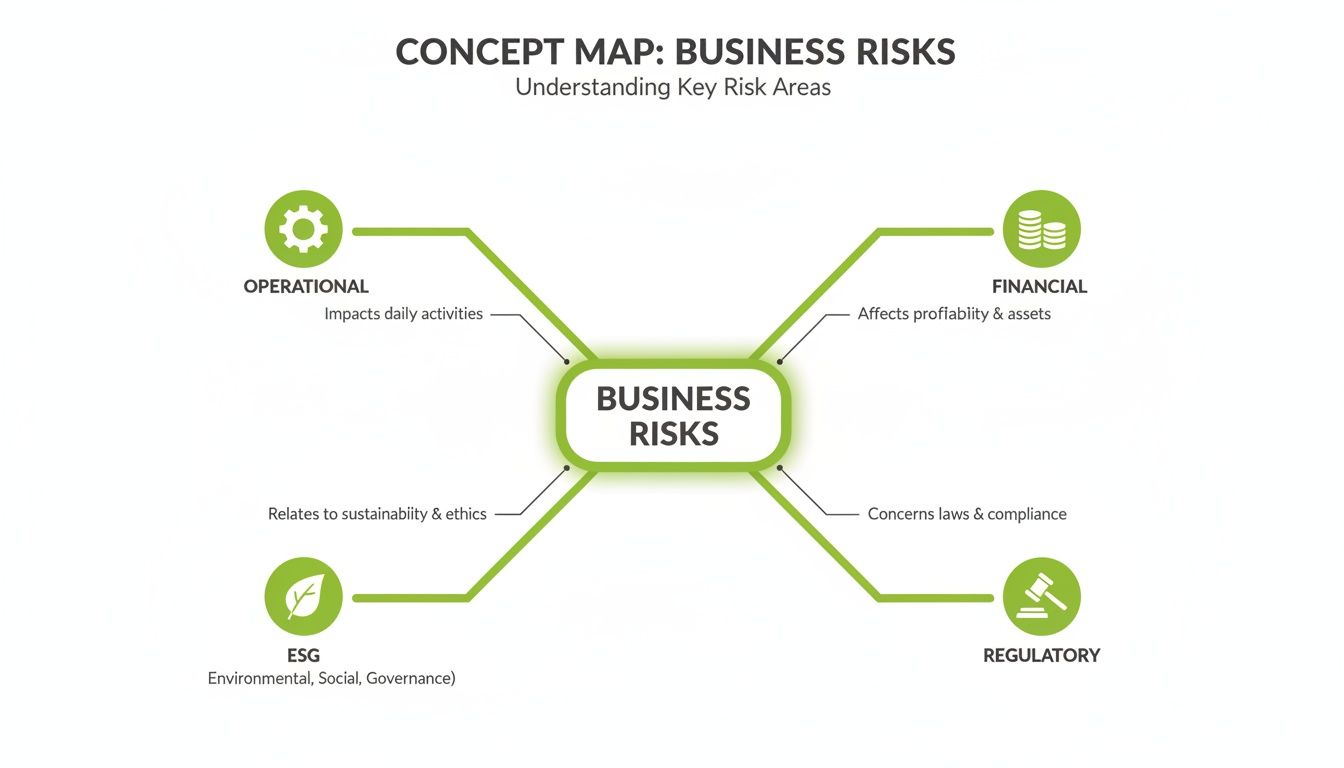
As you can see, areas like operations, finance, ESG, and regulation are not isolated silos. They are interconnected pillars that support a complete, robust risk strategy.
The Double Materiality Assessment
At the heart of the Corporate Sustainability Reporting Directive (CSRD) is the Double Materiality Assessment. Think of it as a tool with two lenses, each designed to give you a critical perspective.
Financial Materiality (The "Outside-In" View): This first lens looks at how external sustainability issues could impact your company's finances. For example, will growing water shortages disrupt your production lines and drive up costs? Could a new carbon tax eat into profit margins?
Impact Materiality (The "Inside-Out" View): The second lens flips the view, assessing how your company's operations affect the planet and people. What impact does your water consumption have on the local community? Are there human rights risks hidden in your supply chain?
A topic is considered "material" if it's significant through either one or both of these lenses. This dual perspective forces a much more honest and complete picture of risk, pushing you beyond thinking only about this quarter's P&L statement.
Getting this assessment right is the mandatory first step for CSRD compliance. It tells you exactly what to report on, making sure your sustainability efforts are focused and meaningful.
Climate Scenario Analysis
How would your business hold up in a world that’s 2°C warmer? What if governments suddenly enacted aggressive climate policies? Climate Scenario Analysis is the tool designed to answer these tough, forward-looking questions.
It's a stress test for your business strategy against several possible climate futures.
This method helps you probe both physical risks (like a key supplier being knocked out by extreme weather) and transition risks (like customers suddenly shifting to low-carbon alternatives). By playing out these "what if" scenarios, you can spot hidden vulnerabilities and build a more resilient, future-proof strategy. It changes the conversation from reacting to climate change to proactively preparing for it.
Creating a Robust Data Inventory
You can't manage what you don't measure. A solid Data Inventory is the foundation of any credible risk management program. This isn't just about gathering numbers; it's the methodical process of identifying, collecting, and organising all the information you need for your assessments and reports.
This inventory is the engine for several critical tasks:
Calculating your carbon footprint across Scopes 1, 2, and 3.
Conducting a product Life Cycle Assessment (LCA) to understand its environmental impact.
Preparing for audits with a clear, traceable data trail that stands up to scrutiny.
A systematic approach to data also strengthens your digital defences. As companies become more technologically dependent, the associated risks grow. The managed security services market in Romania, a key part of this defence, was valued at USD 154.24 million in 2022 and is set to expand rapidly. This trend underscores the need for strong data governance as part of a wider risk strategy. You can learn more about Romania's growing managed security services market on techsciresearch.com.
Without a robust data inventory, any analysis you build is on shaky ground. These three methods, double materiality, scenario analysis, and a solid data inventory, work together to give you a comprehensive, defensible, and strategic view of your entire risk landscape.
Turning Assessments into Audit-Ready Deliverables
A risk assessment is only as good as the report it produces. After the analysis, you need something clear, defensible, and ready to hand over to an auditor. This is where we bridge the gap between complex data and concrete action, creating outputs you can trust and act on with confidence.
So, what does ‘audit-ready’ actually mean in practice? It’s not just a nice-looking report. It’s about building a transparent, logical data trail from start to finish. Every calculation must be backed by a documented methodology, and every conclusion must align with demanding standards like the European Sustainability Reporting Standards (ESRS). It’s the critical difference between a simple data summary and a robust, verifiable asset.
The entire process is designed to turn raw, scattered inputs into certified, credible outputs, guaranteeing traceability and quality at every step.
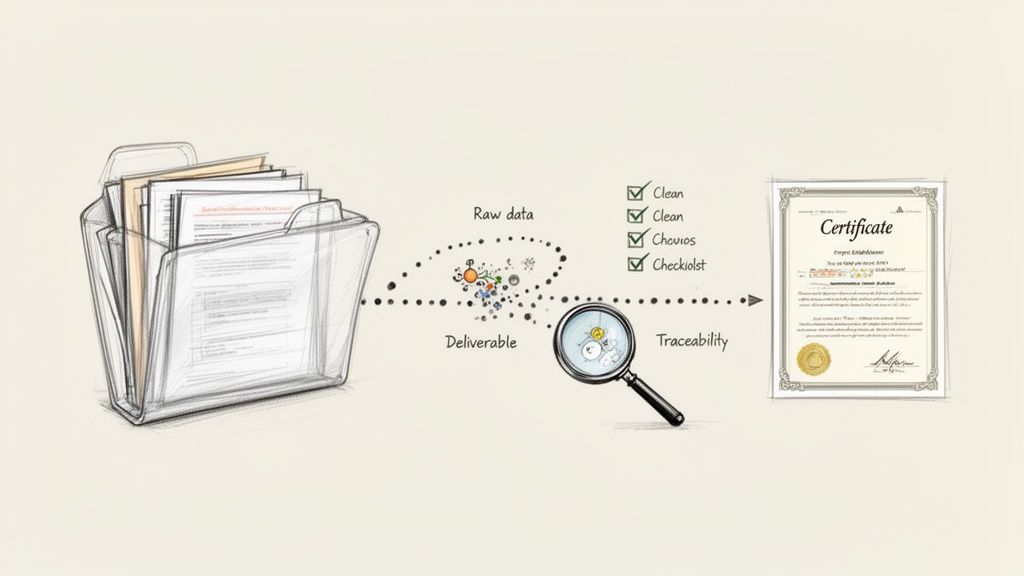
As the diagram shows, it's about systematically processing information, running it through rigorous quality checks, and building it into a certified report you can stand behind.
From Compliance Documents to Strategic Tools
But let’s be clear: the real value goes far beyond passing an audit. These deliverables become powerful strategic tools. They give leadership actionable insights, revealing opportunities that were previously hidden.
Key audit-ready deliverables include:
A Comprehensive Carbon Footprint Report: This is a detailed map of your emissions across Scopes 1, 2, and 3, pinpointing hotspots and showing exactly where to focus decarbonisation efforts for maximum impact.
A Product Life Cycle Assessment (LCA): This deliverable traces a product's environmental impact from raw materials to final disposal, uncovering smart ways to innovate for sustainability and even cut costs.
A Clear Materiality Matrix: Born from your Double Materiality Assessment, this is a powerful visual tool that communicates your most significant risks and opportunities to stakeholders, instantly clarifying strategic priorities.
These documents are designed to be immediately useful. They help you find weak spots in your supply chain, identify cost savings through better resource efficiency, and build a stronger story for investors and customers.
The Hallmarks of a Credible Deliverable
An audit-ready deliverable has specific qualities that signal rigour and transparency, making it simple for an outsider to follow your logic and verify your conclusions. Any quality provider ensures their outputs are built on a solid foundation.
The ultimate goal of any risk assessment deliverable is to create a single source of truth. It should be so clear and well-documented that anyone, from your CEO to an external auditor, can follow the logic and trust the results without question.
To hit that mark, every report and dashboard must have:
A Documented Methodology: It needs to state exactly which standards were followed (like the GHG Protocol or specific ISO standards) and transparently explain any assumptions made. No black boxes.
A Complete Data Trail: The report must link directly back to its source data, making verification easy. For an auditor, this transparency is non-negotiable. You can manage this process effectively through our platform for ESG data management, which centralises all your information.
Actionable Insights and Recommendations: A great report doesn't just present data; it interprets it. It translates complex findings into clear, practical next steps your business can take.
This level of quality is becoming essential. Romania's management consultancy industry is a massive field, with 31,517 businesses generating revenues of €4.4 billion, and many offer risk advisory services. With new rules like the EU Audit Regulation tightening standards, choosing a partner who can deliver truly independent, audit-ready work has never been more critical.
How to Choose the Right Risk Management Partner
Picking a partner for risk management is a strategic move, not just a procurement decision. The right firm becomes an extension of your team, providing the expertise to build long-term resilience, not just a report.
The wrong choice? You could end up with superficial work that looks good on paper but falls apart the moment an auditor starts asking questions.
A smart decision means finding a provider with deep, hands-on experience in the regulations that matter to your business, like the Corporate Sustainability Reporting Directive (CSRD) and the European Sustainability Reporting Standards (ESRS). A proven, transparent methodology isn't a "nice-to-have"; it's essential. Without it, you have no guarantee the work will hold up under scrutiny.
Beyond the Final Report
Here’s a crucial question to ask any potential partner: what is your approach to building our team's skills? Do they just hand over a final report and walk away, leaving you to figure out what comes next? Or do they actively work to give your people the knowledge and tools to manage risk on their own down the road?
A true partnership is measured by how capable a client becomes over time. The goal shouldn't be dependency; it should be autonomy. The provider's role is to build internal competence, not just complete a project.
At ECONOS, we combine delivery with training so teams become autonomous. This philosophy ensures that the value of our work remains long after the project is complete. It builds a culture of risk awareness directly into your organisation.
Key Questions for Your Potential Partner
To help you find a partner truly invested in your long-term success, use this checklist during your evaluation. The answers will quickly show you who can deliver real strategic value and who is just ticking boxes.
Regulatory Expertise: How have you helped clients navigate the specific demands of CSRD and ESRS? Can you share concrete examples of producing audit-ready disclosures that have passed verification?
Methodology and Data: Walk us through your exact process for a Double Materiality Assessment. How do you ensure the data inventory for a carbon footprint or a Life Cycle Assessment (LCA) is both complete and traceable?
Industry Experience: Show us you understand the specific risks and opportunities in our sector. For example, how would your supply chain risk assessment for a manufacturing company differ from one for a financial services firm?
Team Empowerment: What specific training or tools do you provide to help our internal teams manage these processes in the future? How do you ensure that knowledge transfer happens? You can see our approach to helping companies comply with complex EU law.
Long-Term Vision: How do you help clients move from complying with rules to using risk insights to drive strategy and improve performance on platforms like EcoVadis or CDP?
The risk management landscape is growing fast. Europe's market was valued at USD 4.87 billion in 2024 and is projected to hit USD 5.46 billion in 2025. In Romania, the cyber insurance market alone is expected to reach USD 2.2 billion by 2030, which shows how seriously companies are taking specific threats. You can read more about these market trends on icrowdnewswire.com.
In a crowded market, finding a partner who focuses on building your capability is the smartest investment you can make.
Your Action Plan for Implementing Risk Management
Knowing the theory is one thing; turning concepts into a clear roadmap is where the real work begins. This checklist is designed to give you a structured path to either launch a new risk management framework or sharpen the one you already have.
Following these phases will help you move from theory to execution with confidence.
The first step is always building a solid foundation. You need clear support from leadership and a precise definition of what you’re trying to achieve. If the scope is vague, the project is likely to stall.
Phase 1: Laying the Groundwork
Before you can tackle risks, you need alignment and a clear view of where you stand today. This initial phase is all about building the internal structure for success. Without it, even the best intentions will struggle to gain traction.
1. Secure Leadership Buy-In and Define Scope: First, get your executive sponsors on board. The key is to frame this not as a compliance cost but as a strategic investment in business resilience. Then, clearly define your scope. Will you start with climate risk to meet CSRD requirements or tackle operational risks in a critical supply chain? Be specific.
2. Assemble a Cross-Functional Team: Risk isn’t just a finance or sustainability problem; it touches everything. Your team needs representatives from operations, legal, procurement, and finance to get a holistic view and ensure everyone has ownership.
3. Conduct a Gap Analysis: How do your current practices stack up against key requirements, especially from the Corporate Sustainability Reporting Directive (CSRD)? This analysis will show you the biggest gaps in your data, processes, and policies, which in turn will guide your priorities.
Phase 2: Analysis and Prioritisation
With your team and scope locked in, it’s time to dive into the data. This is where you identify what truly matters, ensuring your efforts are focused on the most significant risks and opportunities.
A Double Materiality Assessment is the cornerstone of this phase. It’s the lens through which you’ll view your entire risk landscape, not just a regulatory hurdle, but a powerful tool for strategic clarity. After that, you need a solid plan for gathering the right information.
The quality of your risk management programme is directly tied to the quality of your data. A weak data strategy leads to weak conclusions, leaving you exposed when auditors or stakeholders start asking tough questions.
This practical approach ensures you build a framework that is both compliant and strategically valuable. For companies looking to strengthen their reputation with partners, a strong risk framework can significantly boost platform scores. You can explore our expert guidance on preparing for EcoVadis certification, where risk management is a core component.
Phase 3: Implementation and Monitoring
The final phase is about turning your analysis into action. This means putting systems in place, assigning clear responsibilities, and establishing a rhythm of continuous improvement.
Develop a Data Collection Strategy: Based on your analysis, map out a detailed plan for gathering the data you’re missing, especially for complex areas like Scope 3 emissions. Assign clear ownership for each data point.
Integrate Findings into Strategy: The insights from your assessments cannot just sit in a report. They must feed back into business strategy. This could mean adjusting your supply chain, investing in new technology, or changing product designs.
Establish a Monitoring Cycle: Risk management is not a one-time project. Set up a regular cycle for reviewing risks, updating your materiality assessment, and reporting progress to leadership. This is how risk management becomes a living part of your organisation’s culture.
Implementation Checklist for Your Risk Management Framework
To help you get started, this table summarises the key actions needed to launch or enhance your risk management processes effectively, moving from initial setup to long-term integration.
By following these structured phases, you can build a risk management framework that is not only compliant but also a genuine source of strategic advantage and long-term resilience for your business.
Your Questions About Risk Management, Answered
Jumping into risk management brings up practical questions. Here are clear, straightforward answers to the questions our team hears most often from companies just starting out.
Are Comprehensive Risk Management Services Just for Big Corporations?
Not anymore. While large corporations have mandatory reporting duties under the Corporate Sustainability Reporting Directive (CSRD), smaller businesses are feeling the ripple effect. Customers, partners, and banks are now routinely asking Small and Medium-sized Enterprises (SMEs) for sustainability and risk data for platforms like EcoVadis.
For an SME, proactive risk management is a powerful tool for winning contracts, securing better financing, and becoming more resilient. It’s about scaling the approach. You don't need the same complex machinery as a multinational, but having a clear handle on material risks, like your carbon footprint, has become a ticket to the game.
What’s the Difference Between Risk Management and a Compliance Audit?
Think of it this way: a compliance audit is like looking in the rearview mirror. It’s a snapshot in time that checks if you followed the rules in the past. Risk management, on the other hand, is like looking ahead through the windshield. It’s a forward-looking, continuous process designed to spot potential threats and opportunities before they arrive.
An audit confirms you passed the test yesterday. A strong risk management framework is what ensures you can pass any test, anytime, while making you stronger for the road ahead.
Ultimately, a solid risk framework prepares you to pass any audit. More importantly, it makes your business fundamentally more robust.
How Long Does It Take to Build a CSRD-Ready Risk Framework?
Every company is different, so the timeline can vary depending on size, complexity, and data readiness. That said, a typical project usually lands somewhere between 3 and 9 months.
Here’s a rough breakdown:
Phase 1: Discovery & Scoping (1-2 months): This is where we kick things off with a double materiality assessment and a gap analysis to see where you stand.
Phase 2: The Deep Dive - Data Collection (2-4 months): This is often the most intensive part, especially when gathering data for Scope 3 emissions across the value chain.
Phase 3: Strategy & Reporting (1-3 months): This final stage is all about developing your strategy, creating audit-ready reports, and training your team so they can carry the work forward.
A clear scope from the start and strong internal ownership are the two biggest factors that can speed up the process.
Can These Services Actually Improve Our EcoVadis or CDP Score?
Yes, absolutely. Both EcoVadis and CDP assessments place a heavy emphasis on governance, risk processes, and transparent data. A systematic approach to risk management services gives you the precise evidence and documentation needed to answer their questionnaires with confidence and accuracy.
When you formalise processes for calculating a carbon footprint or running a materiality assessment, you demonstrate a mature, proactive approach to sustainability. That maturity almost always translates into higher scores and a stronger reputation with your business partners.
At ECONOS, our team helps organisations turn risk management from a daunting obligation into a real strategic advantage. Our services are built to strengthen your internal capabilities, ensuring you are not just compliant, but more resilient and competitive for whatever comes next.
Find out how we can support your journey at https://www.econos-esg.com.
Article created using Outrank