
.png)

A studiu de fezabilitate is, at its core, the technical-economic analysis that answers one critical question: "Is this project worth doing?" It assesses if an investment is realistic, profitable, and timely, forming the foundation for any strategic decision, from building a new factory to executing a decarbonization project.
Why Your Studiu de Fezabilitate Needs an ESG Upgrade
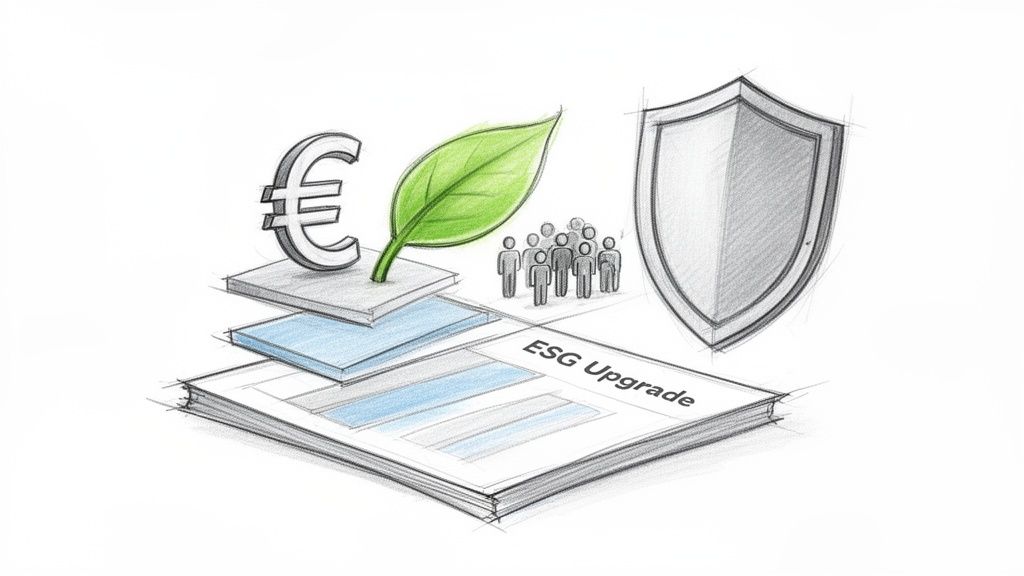
The traditional studiu de fezabilitate is no longer sufficient. We see this across our client base—from manufacturing to retail—that major projects now face intense scrutiny for their environmental and social impact, not just their financial returns.
Investors, banks, and regulators are asking new questions. How does this project align with climate goals? What are its impacts on local communities or the supply chain? But how can companies answer these questions when their initial plans overlook them entirely?
Answering these requires upgrading your feasibility study to integrate Environmental, Social, and Governance (ESG) criteria. This is not about compliance as a goal in itself; it's a fundamental shift in how smart business decisions are made.
The Business Case for an ESG-Focused Study
For any company operating within the EU supply chain, ignoring ESG in the initial planning stages is a significant business risk. Regulations like the Corporate Sustainability Reporting Directive (CSRD) are turning environmental and social data into mandatory financial disclosures. A feasibility study that overlooks these aspects is incomplete and can lead to costly redesigns or project rejection.
Understanding the importance of viability helps frame why this evolution is critical. A modern, ESG-focused study offers clear business advantages:
- It mitigates long-term risks. A proper analysis identifies potential regulatory penalties, resource scarcity issues, and reputational damage before they materialize, protecting your investment.
- It unlocks new funding opportunities. A robust analysis of environmental benefits strengthens applications for green loans, EU funds, and government incentives designed to support sustainable projects.
- It builds stakeholder trust. Demonstrating a commitment to responsible business practices enhances credibility with investors, customers, and client teams. For a deeper dive, you can learn more about key ESG and sustainability terms in our article on this topic.
In our work, we see projects stall because their initial feasibility studies failed to account for carbon emissions or supply chain labor standards. A project deemed financially viable two years ago might be completely untenable under today’s ESG standards.
Ultimately, integrating ESG isn't a checkbox exercise. It transforms the studiu de fezabilitate from a simple go/no-go document into a strategic tool for building a resilient, competitive business. It ensures your projects are not only profitable but also operationally sound and prepared for the future market. This is about smart, forward-thinking business strategy.
Defining the Scope for Your ESG-Focused Study
A project's success is often decided long before the first work begins. For an ESG-focused studiu de fezabilitate, this means moving past a siloed approach to create a blueprint that’s comprehensive, audit-ready, and built for strategic decisions. The goal is not to bolt on environmental metrics but to weave them into the project’s operational and financial DNA.
This starts with clear, execution-focused objectives. What does success look like? The answer must blend financial return with tangible ESG improvements. For instance, a goal like "increase production by 15%" becomes "increase production by 15% while cutting water use per unit by 20% and achieving BREEAM 'Excellent' certification."
From there, we translate these goals into specific Key Performance Indicators (KPIs) that can be tracked throughout the project's life. This provides a clear yardstick for success and proves that sustainability was integrated from day one, not as an afterthought.
Blending Technical, Financial, and ESG Analysis
A modern feasibility study requires a collaborative effort. It demands that technical experts, financial analysts, and sustainability specialists work from the same page. The objective is to build a complete, 360-degree view of the project’s real-world viability by asking more connected questions.
Is the new technology just efficient, or does it align with long-term decarbonization commitments? Are the financial projections robust enough to withstand a future carbon tax or a market shift toward sustainable products?
We often see a disconnect in project planning. The finance team builds a cost model based on today’s material prices, while the sustainability team knows that new regulations are about to place a premium on carbon-intensive inputs. An effective studiu de fezabilitate forces those two conversations together from the start.
Getting this integrated analysis right is how companies avoid expensive surprises and deliver a project that is genuinely profitable and sustainable.
Key Methodologies for a Robust Study
To make your studiu de fezabilitate truly audit-ready, it must be grounded in solid, data-driven methodologies. These tools provide the hard evidence needed to satisfy regulators, investors, and other stakeholders.
Life Cycle Assessment (LCA): This is the standard for understanding a project's full environmental impact, from cradle to grave. It covers raw material extraction, manufacturing, product use, and eventual disposal, offering a holistic view of its footprint.
Carbon Footprint Calculation (Scopes 1, 2, and 3): An accurate count of greenhouse gas (GHG) emissions is non-negotiable. This must include direct emissions from owned sources (Scope 1), indirect emissions from purchased energy (Scope 2), and all other indirect emissions in the value chain (Scope 3).
Double Materiality Assessment: A core component of CSRD compliance, this process identifies which sustainability topics are financially material (they affect the business) and which have a material impact on the world (the business affects them).
Consider the push for infrastructure modernization in Romania. The Feasibility Study (FS) for the Bucharest-Craiova Railway Line modernization, a contract worth RON 40 million, is a practical example. It's not just about engineering; it’s about creating technical-economic documentation that aligns with EU decarbonization goals. You can see the level of detail required for major rail modernisation projects on the official CFR site.
For our clients in sectors like energy and manufacturing, integrating ESG into their studiu de fezabilitate is a critical step for competitiveness. Our Data 4 Climate program, for instance, provides localized Romanian carbon factors that make LCAs more accurate and aligned with standards like the GHG Protocol.
The data from these assessments becomes the backbone of the study. It’s the proof needed to justify decisions, demonstrate compliance with the EU Taxonomy, and manage risk—a process covered by the Romanian law on environmental impact assessment.
We combine delivery with training so teams become autonomous. When a clear and comprehensive scope is defined from the outset, the studiu de fezabilitate transforms from a simple compliance exercise into a powerful tool that de-risks investment and sets the project up for long-term success.
Connecting Financial and Environmental Analysis to Secure Funding
For any project to get the green light, the numbers must work. But what "works" financially is changing. A modern studiu de fezabilitate looks beyond a simple Return on Investment (ROI) to show how sustainability strengthens the bottom line. It's about translating environmental performance into a financial story that investors can understand.
The question is no longer just "What will this cost?" but rather, "What is the real cost of doing nothing?". Linking environmental data directly to financial models is how you answer that question with authority.
This means modeling the real, tangible financial benefits of a sustainability project. An energy efficiency upgrade, for example, doesn't just cut kilowatt-hours; it generates predictable, long-term operational cost savings. Similarly, switching to renewable energy can protect a company from volatile fossil fuel prices and the rise of carbon taxes.
From Carbon Reduction to Financial Opportunity
The data from a Life Cycle Assessment (LCA) and carbon footprint calculations aren't just for compliance reports. They are powerful inputs for financial projections. Every tonne of CO2 avoided represents a potential cost saving or a value-add that makes the business case stronger.
To turn a reduction in greenhouse gas emissions into a hard financial number, you must quantify its value:
- Avoided Costs: Calculate the money saved by avoiding future carbon taxes or penalties under schemes like the EU Emissions Trading System (ETS).
- Operational Efficiency: Model the direct savings from using less energy, water, and raw materials—figures already identified in the LCA.
- New Revenue Streams: Project the potential income from selling “green” products or services, which often command a premium in today's market.
This whole process follows a clear logic: start with the goals, assess the variables, and then build a concrete plan.
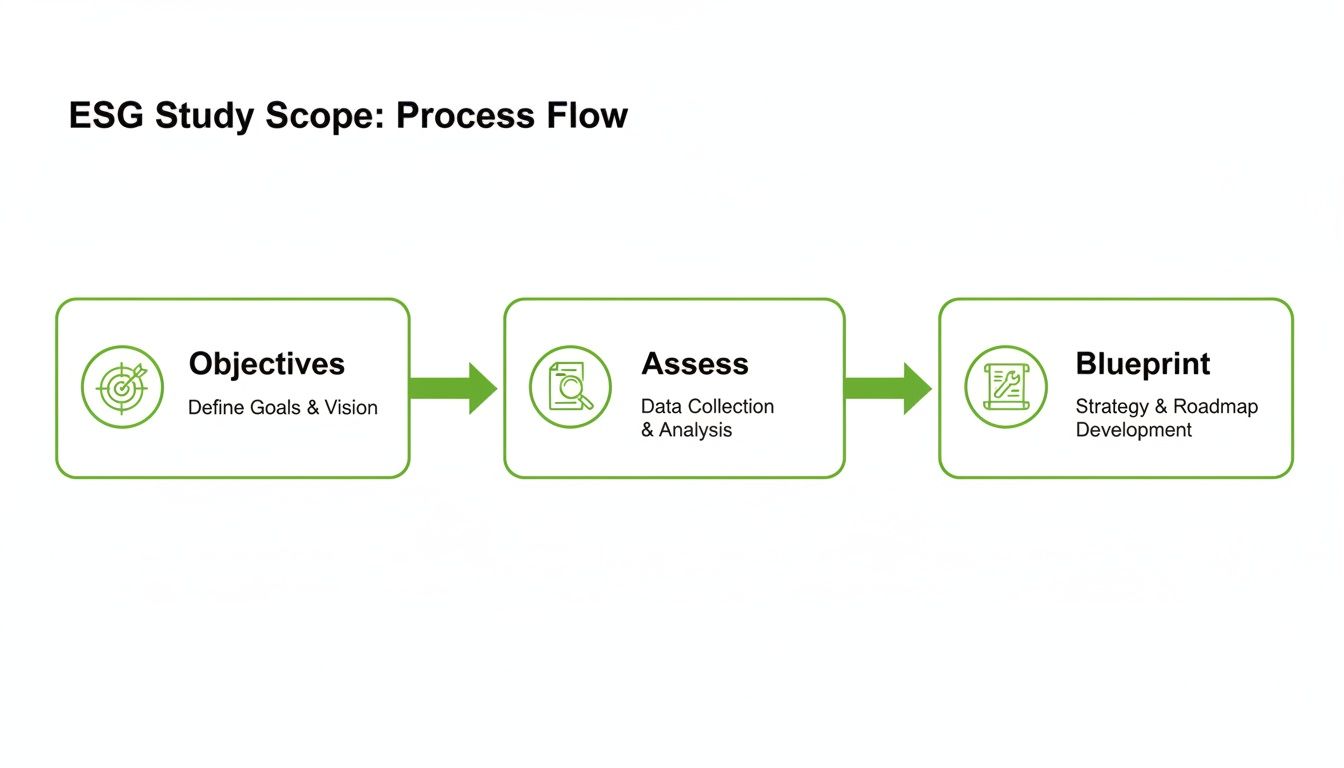
A structured approach like this ensures every critical ESG component is properly assessed before finalizing the project plan, linking high-level objectives directly to measurable outcomes.
Take a solar panel installation on a factory roof. A superficial analysis might stop at the initial capital cost. A robust feasibility study goes deeper. It must include projected energy savings, potential income from selling excess power back to the grid, and the enhanced brand value from using clean energy. To do this properly, you need a solid financial model—even a good solar return on investment calculator can help demonstrate the long-term economic benefits alongside the environmental ones.
Building a Compelling Case for Green Financing
Banks, private investors, and EU funding bodies are now actively looking for projects that are both financially sound and environmentally responsible. A studiu de fezabilitate that clearly connects these two things is far more likely to secure funding. Vague claims about "being green" are no longer enough. You need to show the data.
We see it in discussions with banks: the most successful funding applications are the ones that quantify sustainability. Instead of saying a project will ‘reduce emissions,’ a winning proposal states, ‘This €1.2 million investment will cut Scope 1 emissions by 1,500 tonnes of CO2e annually, leading to an estimated €120,000 in avoided carbon costs per year by 2030.’
This is the level of detail that gives financiers confidence. It proves a project is not only compliant but also resilient and profitable in a low-carbon economy. It shows the homework has been done.
Here’s a practical way to connect financial and environmental metrics. This kind of table is useful for making the case to investors.
Integrating Financial and Environmental Metrics
| Financial Metric | Connected Environmental KPI | Business Outcome & Funding Opportunity |
|---|---|---|
| Operating Expenses (OpEx) | Energy Consumption (kWh) | Reduced electricity bills, lower operational costs. Attracts energy efficiency grants. |
| Future Liabilities | Scope 1 & 2 GHG Emissions (tCO2e) | Avoided carbon taxes and penalties. Demonstrates risk management to investors. |
| Capital Expenditure (CapEx) | Renewable Energy Capacity (MW) | Long-term energy price stability, potential revenue from grid feed-in. Qualifies for green loans. |
| Revenue Growth | Product Carbon Footprint (PCF) | Access to new "green" markets, premium pricing. Strengthens B2B relationships. |
| Cost of Goods Sold (COGS) | Water Usage & Waste Generation (m³) | Lower raw material and disposal costs. Improves resource efficiency and margins. |
Presenting data this way transforms a project from a perceived cost center into a strategic investment. When you can prove that shrinking the environmental footprint also reduces operational risk and creates new value, you are speaking the language of finance.
This approach is critical for accessing dedicated funding like the EU's Modernisation Fund or other government incentives designed to speed up the green transition. These programs demand detailed technical and economic justification, and a well-structured studiu de fezabilitate is the only way to provide it. This is the crucial step that turns a good idea into a funded, actionable project.
Managing Risk and Ensuring Regulatory Compliance
At its heart, a studiu de fezabilitate is a risk management tool. It's a way of looking into the future to answer a tough question: is this project not only profitable today but also resilient enough for tomorrow? When discussing sustainability and decarbonization, this forward-looking analysis becomes absolutely critical.
Any project can be derailed by unexpected pitfalls. Identifying, assessing, and planning for these risks inside a feasibility study is not optional. It’s what transforms a simple plan into a strategic shield against future shocks.
In our experience, projects face three main kinds of risk. The study must tackle each one head-on.
- Technical Risks: These often come from adopting new, sometimes unproven, technologies. How reliable is a new heat pump technology when deployed at scale? What are the real-world operational challenges of shifting to a circular manufacturing process?
- Market Risks: Customer and client preferences are changing. A project that ignores the growing demand for low-carbon products or transparent supply chains is built on shaky ground.
- Regulatory Risks: This is the biggest and most complex category. Upcoming carbon pricing, stricter emissions limits, and new reporting mandates can turn a profitable project into a financial liability almost overnight.
Navigating the EU Regulatory Maze
For any company operating in Romania and across the EU, the web of sustainability regulations is only getting tighter. A modern studiu de fezabilitate must prove that a project is not just compliant today but prepared for what’s around the corner.
Key regulations that need to be woven into the analysis include:
- CSRD/ESRS: The Corporate Sustainability Reporting Directive (CSRD) and its European Sustainability Reporting Standards (ESRS) demand detailed disclosures on environmental and social impacts, risks, and opportunities. A study must generate the data needed for this reporting.
- EU Taxonomy: This is a classification system that defines which economic activities are environmentally sustainable. Aligning a project with the Taxonomy is now crucial for accessing green financing.
- Carbon Border Adjustment Mechanism (CBAM): For imports of certain goods like cement, steel, or aluminum, CBAM puts a price on the carbon emitted during their production. A study must account for these future costs.
The most common mistake we see is treating regulations as a checklist to be ticked off at the end. An effective feasibility study embeds compliance from the start, using regulatory requirements to shape the project's technical and financial structure.
From Compliance to Audit-Readiness
Ultimately, the outputs of a studiu de fezabilitate will be scrutinized by banks, investors, and auditors. This means its findings must be transparent, defensible, and built on a solid foundation of data. We call this audit-readiness.
Getting this right means ensuring every piece of data, every calculation (like your carbon footprint), and every assessment aligns with internationally recognized standards, such as those from the ISO (International Organisation for Standardisation). This meticulous approach gives stakeholders the confidence they need to back a project. If you want more guidance, our team put together a detailed overview of what goes into an environmental audit that you can read here.
Take the construction sector in Romania, which relies heavily on the studiu de fezabilitate for project approvals. In 2023, the sector saw a sharp 20.6% drop in residential building permits compared to 2022. Despite this, construction is still projected to grow. Integrating robust ESG assessments early is key to navigating this market.
A study that includes Scope 1-3 carbon footprinting and proves EU Taxonomy alignment can unlock vital green financing—a game-changer in a sector where sustainability is becoming a condition for growth. You can explore more data on Romania's construction sector resilience and trends.
This is what elevates a studiu de fezabilitate from a simple document to a strategic asset: a detailed, risk-focused approach, backed by solid data and aligned with current and future regulations. It’s how you prove your project is built to last.
Turning Your Study Into an Actionable Decarbonization Roadmap
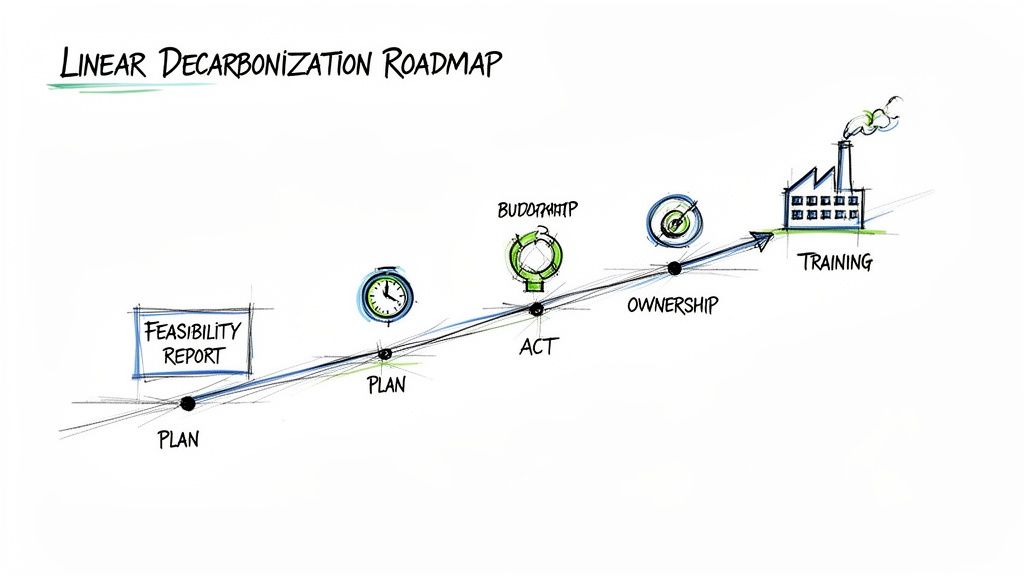
A completed studiu de fezabilitate is not the finish line. It’s the starting point. The goal is not a perfect report, but sustained, real-world progress.
The value of the analysis is only unlocked when its findings become a concrete decarbonization roadmap that teams can follow. This transition from paper to practice is where most sustainability initiatives get stuck.
Without a clear strategy for turning a study into action, the hard work risks being wasted. The key is to make the studiu de fezabilitate a living document that guides day-to-day decisions, not a static file saved on a server.
Securing Buy-In Across the Organisation
Getting buy-in isn’t about just presenting data; it's about creating a shared mission. Communication must be tailored to the audience, because the boardroom and the factory floor care about different things.
For the C-Suite: We speak their language. Frame the roadmap in terms of business outcomes. Connect the decarbonization work directly to risk mitigation, new market opportunities, and financial performance. Show how the studiu de fezabilitate identified ways to not only cut emissions but also reduce costs and create value.
For Operational Teams: The high-level strategy must be translated into concrete, practical actions. Focus on the "how" and "why" for any new processes or technology. Their engagement is critical—they are the ones on the ground who will make or break the plan.
A good roadmap answers one question for every person involved: "What does this mean for my team, and what do we need to do next?"
From our experience, the most effective roadmaps are co-created. When we bring key team members into the planning process after the study is done, we build a powerful sense of ownership. People who help build the plan become its biggest champions.
From Plan to Action: Creating Timelines and Ownership
An actionable roadmap is built on two things: clarity and accountability. Vague goals lead to inaction. The plan must be specific, with clear timelines, assigned owners, and realistic budgets validated in the studiu de fezabilitate.
This means breaking the large, long-term project down into smaller, manageable phases.
Each phase needs:
- A Clear Objective: What specific outcome are you trying to achieve? (e.g., "Install smart meters on all major production lines by Q3.")
- A Designated Owner: Who is responsible for delivering this? A single point of accountability is non-negotiable.
- A Realistic Timeline: What are the start and end dates? Set smaller milestones to maintain momentum.
- A Defined Budget: How much money is allocated, based on the financial analysis from the feasibility study?
This approach turns a daunting journey into a series of achievable sprints. It creates momentum and makes progress visible, which is vital for keeping the organization engaged.
Building Internal Capability Through Training
The client's team is the most important asset for executing a decarbonization plan. New technologies and processes demand new skills. Investing in training is not an optional extra; it's essential for success.
This is why our approach at ECONOS always pairs project delivery with training. We work to build up internal skills so that client teams become autonomous over time. This could be hands-on workshops for operators learning new equipment or strategic sessions with managers on tracking ESG KPIs effectively.
When people have the right knowledge and tools, the roadmap isn't just implemented—it becomes part of the company's operational DNA. This is how you build a more competitive and resilient organization.
Your ESG Feasibility Study Questions, Answered
Integrating sustainability into a studiu de fezabilitate can feel like navigating new territory. We often hear the same practical questions from finance, compliance, and sustainability leaders working on their decarbonization and ESG projects. Here are some straight answers.
How Is an ESG Study Different from a Traditional One?
A traditional studiu de fezabilitate is built around two core questions: Is it technically possible, and will it make money? An ESG-focused study goes deeper. It weaves environmental, social, and governance metrics into the fabric of the analysis.
It doesn’t just ask if a project is profitable. It asks if it's resilient to climate risk, if it complies with looming regulations like CSRD, and if it creates real value for stakeholders. This transforms the study from a simple financial gate into a strategic tool.
What's the Single Most Important First Step?
Get your objectives clear from day one. Before diving into technical work or financial modeling, the team needs to agree on what success looks like from both a business and an ESG standpoint.
For example, don't just aim to "build a new facility." An integrated objective is to "build a new facility that achieves a 30% lower carbon footprint than our existing sites and aligns with EU Taxonomy criteria to unlock green financing." This clarity is the compass that guides the entire study.
The most common mistake we see is commissioning the technical and financial parts of the study separately from the ESG assessment. This siloed approach almost always leads to rework, conflicting data, and missed opportunities. Integration has to start from day one.
How Much Detail Do We Need for the Environmental Analysis?
Your analysis needs to be audit-ready. This means going far beyond vague estimates or "eco-friendly" claims. The work must be grounded in established, verifiable methodologies.
That typically includes:
- Life Cycle Assessments (LCA): To map the full environmental footprint of your project, from raw material extraction to end-of-life.
- Carbon Footprinting: To properly quantify emissions across Scope 1, Scope 2, and the notoriously tricky Scope 3.
- EU Taxonomy Alignment Checks: To prove the project meets the technical screening criteria demanded by banks and investors for green funding.
Regulators, investors, and banks no longer accept good intentions. They demand data.
How Long Does an ESG Feasibility Study Take?
There’s no single answer. The timeline depends entirely on the project's complexity, the availability of data, and the external assessments needed. A simple upgrade might take a few months; a major new industrial facility could take much longer.
The biggest variable is often initial data gathering. If operational data—like energy bills, material flows, and waste reports—is already organized, the process will be significantly faster.
Ultimately, a well-executed study is a strategic process, not just a document to be rushed. Cutting corners often leads to overlooked risks and a weaker business case, costing far more time and money down the road.
To help you get started, here are quick answers to some of the most common questions we get.
Common Questions on an ESG Studiu de Fezabilitate
| Question | Short Answer | Key Consideration |
|---|---|---|
| What regulations are most important? | The CSRD/ESRS, EU Taxonomy, and CBAM are the big three driving this shift. | Your study must show how the project aligns with these rules to de-risk it for funders and management. |
| Can we add the ESG part later? | It’s not advisable. Retrofitting ESG analysis is inefficient and often leads to a weaker, less credible business case. | Integrate ESG from the initial scoping phase to identify risks and opportunities early on. |
| Who should be involved? | A cross-functional team: finance, operations, sustainability, legal, and compliance. | This ensures all perspectives are covered and builds internal buy-in from the start. |
| Does this apply to SMEs? | Yes, if you're in the supply chain of a large company reporting under CSRD, they will start asking you for this data. | Proactively preparing a study can become a major competitive advantage. |
Integrating ESG isn't just about compliance; it's about building a more resilient, credible, and fundable project from the ground up.
At ECONOS 🌱, we help you build robust, audit-ready feasibility studies that connect sustainability to financial performance, unlocking new funding and driving long-term value. Explore our ESG services to ensure your next project is built for success.