
.png)
Most business leaders look at their scrap iron pile and see a disposal problem. We see something different: a dormant resource bank just waiting to be tapped. Imagine that pile of reciclarea fierului vechi (scrap iron recycling) not as a cost centre, but as a direct pipeline to lower raw material costs and a far more resilient supply chain.
The Untapped Value in Your Scrap Pile
For too long, scrap iron has been dismissed as just an industrial leftover—a headache to be managed rather than a resource to be optimised. This mindset isn't just outdated; it's expensive. In an economy increasingly defined by resource scarcity and regulatory pressure, treating your scrap pile as a strategic asset is no longer a choice. It’s a fundamental shift in thinking that can deliver a serious competitive advantage.
This guide moves the conversation about reciclarea fierului vechi beyond simple collection and disposal. We'll show you how a solid recycling programme becomes a cornerstone of a modern, resilient business strategy—connecting directly to the metrics that matter for your bottom line and your stakeholders.
From Waste Management to Strategic Asset
The real value of recycling scrap iron goes far beyond just keeping your facility tidy. It’s a direct route to major operational and financial wins. By integrating recycled steel back into your own production—or influencing your suppliers to do the same—you can unlock powerful benefits:
- Lower Raw Material Costs: Recycled scrap is almost always cheaper than virgin iron ore, offering an immediate and direct saving.
- Reduced Energy Bills: Making steel from scrap uses up to 74% less energy than producing it from raw materials. That's a saving that goes straight to your operational expenses.
- A More Resilient Supply Chain: A local, circular supply of scrap helps insulate your business from the price shocks and geopolitical risks tied to the global commodities market.
Making this shift from a linear "take-make-dispose" model to a circular one is fundamental for long-term growth. This core idea applies broadly to all waste streams, a foundational concept we explore in our ghid despre colectarea selectivă a deșeurilor.
Recycling scrap iron isn't just another environmental initiative; it is a powerful lever for business efficiency. It turns a liability on your balance sheet into a reliable, cost-effective resource that strengthens your entire value chain.
Meeting Modern Regulatory Demands
Beyond the clear economic gains, a well-documented recycling programme is now a critical tool for navigating complex new EU regulations. It’s a practical first step in your company’s decarbonisation journey and provides tangible proof of your commitment to sustainability.
This single operational activity connects directly to the metrics that investors and regulators are watching closely. For instance, the data from your recycling efforts can be used to prove compliance and lower your risks associated with:
- The Corporate Sustainability Reporting Directive (CSRD): Data on recycled content feeds directly into mandatory disclosures for ESRS E1 (Climate Change) and ESRS E5 (Resource use and circular economy).
- The Carbon Border Adjustment Mechanism (CBAM): Proving a higher percentage of recycled material in your goods can directly lower the carbon import taxes you have to pay.
Ultimately, reciclarea fierului vechi is about turning an everyday operational activity into a source of strategic value that boosts resilience, cuts costs, and ensures compliance.
How Scrap Iron Becomes New Steel
So, what actually happens to that pile of scrap metal sitting on your factory floor? The process of reciclarea fierului vechi isn't some black-box mystery. It's a surprisingly straightforward, logical journey that turns industrial waste into high-quality new steel.
For any manager in sustainability or procurement, getting a handle on this process is the key to transforming a logistical headache into a strategic advantage. It’s all about a circular flow of resources.
This journey, from scrap pile back to a valuable asset, is how recycling directly cuts costs and helps your company meet its green compliance goals.
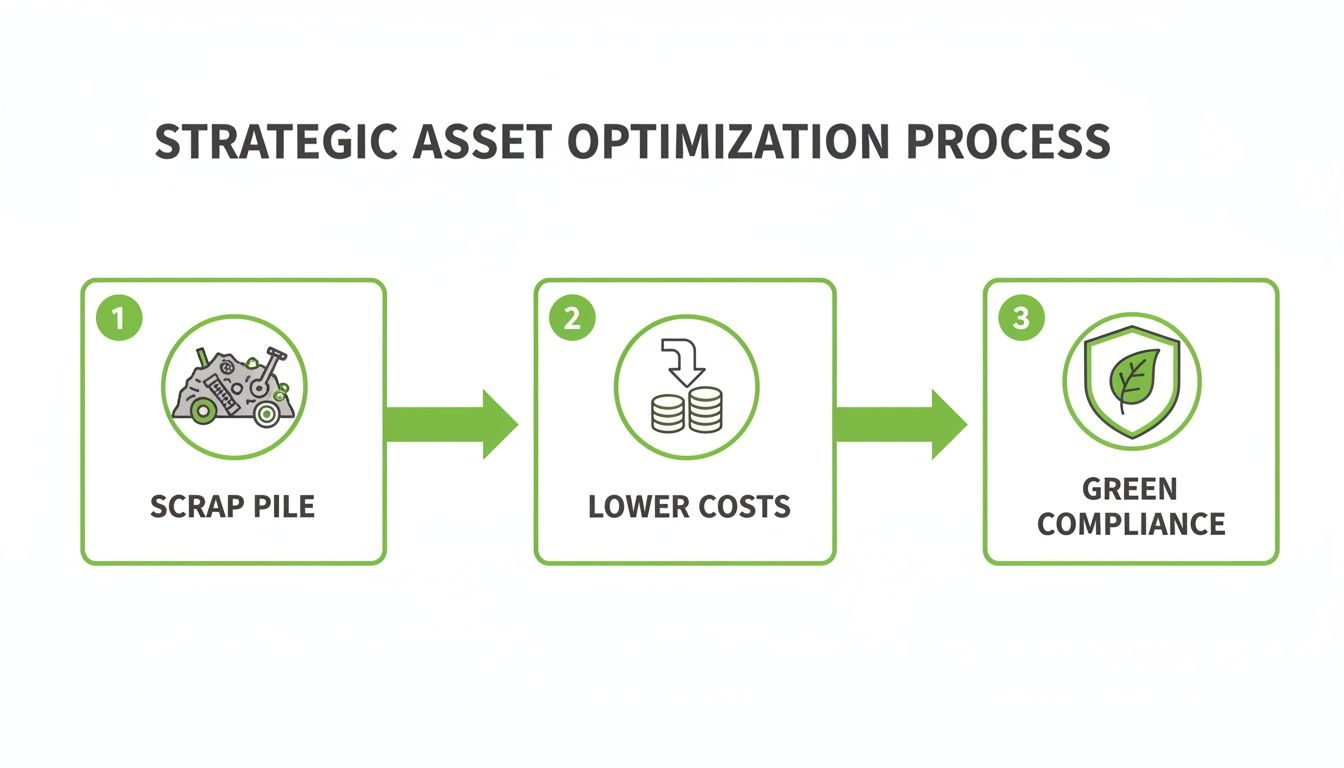
The diagram makes it clear: managing scrap iron isn't just about waste disposal. It's a direct path to lowering your operational expenses while staying ahead of regulatory demands.
Stage 1: Collection and Sourcing
It all starts with getting the scrap. This fier vechi, or old iron, typically comes from three main places:
- Industrial Scrap: This is the good stuff—clean, consistent, and generated right on the factory floor. Think offcuts, metal shavings, and rejected parts with a known chemical makeup.
- Demolition Scrap: This is the heavy metal from dismantled buildings, bridges, and old infrastructure. It’s your large structural beams, rebar, and pipes.
- Consumer Scrap: This is the flood of end-of-life products like old cars, appliances, and steel packaging. It’s plentiful, but it needs a lot more work to clean up and sort.
Companies like REMAT CLUJ S.A. make this first step easy by offering services to collect scrap directly from your site, whether it's a large industrial plant, a construction project, or a smaller business.
Stage 2: Sorting and Segregation
Once the scrap arrives at a processing facility, the real work begins. Sorting is absolutely critical because it dictates the quality—and value—of the final recycled steel. The goal here is simple: separate the valuable ferrous metals (iron and steel) from everything else.
This isn’t just done by hand anymore. It's a mix of brute force and high tech:
- Magnetic Separation: Giant overhead magnets do the heavy lifting, pulling all the iron and steel away from other materials like plastic, wood, and non-ferrous metals.
- Sensor-Based Sorting: This is where it gets smart. Advanced systems using X-ray fluorescence (XRF) and other sensors can identify different metal types with incredible precision, separating them automatically.
- Manual Sorting: Finally, trained workers give everything a last look-over, pulling out any remaining contaminants to ensure the scrap meets the specific grade the steel mills are paying for.
Simply put, the quality of the final recycled steel is locked in at the sorting stage. A cleaner, well-sorted batch of scrap fetches a higher price and produces a better product.
Stage 3: Shredding and Compacting
With the sorting done, the scrap iron is prepared for its trip to the furnace. Large, awkward pieces of metal are expensive to transport and difficult to melt efficiently, so they need to be processed.
First, huge hydraulic shears—often called foarfecă hidraulică—slice through thick steel beams like they're nothing. The scrap is then fed into a massive shredder that tears it into fist-sized chunks.
These smaller pieces are then compacted into dense bales or blocks. This step is all about density. It makes the material much cheaper to transport and way easier to load into a furnace.
Stage 4: Melting and Purification
The final stop is the steel mill. Here, the processed scrap is loaded into an Electric Arc Furnace (EAF), which is where the real magic of reciclarea fierului vechi happens. Inside the furnace, massive graphite electrodes are lowered into the scrap. A powerful electric arc flashes between them, generating immense heat that quickly melts the steel.
The EAF is the heart of steel's circular economy. Unlike old-school blast furnaces that need virgin iron ore and coal, an EAF's main ingredient is scrap iron, which slashes its environmental footprint.
Once the steel is molten, alloys are mixed in to get the precise chemical composition needed for the new product. Any remaining impurities float to the top and are skimmed off as slag. The pure, molten steel is then cast into billets, slabs, or blooms, ready to start its next life as a brand-new product.
This isn't a niche process; it's becoming the standard. Eurofer data shows that in 2023, the EU27 used 71,775 thousand tonnes of scrap in steel production, with electric arc furnaces now responsible for over 36% of total output. As an EU member, Romania is part of this shift, with its own scrap market set to grow as industrial and construction sectors churn out more fier vechi. You can learn more about Romania’s role in these recycling trends from Romania Insider.
Connecting Recycling to Financial and Climate Wins
Now that we’ve covered the technical side of reciclarea fierului vechi, let’s get to the real reason this matters to any modern business leader: the direct, measurable impact on your bottom line and your climate strategy.
When you stop seeing scrap iron as a waste product and start treating it as a strategic resource, you unlock serious economic gains and a powerful decarbonisation tool. These aren't just abstract ideas. They are hard numbers that strengthen your company’s financial health and its credibility with investors, regulators, and customers.
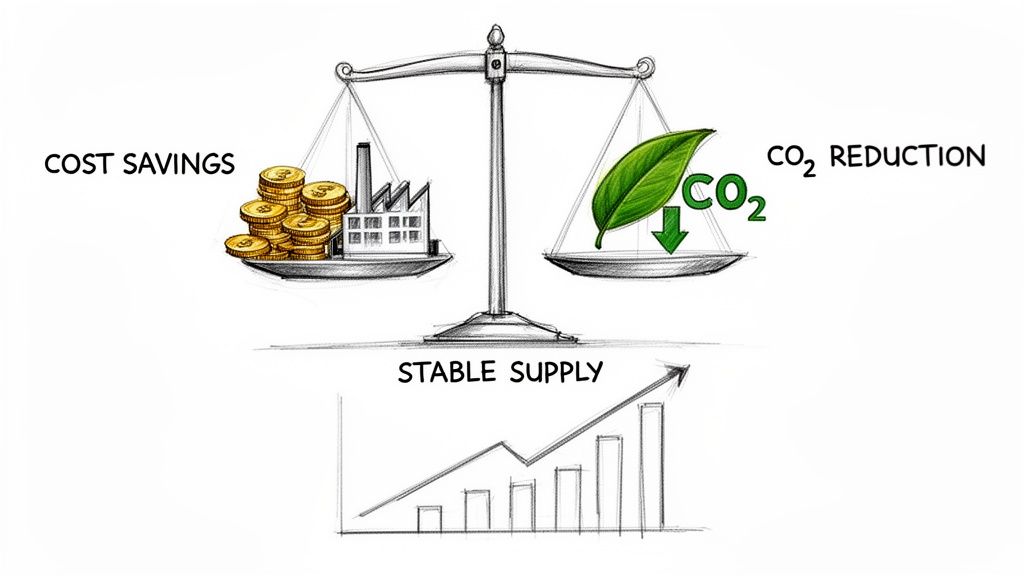
This shift from a linear "take, make, dispose" model to a circular one creates a double win. You cut costs and shrink your environmental footprint at the same time, turning a simple operational choice into a foundation for sustainable growth.
The Economic Case for Scrap Iron
The financial benefits of using recycled scrap iron are immediate and clear, building a powerful business case that resonates with both your finance and procurement teams. By embedding circularity into your supply chain, you’re making a direct investment in efficiency and resilience.
The key advantages are straightforward:
- Lower Raw Material Costs: Scrap steel is consistently cheaper to buy than mining and processing virgin iron ore. This direct saving has a major impact on your production margins, especially in a world of volatile commodity prices.
- Reduced Energy Bills: Making steel from recycled scrap can slash energy consumption by up to 74%. This dramatic drop in energy use translates directly into lower utility bills—a huge operational expense for any industrial company.
- A More Stable Supply Chain: Relying on a local and regional supply of scrap iron helps protect your business from the geopolitical risks and logistical nightmares tied to global mining. It creates a supply chain that is far more predictable and resilient.
Quantifying the Climate Impact
The climate benefits of reciclarea fierului vechi are just as powerful as the economic ones. For any manufacturing company, switching to recycled steel is one of the single most effective ways to lower its carbon footprint. The data tells the story.
Recent EU-27 statistics show a massive trend: steel scrap consumption jumped by 16.7% to 87.853 million tonnes in 2021. This shift, which includes Romania, is part of a global movement where scrap now makes up 21.9% of crude steel production. The result? Nearly 950 million tonnes of CO2 emissions are avoided every year.
This table breaks down the direct savings you can achieve.
Impact of Recycling 1 Tonne of Scrap Iron vs. Virgin Production
This table quantifies the direct environmental and resource savings achieved by recycling scrap iron, highlighting its efficiency compared to producing steel from raw materials.
For Romanian companies focused on decarbonisation, this data directly addresses Scopes 1-3 emissions. It’s a clear path to hitting science-based targets and proving your commitment to investors and customers. To dig deeper into regional waste data, you can learn more about municipal waste findings from the European Environment Agency.
By choosing recycled steel, you are not just making an environmental statement. You are making a data-driven decision that directly reduces your carbon liability.
Using Life Cycle Assessments to Prove the Value
So, how do you translate these benefits into a format that your CFO and sustainability auditors will trust? The answer is a Life Cycle Assessment (LCA).
An LCA is a formal, standardised method used to measure the environmental impacts of a product across its entire life—from raw material extraction and processing to manufacturing, distribution, use, and final disposal.
When you run an LCA, the advantages of using recycled scrap become undeniable. The assessment provides hard data showing a lower footprint across multiple critical areas, including:
- Global Warming Potential: Drastically reduced CO2 emissions, thanks to lower energy needs and skipping the carbon-intensive process of mining and smelting iron ore.
- Resource Depletion: Clear proof that you are conserving finite natural resources like iron ore, coal, and limestone.
- Water Usage: Significant reductions in the amount of water your production process consumes compared to primary steelmaking.
An LCA gives you the robust, third-party-verifiable data you need to make your case. It transforms your recycling efforts from a simple operational story into a credible, quantifiable pillar of your corporate strategy—ready for sustainability reports, investor decks, and green financing applications.
Using Scrap Recycling for EU Regulation Compliance
For many companies, environmental regulations feel like just another complex and costly burden. But what if one of your simplest operational activities—reciclarea fierului vechi—was actually a powerful tool for meeting these new demands? This isn’t just about good practice; it's a direct, practical way to manage regulatory risk and even cut financial penalties.
Turning your recycling data into a compliance asset is no longer optional. With major EU regulations now in force, the ability to prove what’s in your products and how they’re made has become a critical business function. For finance and compliance leaders, the question is simple: how can we use our existing operational data to reduce risk?
The answer lies in connecting your scrap metal recycling efforts to two specific, high-impact pieces of legislation: the Corporate Sustainability Reporting Directive (CSRD) and the Carbon Border Adjustment Mechanism (CBAM).
Addressing the Corporate Sustainability Reporting Directive (CSRD)
The CSRD now requires thousands of companies to disclose detailed, audit-ready information on their environmental, social, and governance (ESG) performance. This is not a box-ticking exercise. A documented programme for reciclarea fierului vechi directly feeds into the mandatory disclosures required under the European Sustainability Reporting Standards (ESRS).
Specifically, your data on recycled content provides the hard evidence needed for two key standards:
- ESRS E1 (Climate Change): Using recycled steel, which has a significantly lower carbon footprint than virgin steel, allows you to report lower Scope 3 emissions. This is crucial for showing real progress on your decarbonisation roadmap and meeting climate targets.
- ESRS E5 (Resource use and circular economy): This standard demands that companies report on resource inflows and outflows, including the percentage of recycled materials used. High-quality data from your scrap recycling programme directly satisfies this requirement, proving your commitment to circular business models.
Failing to provide this data isn't an option. It can lead to non-compliance penalties, erode investor confidence, and do serious damage to your company's reputation.
Under CSRD, what gets measured gets managed—and reported. Your scrap recycling data is no longer just operational information; it's a key component of your mandatory corporate disclosure.
Lowering Costs Under the Carbon Border Adjustment Mechanism (CBAM)
Think of CBAM as a carbon tax on certain goods imported into the EU, including iron and steel. Its goal is to level the playing field between EU producers, who already pay for their carbon emissions, and non-EU producers, who may not. For importers and manufacturers, this represents a direct and potentially significant new cost.
This is where your recycling data becomes a powerful financial lever. The amount of CBAM tax you pay is calculated based on the "embedded emissions" of the products you import. And products made with a high percentage of recycled content have dramatically lower embedded emissions.
Here’s how to use this to your advantage:
- Engage Your Suppliers: Work proactively with your non-EU suppliers to get verifiable data on the percentage of recycled scrap used in their steel production.
- Verify the Data: This requires solid documentation, like supplier declarations, material composition datasheets, or third-party certifications. Traceability is everything.
- Report to Authorities: Use this verified data to declare lower embedded emissions for your imported goods. This, in turn, directly reduces your CBAM financial liability.
Without this proof, authorities will use default values that assume a much higher carbon footprint, automatically leading to a higher tax bill. A proactive approach to collecting supply chain data for reciclarea fierului vechi is, therefore, a direct strategy for cost reduction. As these regulatory frameworks evolve, understanding their connections is essential. To get a better grasp on recent changes, you can read our guide on how the Omnibus package affects CSRD and other EU directives.
By positioning scrap recycling at the core of your compliance strategy, you transform a simple waste management task into a tool for mitigating risk, lowering costs, and building a more resilient and credible business.
Turning Recycling Data Into Credible Reports
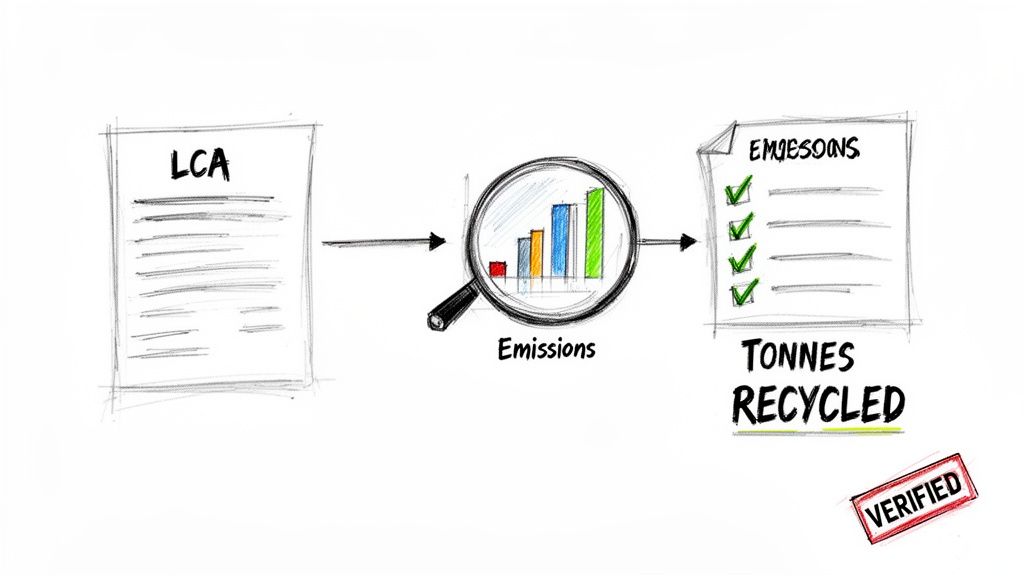
Your operational efforts in reciclarea fierului vechi only really count when they are accurately measured and credibly reported. It’s no longer enough to just recycle; you have to translate that hard work into a language that regulators, investors, and customers can actually understand and trust. This is all about turning raw data—like tonnes of scrap processed—into audit-ready metrics.
The entire goal is to bridge the gap between doing the work on the ground and getting the credit for it in the boardroom. A structured approach to measurement and reporting transforms your recycling programme from a simple cost centre into a strategic asset you can prove. This is absolutely essential for unlocking benefits like a stronger corporate reputation or better access to green finance.
Calculating Your Impact with Life Cycle Assessments
The foundation of any credible sustainability claim is the Life Cycle Assessment (LCA). Think of an LCA as a complete environmental audit of a product, from the moment raw materials are pulled from the earth to the day it’s thrown away or recycled. It provides the hard data you need to prove, without a doubt, the advantages of using recycled materials.
When you apply an LCA to steel production, the benefits of using recycled scrap iron become undeniable. The assessment clearly shows a much lower impact across key environmental metrics when compared to making steel from virgin iron ore. This isn’t just a vague claim; it's a quantifiable, science-based conclusion that will stand up to scrutiny from auditors and stakeholders.
Demystifying Emission Factors and Data Accuracy
To convert your recycling activities into carbon metrics, you need to use emission factors. An emission factor is simply a coefficient that calculates the amount of greenhouse gas released per unit of activity. The big challenge here is that using generic, global factors can be wildly inaccurate and completely undermine the credibility of your final report.
So, how do you make sure your calculations are as precise as possible? The answer is localisation.
Using region-specific emission factors is critical for accurate carbon accounting. Generic data can mask your true progress, but localised data provides a far more precise and defensible picture of your impact.
This is exactly why initiatives like the ECONOS Data 4 Climate project are so important. By developing emission factors that are specific to Romania, local companies can calculate their carbon footprint with much greater accuracy. This level of precision is non-negotiable for building trust and ensuring your reports are truly credible.
Integrating Data Into Key Reporting Frameworks
Once you have solid, defensible data, the final step is to integrate it into the reporting frameworks that actually matter to the market. Your recycling metrics are not just internal KPIs; they are crucial inputs for several internationally recognised standards.
To make sure your data is robust and generates truly credible reports, it's vital to use specialised methods for measuring environmental impact, for example, by using efficient Carbon Accounting Tools.
Here’s where your data on reciclarea fierului vechi becomes most powerful:
- GHG Protocol: Data on recycled content directly lowers your reported Scope 3 emissions (specifically under Category 1, Purchased Goods and Services). This is a primary metric for any serious corporate decarbonisation strategy.
- CDP (formerly Carbon Disclosure Project): Your responses to the CDP questionnaire are massively strengthened with verifiable data on circularity and emissions reductions, which can significantly improve your score.
- EcoVadis Assessments: Proving you use recycled materials and have a lower environmental footprint contributes directly to a higher EcoVadis rating, making you a much more attractive partner for large corporate buyers. You can check out our guide on effective waste management record-keeping to ensure your foundational data is solid.
The trend towards circularity is clear. While Romania's municipal solid waste recycling rate was a low 12% in 2023, far below the EU average, industrial metals like iron are consistently recovered. Across the EU, the use of steel scrap soared to 87.853 million tonnes in 2021—a 16.7% increase—showing a strong market shift that also helps with EU Taxonomy compliance. For any company, this translates to real savings: recycling one tonne of iron saves 74% of the energy needed for primary production.
Frequently Asked Questions About Scrap Iron Recycling
The world of industrial recycling can seem tangled, but getting a grip on reciclarea fierului vechi is something modern businesses just can’t afford to ignore. We often get questions from companies looking to sharpen their recycling programmes. Here are the answers we give, framed for business leaders who need clear, practical information.
How Do We Start Verifying Recycled Content from Suppliers for CBAM and CSRD?
The only way to start is by talking directly to your key suppliers. You need to officially ask for the documents that back up their claims. This means things like material composition datasheets, supplier declarations, or recognised third-party certifications (like ISO 14021 for environmental labels). Real, audit-ready data needs a paper trail you can follow.
This usually means you'll have to update your supplier code of conduct. From now on, disclosing recycled content is a mandatory part of doing business with you. It’s no longer a simple request; it's the new standard for your supply chain.
For the Corporate Sustainability Reporting Directive (CSRD), this information is fundamental for your double materiality assessment under ESRS E5 (Resource use and circular economy). For the Carbon Border Adjustment Mechanism (CBAM), it's your core evidence to argue for lower embedded emissions, which translates to a smaller carbon tax bill. Our advice is to roll this out in phases, starting with your most important, high-volume suppliers.
A common question we hear is: "How can we trust our suppliers' data?" Verification is everything. Start by demanding formal documents, but be prepared to conduct site visits or bring in third-party auditors for high-risk suppliers. You need to be sure that data is solid enough for regulatory reporting.
Our team helps clients build these data collection systems and supplier engagement programmes from scratch. We make sure the information you collect is reliable, well-structured, and ready to stand up to the scrutiny of EU regulators and your own financial auditors.
What Is the Real Carbon Footprint Difference Between Virgin and Recycled Steel?
The difference isn't just a small improvement; it's massive. Making one tonne of steel from virgin iron ore in a traditional blast furnace is an incredibly carbon-heavy process, kicking out roughly 2 tonnes of CO2.
By contrast, making that same tonne of steel from scrap iron in an Electric Arc Furnace (EAF) emits only about 0.5 tonnes of CO2. That’s a 75% reduction in direct emissions.
This huge saving happens because the reciclarea fierului vechi process skips the dirtiest part of primary steelmaking entirely: the chemical reduction of iron ore with coal. When you report your greenhouse gas emissions under the GHG Protocol, this simple choice directly slashes your Scope 3 emissions, specifically in Category 1 (Purchased goods and services). This single decision makes your decarbonisation plan far more convincing to investors and regulators.
How Is Reciclarea Fierului Vechi Relevant for an SME?
For a Small or Medium-sized Enterprise (SME), having a documented recycling programme isn't a "nice-to-have"—it's about future-proofing your business. Your large corporate customers are under immense pressure from their own CSRD and net-zero targets, and they are pushing those sustainability demands down to every link in their supply chains.
A documented programme for reciclarea fierului vechi can be the very thing that helps you win and keep contracts with these bigger clients. It proves you're a reliable partner who can help them meet their own compliance goals.
Here’s how it gives you a competitive edge:
- Better Assessment Scores: It directly boosts your performance in sustainability assessments like EcoVadis, which are often a requirement to even be considered a preferred supplier.
- Greater Cost Stability: Relying on recycled materials can shield your business from the volatile prices of virgin resources and energy.
- Enhanced Resilience: It makes you a more resilient and attractive partner in a market where supply chain transparency is no longer optional.
What Are the First Steps to Create a Credible Report on Our Recycling Efforts?
Putting together a credible report on your recycling impact doesn't need to be overwhelming. It’s a logical process that builds confidence and ensures your data can be defended.
- Establish a Baseline: First, figure out where you stand today. Measure the total scrap iron you generate or buy over a specific period. Track the weights, sources, and dates.
- Implement a Robust Data System: This doesn't require expensive software right away. It can start with well-organised spreadsheets that track key data points consistently. The goal is to create a reliable record.
- Calculate the Impact: Use recognised methods to turn your raw data (tonnes of scrap) into environmental metrics. This involves applying official emission factors to calculate the CO2 savings. For the best accuracy, use local factors, like those from our Data 4 Climate initiative for Romania.
- Present Data Clearly: Finally, weave these calculated metrics into your sustainability reports, annual reviews, or even customer communications.
We combine delivery with training so teams become autonomous. Our goal is to give your team the knowledge and tools to manage this process on their own for the long haul, building lasting capability and real confidence in your reporting.
At ECONOS 🌱, we help companies turn their recycling data into a strategic asset for compliance and growth. From carbon footprinting to CSRD reporting and EcoVadis readiness, we provide the practical expertise and tools to make your sustainability efforts count. Learn more about how we can support your journey at https://www.econos-esg.com.