
.png)

Submitting the Environmental Fund declaration (declaratie fond mediu) is a non-negotiable part of business in Romania for companies whose products have an environmental footprint. We see this not as a burden, but as a practical tool for managing risk and cost. Real progress comes from execution, not just compliance paperwork.
Across our client base in retail, manufacturing, and technology, we've noticed a shift. Companies are realizing the data required for this declaration is a critical asset. Yet, many struggle with scattered data, unclear ownership, and the risk of costly errors. The core challenge isn't the form itself, but building a scalable, affordable process to collect and verify the information.
Here are our team's key takeaways for getting it right:
- Centralize Data Ownership. The information needed—packaging weights, sales volumes, material types—is often spread across logistics, finance, and procurement. The first step is to assign a clear owner to consolidate this data. This builds internal capability, making your team more autonomous over time.
- Turn Compliance into Operational Progress. The data you gather for the Environmental Fund is the foundation for your wider Environmental, Social, and Governance (ESG) strategy. It directly feeds into your Scope 3 carbon footprint calculations and prepares you for audits related to the Corporate Sustainability Reporting Directive (CSRD). The goal is progress, not just a perfect report.
- Treat Deadlines as a Financial Tool. Penalties for late or incorrect submissions are significant. By mapping out deadlines and building a buffer for internal reviews, you can manage this process as a predictable operational cost, not a financial risk. This discipline builds trust with partners and financial institutions.
So, what does this mean for your company? The declaration is more than a compliance task; it’s a test of your operational readiness. Does your team have the right data systems and processes in place to ensure accuracy and timeliness? We combine delivery with training so teams become autonomous, transforming this mandatory report into a tool for building a more resilient and competitive business.
Mastering this process is a concrete step toward better operational control.
What Is The Environmental Fund Declaration?
The Environmental Fund Declaration is the practical application of the "polluter pays" principle. It's a system designed to ensure businesses take financial responsibility for the products and materials they introduce into the country.
The obligation to file isn't based on your company's size or turnover. It’s triggered by specific business activities. If your company does any of the following, you’re on the hook to declare and pay.
- Introducing any packaged goods to the Romanian market, whether you import them or produce them locally.
- Selling electrical and electronic equipment (EEE).
- Placing batteries and accumulators on the market.
- Importing or producing tyres, lubricants, and various oils.
- Manufacturing or importing single-use plastic bags that are subject to the eco-tax.
To make it easier to figure out if this applies to you, here’s a quick breakdown of the most common triggers.
Who Needs to Submit the AFM Declaration
If your business falls into any of these categories, you have a legal duty to file the AFM declaration. Getting this wrong is a business risk.
Why This Declaration Is More Than Just Paperwork
Treating this declaration as a simple compliance chore is a missed opportunity. For many of our clients, we’ve seen how getting this right builds a strong foundation for their entire sustainability strategy.
In practice, the data you gather for the AFM declaration is the bedrock for more advanced ESG initiatives. It’s the starting point for calculating your company’s Scope 3 carbon footprint, conducting a product Life Cycle Assessment (LCA), or building a credible CSRD/ESRS report.
Properly managing this obligation sends a clear signal to your partners, investors, and customers. It shows your business has a handle on its environmental impact and is aligned with EU-wide goals. On the flip side, failing to comply can lead to hefty fines and serious reputational damage.
The Digital Shift and What It Means for You
A major change happened back in July 2022. The Administrația Fondului pentru Mediu (AFM), the agency that manages this system, moved everything online. All submissions for the model declaratie fond mediu are now exclusively digital.
This means your company must use the AFM-Online platform and a qualified electronic signature to file your reports. The goal was to simplify the process, but it also means you need solid internal data systems and someone on your team who truly owns this reporting process. If you want to dive deeper into the specifics, you can find more details about the declaration process and its requirements. This digital mandate makes it clearer than ever: good data management is no longer optional.
Navigating The Online AFM Declaration Form
Logging into the AFM-Online portal for the first time can be intimidating. The interface is dense, and it’s not always clear which fields to fill out. Once our clients grasp the logic, however, it becomes a routine, manageable task.
The first real challenge isn't the form itself—it’s tracking down the necessary information within your own company. This data is almost always scattered across different departments. Your ERP holds the sales volumes, but the import records have the packaging weights. Your first job is to connect the dots between finance, logistics, and operations.
Locating And Inputting Your Data
The online form is built around specific annexes (anexe), each one corresponding to a different environmental obligation. The good news? You only need to complete the sections that apply to your business.
Let’s walk through a common scenario: a company that imports and sells consumer electronics.
- EEE Obligation: Your team will need to pull sales data for every electronic product sold during the reporting period. This information, typically from your ERP, has to be sorted according to the official EEE classifications.
- Packaging Obligation: For those same products, you need to declare the weight of all packaging. This means getting data from your suppliers or, in many cases, physically weighing product samples. You’ll have to break it down by material type: cardboard, plastic, metal, and so on.
- Battery Obligation: If the electronics have batteries, you must also report the quantity and type of batteries you've placed on the market. You can usually find this information on the product’s technical sheets.
From our experience, a frequent mistake is misclassifying products or using the wrong units of measure. The form requires all weights to be in kilograms, so make sure every piece of data is converted correctly before you start typing.
This is what the process looks like when you boil it down to the essentials.
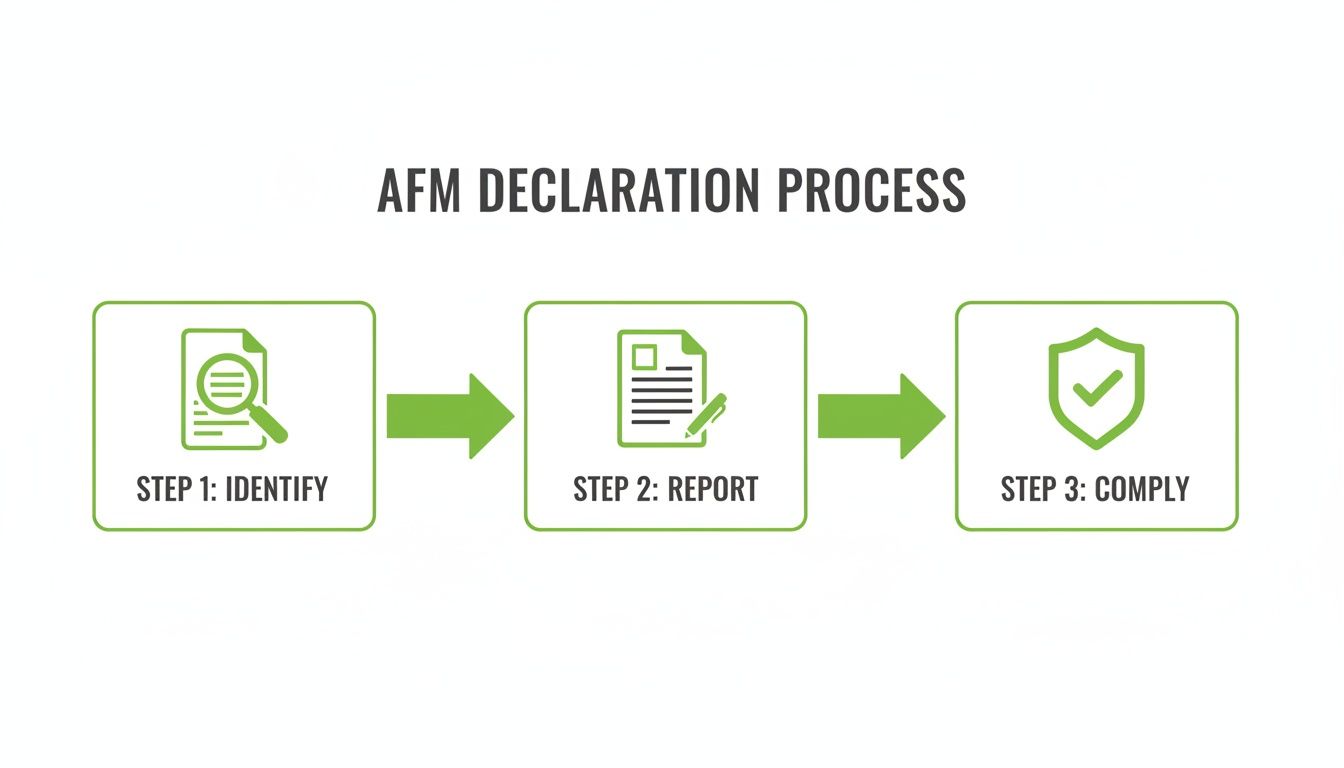
This workflow simplifies it into three core phases: identifying your specific obligations, reporting the data with precision, and ensuring you are fully compliant to avoid any penalties.
From Form Fields To Final Submission
Once you've gathered all your data, the next part is the actual entry into the AFM-Online portal. While it might sound a bit abstract, understanding how to create online forms can actually give you insight into how the AFM system is designed and help you anticipate its logic.
The official AFM website should always be your go-to source for accessing the portal and staying on top of legislative changes.
Take some time to get familiar with the main sections of the website before you even log in to the declaration portal. It can save you a lot of time and prevent simple mistakes during the submission process. As you fill out the declaration, triple-check every entry. A single misplaced decimal point can have serious financial repercussions.
A critical tip we give every client: Get both your finance and operations teams to do a final review before you hit submit. The finance team gets the cost implications, while the operations team can spot-check the accuracy of product and material quantities.
This collaborative review is the single best way to ensure your model declaratie fond mediu is right the first time.
And for companies looking to get a better handle on their reporting across multiple environmental platforms, our guide on ANPM reporting and authentication offers more practical advice. Mastering this process isn’t just about dodging fines; it’s about building a reliable data foundation for all your future ESG efforts.
Calculating Contributions and Avoiding Costly Penalties
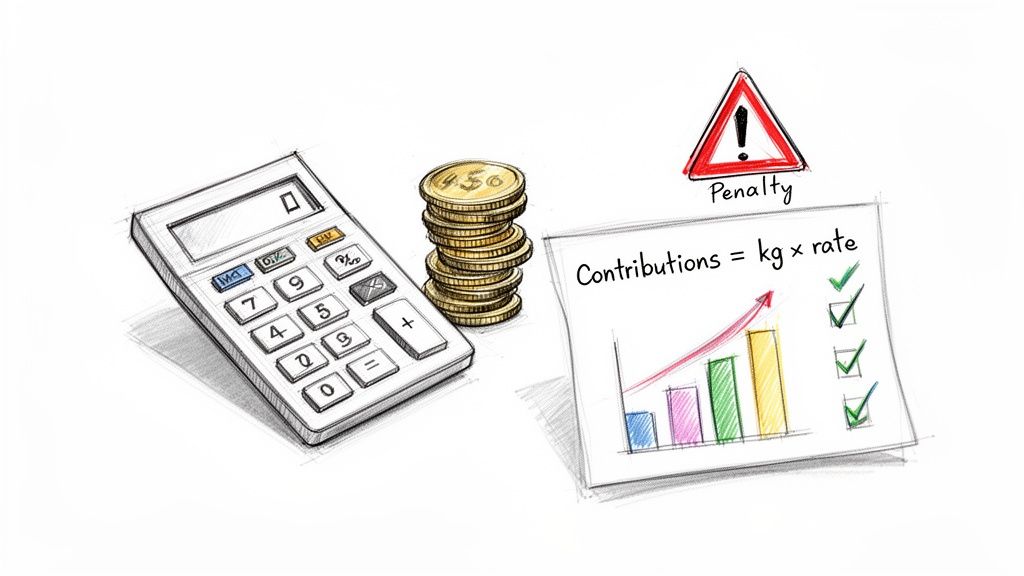
This is where the model declarație fond mediu stops being just paperwork and starts hitting your budget. Getting the calculations right isn’t only about staying compliant; it’s about smart financial planning. The core idea is simple: the more environmental impact you have, the more you contribute.
The actual maths depend on your specific obligation. For packaging, which is the most common, the formula is straightforward:
Total Contribution = (Weight of Material in kg) x (Contribution Rate per kg)
Of course, each material—be it plastic, cardboard, glass, or metal—has its own rate. These are set by the Administrația Fondului pentru Mediu (AFM) and can change, so keeping an eye on their updates is a non-negotiable part of the job.
Key Contribution Categories and How to Calculate Them
To budget accurately, you need to know exactly how each of your obligations is calculated. From our experience, most companies grapple with the same few categories.
- Packaging Waste: This is the big one for most businesses. You report the total weight of packaging materials you bring into the Romanian market. If you don't meet your recycling targets, you pay a penalty of 2 lei/kg on the difference. Those kilograms add up incredibly fast.
- Electrical and Electronic Equipment (EEE): The contribution here is tied to the weight of new electronics you place on the market. The rates can vary widely depending on the type of product.
- Batteries and Accumulators: This works much like EEE. Your contribution is calculated based on the weight and chemical composition of the batteries you sell.
A classic mistake we see is overlooking linked obligations. Let's say you sell an electronic gadget. It probably comes in a cardboard box, sits in a plastic tray, and contains a lithium-ion battery. That's not one obligation; it’s three, and each needs to be calculated and reported separately. This is why having a rock-solid system for your effective waste management evidence isn't just good practice—it's essential for getting this right.
The High Cost of Non-Compliance
So, what happens if you get the numbers wrong or just miss a deadline? The penalties are steep, and they're designed that way to enforce accountability.
The fines aren't just a slap on the wrist; they represent a serious business risk. Forgetting to file can trigger a penalty, but delaying payment starts a meter running on daily interest that can quickly spiral into a major financial headache.
The penalty system is unforgiving. Simply failing to submit your declaration can lead to fines as high as 250,000 lei. On top of that, late payments accumulate daily proportional penalties, making even small delays extremely expensive. This strict framework is designed to hold companies accountable, and it’s no surprise that compliant businesses are seen as more resilient and reliable partners, especially in EU supply chains governed by rules like CBAM.
Ultimately, the goal is to treat your AFM contributions as a predictable operational cost, not a potential financial shock. Accurate calculations and on-time submissions protect your bottom line and solidify your reputation as a trustworthy business partner.
Right, you've done the hard work of gathering the data and running the calculations. But a perfect declaration is worthless until it's submitted correctly and on time. Let’s talk about navigating the final stretch: the deadlines and the digital submission process for your model declaratie fond mediu.
The whole system is now online, which simplifies things in theory, but introduces its own set of technical hurdles.
First things first: you absolutely need a qualified electronic signature. Since July 2022, all declarations must go through the AFM-Online platform, and that signature is your non-negotiable key to entry. If your company doesn't have one, this is your top priority. Getting one involves choosing an accredited provider and verifying your company's identity, so it’s not something you can sort out an hour before the deadline.
Mastering the Submission Calendar
Missing a deadline is not an option—it leads directly to penalties. The dates vary depending on what you're declaring, so your team needs a rock-solid calendar to work from. A proactive timeline is the only way to avoid the last-minute scramble that breeds mistakes.
Here's a breakdown of the most common reporting cycles you'll need to manage:
- Monthly Obligations: These are almost always due by the 25th of the following month. Think contributions for hazardous substances or specific emissions.
- Quarterly Obligations: Due by the 25th of the month after the quarter ends. The eco-tax on single-use plastic bags is a classic example that falls into this category.
- Annual Obligations: This one is a biggie, usually due by January 25th of the following year. It's critical for reconciling your annual packaging recycling targets against your actual performance.
Knowing these dates lets your finance and operations teams plan backwards. They can set internal deadlines for data collection, calculation, and that all-important final review. This turns what could be a stressful fire drill into a predictable, routine part of business.
Our best advice is to set your internal deadline at least one week before the official AFM deadline. This buffer gives you time to troubleshoot any unexpected technical glitches with the platform or signature validation without the risk of a late filing.
To help you with your compliance planning, we've put together a summary of the key deadlines you'll need to track throughout the year. Having these dates in one place makes it easier to coordinate across departments and ensure nothing falls through the cracks.
2026 AFM Declaration Deadlines at a Glance
This table is your starting point for building a reliable internal compliance calendar. Remember to always double-check the specific requirements for your industry, as certain niche contributions might follow a different schedule.
Troubleshooting the Digital Submission
Even with flawless preparation, technology can fail you. The AFM-Online platform can throw an error, or your electronic signature might refuse to validate. When this happens, don't panic. A methodical approach will solve most issues.
Before you even try to upload, always save a local copy of your completed declaration. If the platform gives you an error, the first step is simple: refresh the page and try again.
If the problem persists, check the official AFM website for any announcements about system maintenance or outages. If the issue seems to be your electronic signature, make sure your certificate hasn't expired and that your signing software is configured correctly. A calm, step-by-step process is the key to getting your model declaratie fond mediu filed successfully.
Putting Your AFM Data to Work in Your ESG Strategy
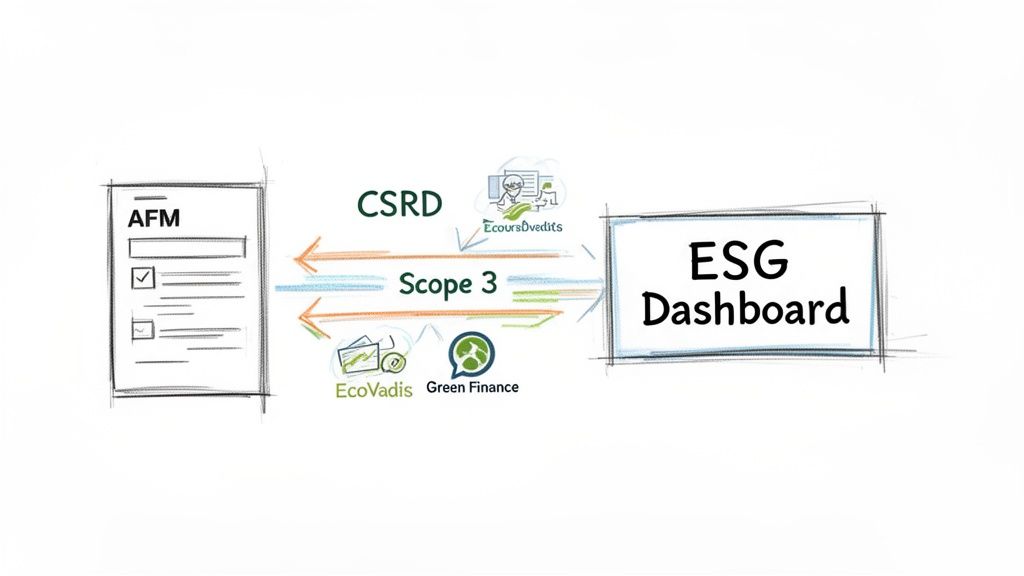
The data you gather for the model declaratie fond mediu has enormous strategic value that goes far beyond just ticking a compliance box. Too many companies treat this as a painful, isolated admin task. We see it differently. This is a core dataset for your entire Environmental, Social, and Governance (ESG) framework.
Think of it as the starting point, not the finish line. The detailed information you collect on packaging, electronics, and other materials isn't just for the AFM. It’s a verifiable, audit-ready inventory of your product-related environmental footprint.
From Compliance Data to Strategic Insights
The real opportunity comes from connecting these numbers to your wider business goals. How does a mandatory declaration become a competitive advantage? It starts by seeing the data for what it truly is: a rich source of operational intelligence.
This is where a simple compliance exercise transforms. For companies in sectors like retail, manufacturing, or ICT, this declaration is a direct feed into critical ESG reporting frameworks. For instance, the environmental data from your AFM filings is fundamental for calculating your Scope 3 carbon footprint and running detailed Life Cycle Assessments (LCA)—both central to new EU regulations. You can get a deep dive into the specifics of recycling obligations and reporting standards here.
This shift in perspective is what separates leaders from laggards. The exact same data used to calculate a financial contribution can be used to pinpoint material inefficiencies, streamline your supply chain, and strengthen your position in the market.
By integrating this data, you move from reactive reporting to a proactive strategy. It’s an approach that builds genuine operational progress, not just a perfect report.
Unlocking Broader ESG Opportunities
Using your AFM data effectively unlocks several major business benefits. On a basic level, it shows a sophisticated level of data management that resonates with everyone from investors to supply chain partners.
Here are three ways accurate AFM data can immediately drive your ESG agenda:
Strengthens CSRD/ESRS Reporting: The Corporate Sustainability Reporting Directive (CSRD) and its European Sustainability Reporting Standards (ESRS) demand granular, verifiable data. Your AFM data on packaging and product lifecycles provides an audit-ready foundation for disclosures under ESRS E1 (Climate Change) and ESRS E5 (Resource Use and Circular Economy). We cover how to build a robust framework in our guide to creating a sustainability report.
Improves EcoVadis Scores: Platforms like EcoVadis reward companies that can prove their environmental management systems with hard data. Using precise figures from your model declaratie fond mediu to show exactly how you track materials and manage waste can directly boost your score in the "Environment" pillar—a critical factor for suppliers in competitive EU markets.
Unlocks Green Financing: Banks and investors are increasingly linking financing terms to ESG performance. Demonstrating a clear, data-backed understanding of your environmental footprint and obligations can improve your access to green loans and sustainability-linked financing, often at much better rates.
Our approach isn’t just about delivering a report; it’s about delivery and training. We empower your internal teams to use this compliance data on their own. This builds lasting capability, ensuring your sustainability work becomes scalable, affordable, and woven directly into your core business strategy.
Common Questions on the Fondul pentru Mediu Declaration
Even with the clearest instructions, real-world questions always pop up when it’s time to file your model declaratie fond mediu. We've seen companies run into the same practical issues time and again, so here are direct answers to the most common ones.
What If I Find a Mistake in a Submitted Declaration?
It happens. If you discover an error after you’ve already hit “submit,” you need to file a corrective declaration (declarație rectificativă) through the AFM-Online platform.
This isn’t just an update; the new form completely replaces the old one for that specific month or quarter. The key is to act the moment you spot the mistake to keep potential penalties to a minimum.
The corrective form lets you fix your quantities or calculations, and any difference in what you owe will be settled. Always keep detailed notes explaining why the correction was necessary. Auditors will want to see that documentation.
Are There Exemptions for Small Businesses?
This is one of the most common and costly assumptions we see. Generally, your duty to declare is tied to your type of activity, not the size of your company.
Certain specific thresholds might apply—for example, producers introducing packaging below a certain annual weight might have simplified obligations. But these thresholds change, and it’s your responsibility to check the latest legislation for your specific products.
Assuming you're exempt without verifying it against the official rules is a recipe for a compliance headache down the line.
The rule of thumb is simple: if you put products on the market that have an environmental footprint, you almost certainly have a reporting obligation. Never assume you're exempt.
How Do I Account for the Waste Sales Contribution?
The 2% contribution on revenue from selling recyclable waste—like scrap metal, cardboard, or plastic—is a separate obligation, and the responsibility for paying it is structured a bit differently.
In theory, this tax should be withheld at the source by the buyer, who is typically an authorised collector or recycler. They are supposed to pay it directly to the Environmental Fund on your behalf.
However, your company remains legally responsible for making sure this actually happens. You need clear documentation from the buyer confirming the tax was withheld and paid. If that paperwork is missing or mismanaged, you could find yourself liable for the payment all over again.
At ECONOS 🌱, we help companies transform compliance headaches like the Fondul pentru Mediu declaration into a strategic advantage. We bring the expertise and tools to make sure your data is accurate, your reports are audit-ready, and your ESG strategy is built on a solid foundation.
Learn how our ESG reporting and compliance services can support your business