
.png)
Real progress in environmental compliance comes from daily execution, not just frameworks. For companies in Constanța, especially in logistics, manufacturing, or energy, the Garda de Mediu is a key local stakeholder. Viewing them as a partner, rather than a hurdle, is a strategic move that builds business resilience.
We see a clear pattern in our work: companies that struggle are often those caught off guard by unannounced inspections, whereas those who succeed have integrated compliance into their daily operations. The core challenge isn't a lack of desire, but a gap between high-level policy and on-the-ground execution. How do you bridge that gap without overwhelming your teams?
Here are three key takeaways for businesses in Constanța:
Treat "Audit-Ready" as Your Normal State. The Garda de Mediu's inspectors can arrive for both planned and unannounced checks. Your essential documents—environmental authorisation, waste management records, and emissions data—should be organized and accessible at all times. This isn't about scrambling before a visit; it's about having robust systems that prove compliance is part of your daily routine.
Turn Waste Management into a Measurable Advantage. For inspectors, waste management is a primary indicator of your overall environmental commitment. They need to see documented proof of correct sorting, traceability, and disposal through authorised collectors. This isn't just a cost; it's an opportunity. Strong performance here directly supports your ESG (Environmental, Social, and Governance) reporting and enhances your reputation within the EU supply chain.
Connect Local Compliance to High-Level Reporting. The data an inspector requests for a local audit is the same data needed for frameworks like the Corporate Sustainability Reporting Directive (CSRD). Integrating your on-the-ground data collection—like monitoring Greenhouse Gas (GHG) emissions—with your reporting processes makes your business more efficient and credible. This proactive stance is essential for securing green financing and maintaining market access.
For companies in Constanța, this means translating compliance into clear business decisions. It requires assigning ownership for data collection, budgeting for necessary tools, and setting realistic timelines for operational improvements. The goal is to build internal capability so your teams can manage these processes autonomously. We combine delivery with training so teams become autonomous.
Ultimately, proactive engagement with the Garda de Mediu builds trust and reduces risk, turning a regulatory requirement into a competitive advantage.
Understanding Garda De Mediu Constanta's Role
The Garda de Mediu is the on-the-ground enforcement arm for all national and European environmental laws in the Constanța region. Its authority is broad, covering everything from waste management to emissions control.
Its inspectors have the power to conduct both planned audits and unannounced spot-checks. Their primary function is to ensure your operations are "audit-ready"—meaning your daily activities consistently align with legal requirements.
Key Functions and Business Impact
For any business, the agency's work has significant consequences:
- Inspections and Control: The agency actively monitors industrial sites, particularly in a major port city like Constanța with its high concentration of logistics and heavy industry. They verify that what happens on your site matches the conditions of your environmental permits.
- Complaint Management: As the first point of contact for environmental complaints (sesizări), a single well-documented complaint from a citizen or NGO is enough to trigger an official investigation into your operations. This makes your relationship with the local community a direct risk factor.
- Authorisation and Permitting: While other agencies issue permits, the Garda de Mediu enforces them. Non-compliance can lead to consequences ranging from significant fines to a full suspension of your business activities, impacting your operational continuity and trust with partners.
Based on our team's experience with audits, we see that companies engaging proactively with the Garda de Mediu avoid costly delays. Treating compliance as an ongoing process, not a last-minute scramble, is what sets successful businesses apart.
Navigating these local requirements is vital, particularly for companies with complex supply chains. If you're curious about how things work in the capital, our guide on the Garda de Mediu in Bucharest offers a useful comparison.
To help your team connect with the right people efficiently, we've compiled the key contact information for the Garda de Mediu Constanța.
Garda de Mediu Constanta Quick Contact Reference
Here’s a summary of the essential contact details and hours to help you reach the right department for your needs.
Having these details handy can save you valuable time, whether you're filing paperwork or just need a quick clarification on a procedural point.
How to Effectively File an Environmental Complaint
Submitting a complaint—a sesizare—to the Garda de Mediu in Constanța can trigger action, but only if it's evidence-based. A vague claim about "pollution" will likely be set aside. The goal is to provide a file so clear that an investigation becomes the logical next step.
The difference between a dismissed complaint and one that gets results comes down to the quality of your proof. Concrete evidence is hard to ignore.
Building a Case That Can't Be Ignored
Before writing the complaint, your job is to gather objective, undeniable facts.
Focus your energy on collecting these key items:
- Dated Photos and Videos: This is your most powerful tool. Capture clear images or short clips of the issue—an illegal dump site, a pipe discharging discolored liquid, or a factory emitting unusual smoke. Ensure your device's timestamp is on or meticulously note the exact date and time.
- Official Documents: If a specific company is involved, research public registries for permit numbers or other identifiers. Any official document linking the party to the issue adds significant weight.
- Brief Witness Statements: If others witnessed the event, ask for a short, factual statement. It only needs to include who they are, what they saw, and when. Keep the tone professional and avoid emotional language.
This process flow gives you a clear picture of how a business should approach the Garda de Mediu, from spotting an issue to formal engagement.
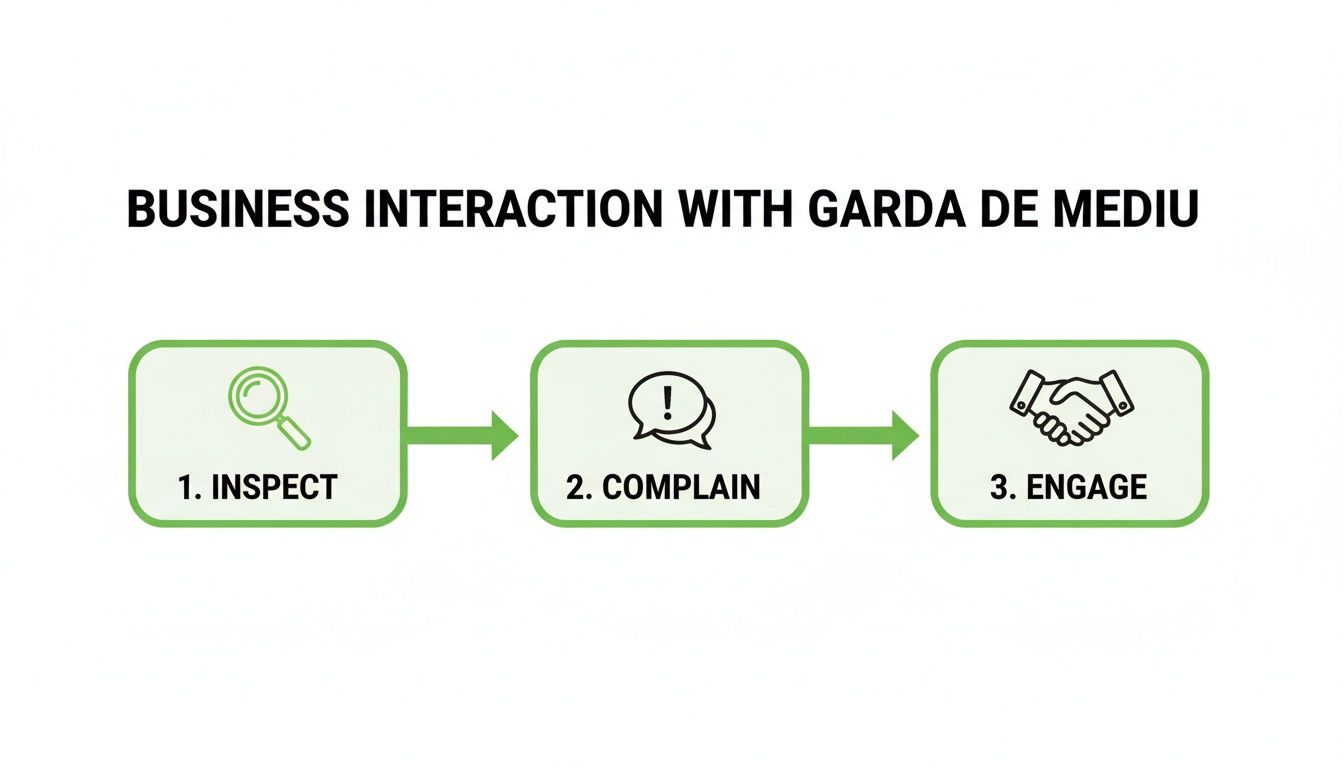
As the diagram shows, a formal complaint isn't just a suggestion; it's a structured, necessary step that connects your initial observation with an official resolution.
Choosing the Right Way to Submit
How you send your complaint matters. For creating an official paper trail, one method is superior.
- Online Portal or Email (cjconstanta@gnm.ro): This is the method we strongly recommend. Submitting via email creates a timestamped, official record. You’ll get a registration number, which is absolutely vital for tracking your case. For any business, this is the only truly professional approach.
- In-Person Submission: This option is best for complex cases with large amounts of physical evidence. If you must go in person, do not leave without a signed and stamped copy of your submission that includes a registration number.
A critical tip from our team: Always get a registration number (număr de înregistrare). Without it, your complaint doesn't officially exist in their system. You have no way to follow up and no proof of submission.
Once your complaint is filed correctly, the agency has a legal obligation to respond, usually within 30 days. If your evidence is solid, it can trigger an on-site inspection, which may lead to anything from an official warning to serious fines for the offender.
By following these steps, you’re not just complaining—you’re ensuring your concerns are taken seriously and are contributing to a healthier, more compliant local environment.
Preparing for Environmental Inspections and Audits
An inspection from the Garda de Mediu Constanța shouldn’t be a source of anxiety. It's a routine check-up. Being ready is about having solid systems that prove your commitment to compliance every day.
Inspections are typically either scheduled compliance checks or incident-driven investigations triggered by a complaint (sesizare). In both cases, the goal is the same: to see documented proof that you are operating within the law.
Essential Documentation for a Smooth Audit
Having your documents in order is the single most important step. When an inspector arrives, the ability to quickly produce clear, organized records demonstrates professionalism and control. Your audit-ready folder, whether physical or digital, must always be current.
Here’s a checklist of the core documents the Garda de Mediu Constanța will almost certainly ask for:
- Environmental Authorisation (Autorizație de Mediu): The foundational document proving your right to operate. It must be current and accurately reflect all your activities.
- Waste Management Records: Detailed logs of all waste streams, including quantities, types, and proof of legal disposal with authorised collectors. This is a common weak spot for many businesses.
- Emissions and Discharges Data: Records from monitoring air emissions or wastewater discharges. The data must align with the limits specified in your permit.
- Chemical and Hazardous Substance Registers: A complete inventory of all chemicals used, their storage locations, and their Safety Data Sheets (SDS).
A well-organized file doesn't just speed up the process; it builds trust. It shows the inspector that environmental management is integrated into your daily operations.

Understanding Inspector Priorities
Inspectors also focus on how your operational reality matches what’s on paper. They almost always check waste handling protocols, emission sources, and chemical storage safety.
The local environmental context provides clues about priorities. The Garda de Mediu Constanța is heavily involved in monitoring air pollution. For businesses in Constanța—a city with significant industrial and port activities—air quality is a major focus.
Recent data shows that while some pollutants like PM2.5 have decreased, challenges with other particulate matter and nitrogen dioxide persist. This local data is invaluable for passing inspections and for companies reporting under CSRD/ESRS, helping focus decarbonisation efforts where they matter most.
Building a robust internal system for environmental compliance is a long-term investment in your company’s resilience. For a deeper dive, you can learn more about conducting a thorough environmental audit in our detailed article. This preparation ensures that any visit from the Garda de Mediu is simply a confirmation of the good work you are already doing.
Meeting Waste Management and Circular Economy Goals
As the key economic engine on the Black Sea coast, Constanța plays a massive role in Romania's push towards a circular economy. For any local business, this means the Garda de Mediu Constanța isn’t just a regulator; it's the main enforcer ensuring you meet your waste management obligations.
For companies in retail, manufacturing, or logistics, compliance today goes beyond dodging fines. It's about proving your supply chain is sustainable, a core metric for ESG frameworks like EcoVadis. The real goal isn't perfect paperwork—it's genuine, measurable operational progress.
What Inspectors in Constanța Are Actually Looking For
The Garda de Mediu's actions are driven by Romania's National Waste Management Plan (NWMP), which translates to non-negotiable obligations for your business.
When an inspector arrives, they're looking for one thing: hard evidence. They need to see clear, documented proof that you are meeting your duties for waste sorting, hitting recycling targets, and using legal disposal channels.
For businesses in Constanța, the main focus is on three key areas:
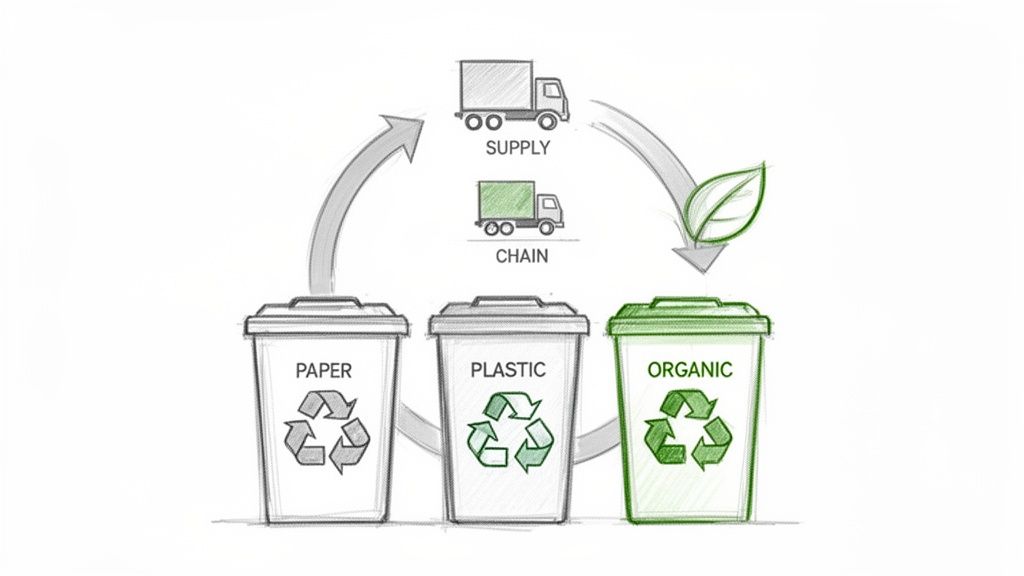
- Selective Collection: You need a working system to separate waste correctly at the source—paper, plastic, glass, and metal. It has to be visible and consistently used.
- Recycling Targets: Producers and importers must meet specific quotas for different materials. You need the numbers to back it up.
- Traceability: A clean paper trail is essential. You must be able to show where all your waste went and prove it was handed over to an authorized collector.
If you need a deeper dive into documentation, our guide on how to properly maintain waste management records breaks down the entire process.
A common mistake we see is companies treating waste management as a low-priority admin task. The Garda de Mediu Constanța, however, sees it as a primary indicator of your company's entire environmental commitment.
How to Turn Compliance into a Competitive Edge
Getting waste management right is an opportunity for operational efficiency and a competitive advantage.
Take Constanța itself. The city has become a recycling leader in Romania. A recent survey showed that 71% of people in the region have a high sense of consumer responsibility. For any company plugged into the EU supply chain, this local leadership provides a powerful story for your own ESG disclosures. You can see the data and learn how Constanța is excelling in recycling efforts.
How do you turn this into action? Start with your own collection systems. Exploring options like used wheelie bins is a practical way to reduce both your environmental footprint and your costs. It's a small step that supports a circular model.
By aligning your waste practices with local enforcement priorities and EU circular economy demands, you're building a more resilient, efficient, and reputable business.
Navigating Compliance in Constanta's Energy Hub
Constanța is fast becoming a major energy hub, a shift that brings growth but also more scrutiny. For any business operating here, the Garda de Mediu Constanța is now a key player, enforcing some of Europe's toughest environmental rules.
The real question is, how do you manage this rising compliance pressure while staying competitive? This goes beyond avoiding fines. It’s about making your operations resilient and aligning them with the EU directives that shape the market.
Connecting On-the-Ground Action with High-Level Reporting
It’s crucial to understand that what happens on the ground is directly tied to high-level European reporting. A local inspector's audit is connected to bigger mandates like the EU's 'Fit for 55' package. This means your operational data must be solid enough for both a local inspection and a complex sustainability report.
Frameworks like the Corporate Sustainability Reporting Directive (CSRD) and the International Financial Reporting Standards (IFRS S1/S2) now require transparent, verifiable data on your environmental footprint. Taking a proactive stance—whether building a decarbonisation strategy or running a double materiality assessment—is becoming essential for securing green financing and keeping market access.
We see a clear pattern with our clients: companies that integrate Greenhouse Gas (GHG) emissions monitoring, following the GHG Protocol, into their day-to-day operations are far better prepared for both surprise inspections and annual reporting. The goal is operational progress, not just a perfect report.
In Constanța’s energy sector, for instance, some firms use advanced methods like drone power line inspection. This isn't just for efficiency; it provides valuable environmental data that serves both internal management and external disclosure needs.
Building In-House Skills for Autonomous Management
The only sustainable way to handle these demands is to build capability within your own company. Your teams need the right skills and tools to manage compliance autonomously, turning a regulatory burden into a driver of operational excellence. This is how you make sustainability work scalable and affordable.
We believe in combining project delivery with training, so your teams don't just get a report—they get the knowledge to become autonomous. When your people understand everything from local enforcement priorities to the nuts and bolts of GHG data collection, compliance stops being a cost center and starts becoming a strategic advantage.
The oversight from Garda de Mediu Constanța is especially important as the region grows into Romania's main energy hub. All this new infrastructure requires serious GHG monitoring. While Romania hit a 58% cut in GHG emissions by 2022 and met its 'Fit for 55' target, Constanța has unique pressures from port operations and energy projects.
With air quality still a challenge due to urban particulate matter and nitrogen dioxide, the agency's role in enforcing EU rules is vital for healthy growth. For any leader in finance or energy, this local reality is critical information for your double materiality assessments and for creating a credible decarbonisation roadmap. You can find more details on Romania's environmental performance on eea.europa.eu.
Ultimately, getting ahead of environmental management strengthens your company’s credibility, makes you more resilient to future shocks, and sets you up for long-term success.
Frequently Asked Questions
When it comes to the Garda de Mediu Constanța, businesses often run into the same practical questions. Here are some direct answers based on our experience, designed to help you handle your environmental obligations with more confidence.
What Triggers an Unannounced Inspection?
An unannounced inspection from the Garda de Mediu isn't necessarily a sign of a major problem, but it’s almost never random. These visits are a standard tool, and they are usually triggered by a specific event.
Most often, an inspector will show up without notice because of one of these reasons:
- A Citizen Complaint (Sesizare): This is the single most common cause. A detailed complaint from a local resident or an NGO about things like strange smells or visible pollution legally forces the agency to investigate.
- A Reported Environmental Incident: Any accident—a chemical spill, a fire, or a sudden release of pollutants—will trigger an immediate inspection to assess the damage and monitor the cleanup.
- Following Up on a Previous Issue: If an inspector found a minor problem during a scheduled audit and asked you to fix it, they might return unannounced to confirm the corrective action was actually taken.
The key thing to remember is that these visits are targeted. They are there to check a specific claim or risk. That’s why having your core documents—environmental permits, waste management records—organized and ready to go at a moment's notice is so critical.
How Long Does It Take to Get an Environmental Authorisation?
Getting your environmental authorisation (autorizație de mediu) is a vital step, but the timeline can feel unpredictable. The official legal deadline for a response is 30 days, but in reality, the entire process usually takes between 30 and 90 days. This clock starts the moment you submit a file that is 100% complete and correct.
So, what causes the delays? It almost always comes down to the complexity of your business. A small coffee shop has a much simpler file than a large factory with multiple emission points.
In our experience helping companies with their applications, the most common reason for delays is an incomplete file. Missing paperwork, using the wrong forms, or providing weak technical data will always result in the agency asking for more information. That request resets the clock and pushes your approval date further out.
Your best strategy is meticulous preparation. Double-check that every required document is present and filled out correctly before you submit anything.
What Are the Most Common Fines for Businesses?
Fines from the Garda de Mediu Constanța can be steep, and they’re typically issued for violations of fundamental compliance rules. While any breach of your permit can attract a penalty, inspectors tend to zero in on a few critical areas.
For businesses in the Constanța region, the most common violations that lead to fines are:
- Improper Waste Management: This is always a top priority. Fines are frequently handed out for incorrect waste sorting, mixing different waste streams, or failing to show contracts and records proving you use an authorised collector for disposal.
- Exceeding Emission Limits: For any industrial operator, going over the permitted limits for air or water pollution is a serious offense that brings significant financial penalties.
- Operating Without a Valid Permit: This is one of the most severe violations. Running your business without a current environmental authorisation—or performing activities not covered by your permit—will result in heavy fines.
Being proactive with your compliance is always cheaper than paying penalties. The best defence is to conduct regular self-audits and keep your records impeccably organised.
At ECONOS 🌱, we provide end-to-end support for companies navigating the complexities of environmental compliance and ESG reporting. From securing permits to developing audit-ready decarbonisation strategies, our team combines delivery with training to help you build autonomous, resilient operations. Learn how we can support your business.