
.png)

For any business in Cluj, an interaction with the Garda de Mediu Cluj is a predictable part of the operational landscape. Real progress comes from execution and preparation, not last-minute panic.
We see a consistent pattern across our clients and in discussions with auditors: companies often treat environmental compliance as a reactive task, driven by fear of fines. They struggle with disorganized documentation, inconsistent internal procedures, and a lack of clear ownership, which creates unnecessary risk during inspections. The shift toward proactive, systematic management is where the real value lies.
Here are our key takeaways for turning this challenge into a business advantage:
- Build a State of "Always Audit-Ready." Your goal isn't just to pass an inspection; it's to maintain a system where an unannounced visit from the Garda de Mediu is a routine event, not a crisis. This means having a centralized compliance folder (digital or physical) with up-to-date permits, waste records, and monitoring data that is instantly accessible. It’s a matter of operational discipline.
- Establish a Single Point of Contact (PoC). During an inspection, multiple team members trying to "help" often leads to conflicting information and mistakes. Designate one well-trained person to manage the entire process—from greeting the inspectors to reviewing the final report. This ensures clarity, control, and professional communication.
- Use the 15-Day Appeal Window Strategically. Receiving a fine (proces-verbal) is not the end. It's the start of a critical 15-day window to file a legal challenge (plângere contravențională). Don't just pay the fine. Use this time to engage a legal expert, gather counter-evidence, and analyze the inspector’s findings for procedural errors. A well-documented appeal can significantly reduce or nullify penalties.
What does this mean for your business? The key decision is to shift from seeing compliance as a cost center to viewing it as a component of operational excellence. How can you ensure your environmental data is accurate and ready for any audit? This requires clear ownership, a realistic timeline for internal checks, and the right tools to manage documentation.
Ultimately, proactive compliance builds trust with regulators and strengthens your business's resilience.
Understanding Your Relationship with Garda de Mediu Cluj
Many companies view the Environmental Guard (Garda de Mediu) as an enforcement body that exists only to issue fines. This narrow perspective limits your ability to manage environmental risk effectively. A better strategy is to view the Guard as a key stakeholder—one with clear and established rules of engagement.
Building a transparent, informed relationship with the Garda de Mediu Cluj can dramatically reduce operational headaches. It helps you anticipate requirements, maintain compliance with confidence, and resolve potential issues before they escalate. This foundation of knowledge is essential for long-term business resilience and demonstrates a commitment to operational progress, not just perfect reporting.
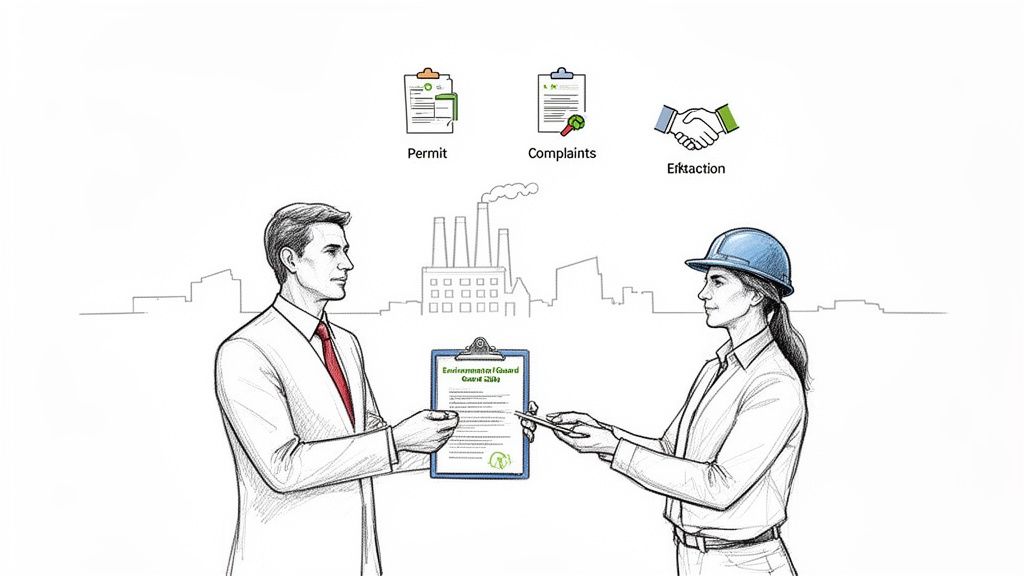
Core Functions and Responsibilities
The mandate of the Garda de Mediu Cluj extends beyond inspections. Its primary responsibilities directly shape how local companies must operate.
Their key functions include:
- Scheduled and Unannounced Inspections: Verifying that your company operates within the conditions set out in your environmental authorisation (autorizație de mediu).
- Investigating Public Complaints: Responding to notifications (sesizări) from citizens, NGOs, or other businesses about potential environmental issues.
- Enforcing Sanctions: Applying corrective measures, issuing warnings, or levying fines when violations are identified.
- Monitoring Environmental Impact: Tracking the overall environmental health of Cluj county, from air and water quality to waste management practices.
This wide scope means every operational choice—from waste disposal to production changes—carries a compliance dimension. To help navigate these interactions, the following table outlines the official channels for common procedures.
Garda de Mediu Cluj Key Contact and Service Channels
| Service/Interaction Type | Official Channel/Method | Key Details |
|---|---|---|
| Submitting a Complaint (Sesizare) | Email: cj@gnm.ro or Fax: 0264.410.601 | Clearly state the issue, location, and your contact details. This is for public complaints. |
| Requesting an Inspection | Official Written Request (Adresă Oficială) | Submit a formal, signed, and registered letter to the institution. |
| Obtaining/Updating an Authorisation | Agency for Environmental Protection (APM Cluj) | The Guard inspects compliance; APM Cluj issues the actual authorisation. Start with APM. |
| Contesting a Sanction (Proces-Verbal) | Legal Challenge in Court | You have 15 days from the date you receive the fine to file a legal challenge (plângere contravențională). |
| General Inquiries | Phone: 0264.410.600 or Email: cj@gnm.ro | Best for procedural questions, not for submitting formal requests or complaints. |
This table serves as a starting point. Always confirm specific requirements for complex issues, as procedures can be updated.
Why Proactive Engagement Matters More Than Ever
The environmental context in Cluj is intensifying. Public awareness and regulatory scrutiny are high, especially with concerns over air quality tied to urbanization. This puts more pressure on businesses to demonstrate strong environmental stewardship.
A proactive compliance posture is a critical element of risk management and competitiveness. Waiting for an inspection to reveal a problem is a strategy that is guaranteed to fail.
The goal is to shift the company mindset to a state of constant audit-readiness. This is a core principle our team at ECONOS instills in clients. We combine delivery with training so teams become autonomous, capable of managing these risks on their own.
For businesses operating across Romania, understanding local authority nuances is vital. If you have operations in the capital, you may find our guide on interacting with the Garda de Mediu in Bucharest helpful.
Ultimately, building a constructive relationship with the Garda de Mediu Cluj is about taking control. It empowers your business to operate with certainty, manage risks effectively, and build trust.
Cum Depui o Sesizare sau o Solicitare Oficială Eficientă
Când vrei să trimiți o notificare formală (sesizare) sau o cerere către Garda de Mediu Cluj, precizia este totul. Ca să fii sigur că demersul tău primește atenția cuvenită, trebuie să-l structurezi corect de la bun început. Un dosar bine documentat nu e doar o dovadă de spirit civic; este, în esență, un instrument de management al riscului.
Fie că ești un cetățean îngrijorat de o problemă locală sau o companie care raportează un incident de mediu, principiile rămân aceleași. Afirmațiile vagi sunt ușor de ignorat, dar o sesizare bazată pe fapte clare și verificabile impune un răspuns. Scopul tău este să le faci inspectorilor munca mai ușoară, ajutându-i să înțeleagă situația și să acționeze rapid.
Cum Transformi o Plângere într-un Dosar de Caz
Eficiența demersului tău depinde în totalitate de calitatea informațiilor pe care le oferi. Diferența dintre o plângere care produce rezultate și una care se pierde în sistem stă, de cele mai multe ori, în detalii și dovezi. Există, desigur, o distincție majoră între a reclama o depozitare ilegală de deșeuri și a solicita o autorizație de mediu, fiecare necesitând o abordare specifică.
O sesizare este reactivă; alertează autoritățile despre o problemă care s-a întâmplat deja. O solicitare oficială, cum ar fi o inspecție sau o clarificare legislativă, este proactivă; încearcă să prevină problemele sau să lămurească anumite obligații. În ambele cazuri, te va ajuta enorm să înțelegi principiile din spatele drafting effective formal requests. Aceste cunoștințe asigură că solicitarea ta este luată în serios din prima clipă.
Elementele Esențiale ale unei Sesizări Corecte
Ca să construiești un caz solid, documentul tău trebuie să includă câteva elemente cheie. Gândește-te că pregătești un dosar pentru cineva care nu are nicio informație prealabilă despre situație. Scopul tău este să oferi o imagine completă și de sine stătătoare.
Iată detaliile absolut necesare pe care trebuie să le incluzi:
- Locația exactă: Descrierile vagi, precum „lângă parcul industrial”, nu sunt de ajuns. Folosește o adresă stradală completă, coordonate GPS sau repere clare pentru a indica precis locul problemei.
- Descrierea detaliată a faptei: Ce anume ai observat? Descrie tipul de deșeuri, culoarea fumului, mirosul sau activitatea specifică pe care o consideri ilegală. Cu cât ești mai specific, cu atât mai bine.
- Data și ora: Notează exact când ai observat incidentul. Dacă este o problemă continuă, oferă un istoric al evenimentelor.
- Dovezi (fotografii, video): Acesta este punctul critic. Fotografiile și clipurile video sunt cele mai puternice dovezi. Asigură-te că fișierele media sunt clare, bine luminate și, dacă e posibil, au data și ora înregistrate automat (timestamp).
- Datele tale de contact: Conform legii (OG 27/2002), sesizările anonime nu sunt luate în considerare. Trebuie să furnizezi numele și datele tale de contact, dar poți sta liniștit: aceste informații sunt confidențiale și nu vor fi divulgate părții reclamate.
Punând cap la cap aceste elemente, transformi o simplă plângere într-un dosar convingător pe care autoritățile sunt obligate să-l investigheze temeinic. Pentru companii, gestionarea acestor sesizări și a altor date de mediu devine tot mai importantă. Pentru mai multe detalii pe acest subiect, te-ar putea interesa ghidul nostru despre autentificarea pe platforma de raportare ANPM, care atinge principii similare de management al datelor.
Scenariu real: Imaginează-ți că o firmă de producție descoperă un depozit ilegal de deșeuri pe o proprietate vecină. În loc să dea un telefon scurt, managerul fabricii pregătește o sesizare formală. Aceasta include coordonatele GPS ale depozitului, fotografii de înaltă rezoluție cu butoaiele de deșeuri (cu etichete vizibile), un jurnal al datelor în care au fost observate noi depozitări și o scrisoare oficială cu antetul companiei. Această plângere structurată și susținută de dovezi duce la o investigație rapidă din partea Gărzii de Mediu Cluj, protejând compania de o potențială răspundere și rezolvând un pericol de mediu local.
Navigating a Garda de Mediu Inspection with Confidence
An unannounced visit from the Garda de Mediu Cluj can be stressful, but it doesn't have to be a crisis. With the right preparation, an inspection becomes a routine check that proves your company’s commitment to environmental rules.
The key is to have a clear plan for what to do before, during, and after a visit from inspectors. A structured approach helps you stay in control, minimizes risk, and demonstrates responsibility.
Before the Inspection: The Power of Preparation
The most important work happens long before an inspector arrives. Being "audit-ready" at all times is the bedrock of a solid compliance program.
At the heart of this readiness is your compliance folder. This could be a physical binder or a secure digital folder, but the key is that your main staff can find it immediately.
Your folder should contain, at a minimum:
- Environmental Authorisation (Autorizația de Mediu): The latest version, including any updates.
- Waste Management Records: Contracts with approved waste collectors, transport forms (formulare de transport), and annual waste generation reports.
- Emissions and Discharge Data: All monitoring reports for air, wastewater, or other regulated outputs.
- Chemical and Substance Inventories: Current records of all hazardous and non-hazardous materials used and stored.
- Previous Inspection Reports: Copies of past reports (note de constatare or procese-verbale) and proof that you fixed any issues they found.
Keeping these documents organized is your primary proof of compliance. A tidy folder signals professionalism and is a universal rule when handling regulatory auditors of any kind.
During the Inspection: A Guide to Professional Conduct
When inspectors from Garda de Mediu Cluj are on-site, your aim is to help them do their job efficiently and professionally. The best way to achieve this is to remain calm and organized.
First, designate a single point of contact (PoC) to stay with the inspectors throughout their visit. This person must know your environmental procedures, where to find documents, and how to remain calm under pressure. This avoids having multiple employees give conflicting answers.
Your designated PoC should:
- Cooperate, Don't Obstruct: Give them direct access to the documents and areas they request to see.
- Answer Directly and Honestly: Answer only the questions asked. Don't volunteer extra information or speculate.
- Take Your Own Notes: Document every question, every area they inspect, and every document they review. Take your own photos if it helps. These notes are critical if you later need to challenge their findings.
A common mistake we see is when multiple team members try to "help" during an inspection, often leading to confusion and contradictory statements. A single, well-prepared PoC is always the best strategy for maintaining control and clarity.
The logic of being structured and evidence-based also applies to filing complaints, not just managing inspections. The process follows a similar three-stage flow of documenting, submitting, and following up.
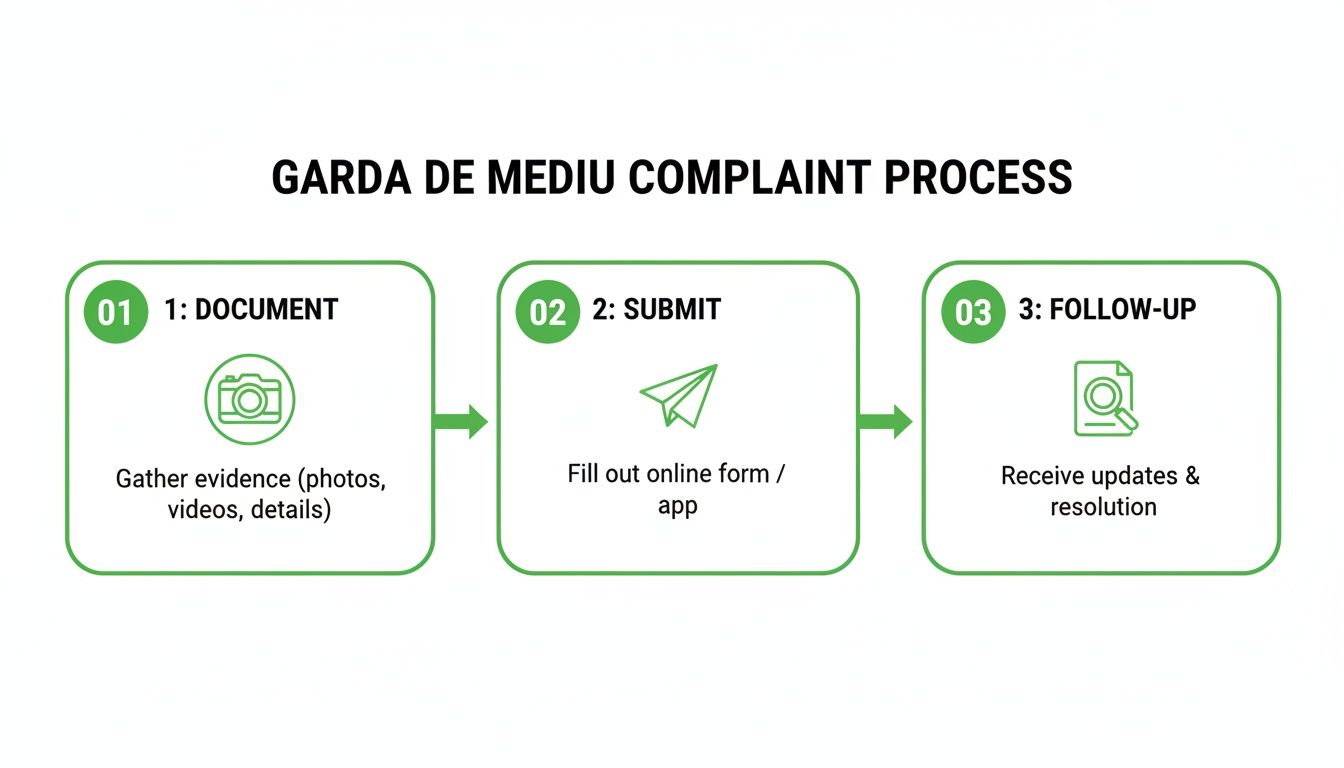
This visual shows why a clear, documented approach is so important, whether you are making a complaint or responding to an inspection.
After the Inspection: From Report to Action
The inspection isn't over until the inspectors write their report—either a notă de constatare (finding note) or a proces-verbal de constatare a contravenției (report of contravention). Do not sign anything until you have read it carefully and understand everything. You have the right to add your own objections or comments directly to the report before you sign.
Once you have the report, your work begins.
- Analyse the Findings: Review the report with your environmental team (and a lawyer, if necessary). Understand exactly what violations were found and what corrective actions are required.
- Create an Action Plan: For every required action, assign it to a specific person, set a hard deadline, and document the steps needed to achieve compliance. This plan is your internal roadmap.
- Communicate with the Authority: If any required actions are unclear or the deadline is unfeasible, formally notify the Garda de Mediu Cluj in writing.
A well-managed inspection is a direct reflection of your company's responsibility. For a deeper look into preparing your systems, it's worth reading our guide on what a comprehensive environmental audit entails.
Responding to Sanctions and Navigating the Appeals Process
Receiving a formal sanction from the Garda de Mediu Cluj is a critical decision point. The document you receive—the proces-verbal de constatare a contravenției—outlines the alleged violation and the proposed penalty.
This document is not a final verdict. How you react in the next few days will directly shape the financial and operational fallout for your business. Simply paying the fine is rarely the most cost-effective move.
Understanding the Types of Sanctions
Penalties from Garda de Mediu Cluj range from simple warnings to measures that can halt your operations. You need to know what you’re facing.
These are the most common penalties:
- Avertisment (Warning): For minor, first-time issues with no significant environmental damage. It’s a formal notice to fix the problem without a financial penalty.
- Amendă Contravențională (Fine): The most common sanction. Fines can vary from small amounts to business-critical sums, depending on the violation.
- Măsuri Suplimentare (Additional Measures): Inspectors can order specific actions with tight deadlines, such as stopping an activity, installing new equipment, or commissioning an environmental audit.
- Suspendarea Activității (Suspension of Activity): The most severe penalty. For serious or repeated violations, the Guard can temporarily halt all or part of your operations.
Each of these demands a different response. A warning requires a quick fix and documentation, while a large fine or suspension order requires an immediate legal and operational strategy.
Your Right to Appeal and the Critical 15-Day Window
Romanian law provides a clear path to challenge a sanction you believe is unfair, excessive, or based on error. This is your right to file an appeal, known as a plângere contravențională.
The single most critical factor is time. You have exactly 15 days from the moment the proces-verbal is handed to you to file your appeal with the local court (judecătorie). If you miss this deadline, you automatically accept the sanction, and your right to challenge it is gone forever.
This 15-day window is absolute. There are no extensions. As soon as that sanction notice arrives, the clock starts ticking.
Building a Robust Case for Your Appeal
Winning an appeal against the Garda de Mediu Cluj is about using evidence and procedure to build your case. A strong appeal dismantles the inspector's findings with your own documented proof of compliance.
Here’s what to do, quickly:
- Engage a Lawyer, Immediately: The first call should be to a lawyer specializing in environmental law and administrative disputes. They can spot procedural errors in the proces-verbal that could invalidate it and help frame a powerful legal argument.
- Gather Your Counter-Evidence: Revisit the notes taken during the inspection. Collect all relevant documents—waste manifests, monitoring logs, equipment maintenance records, photos—anything that contradicts the inspector's report. If the fine was for exceeding an emissions limit, do you have calibration records showing your monitoring equipment was working correctly?
- Document Everything: Your appeal must be built on facts. The most successful challenges often prove that compliance systems were in place and functioning correctly at the time of the alleged violation.
For example: A Cluj manufacturing plant was fined for improper waste segregation. The company appealed. They submitted internal waste audit logs, training records for the responsible staff, and time-stamped photos from the day before the inspection showing all bins were correctly labelled. This evidence proved the inspector’s observation was an isolated mistake, not a systemic failure, leading to a significant reduction in the penalty.
This shows how a proactive, evidence-based approach can transform a costly sanction into a manageable issue.
Building a Proactive Environmental Compliance Program
The smartest businesses in Cluj are building compliance into their core strategy, moving beyond a defensive, penalty-avoidance mindset. This is where a real competitive edge is found. It's an evolution from basic compliance to strategic environmental management.
This proactive approach connects local regulatory duties with broader Environmental, Social, and Governance (ESG) goals. For companies in Cluj, this is especially relevant as the city pushes to achieve climate neutrality by 2030, creating a business climate where strong environmental performance is expected.
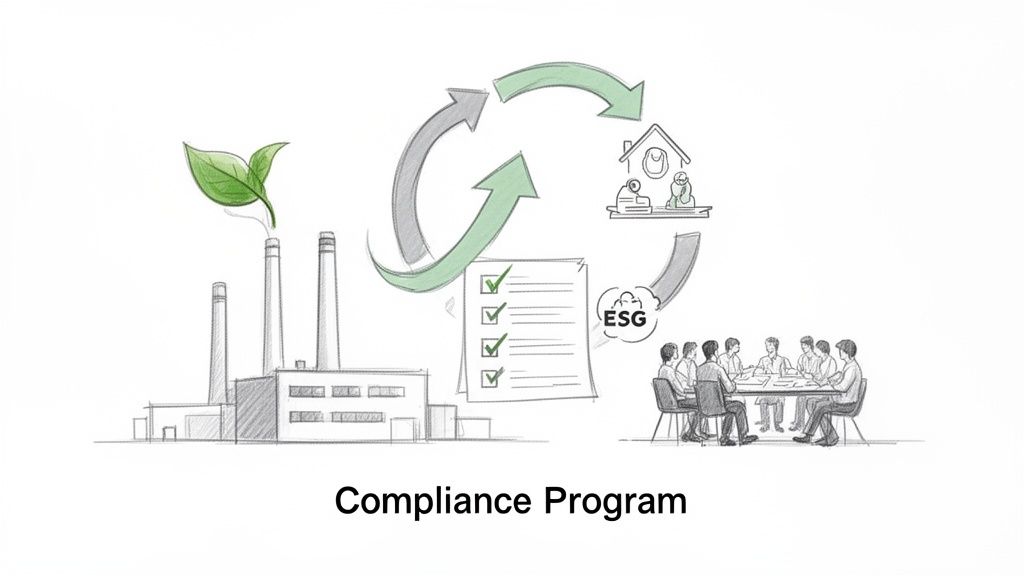
From Reactive Fixes to Proactive Strategy
For too long, environmental compliance has been seen as a cost center. A proactive program reframes this view as an investment in a company's resilience, reputation, and long-term profitability.
How does a business in Cluj make this shift? It starts by embedding environmental thinking into daily operations.
You stop asking, "What must we do to pass an inspection?" and start asking, "How can our environmental performance create business value?"
A proactive program stands on three pillars:
- Systematic Internal Audits: Regularly checking your own compliance before the Garda de Mediu Cluj does.
- Intelligent System Design: Building efficient processes for waste, energy, and water aligned with circular economy principles.
- Continuous Team Empowerment: Training staff not just on the rules, but on why they matter and how their role contributes.
This system doesn't just manage risk—it unlocks opportunities.
The Business Case for Going Beyond Compliance
A solid environmental program delivers benefits that impact your bottom line and market position.
Companies we work with see tangible returns in critical areas.
Supply Chain Resilience and Market Access
Major European clients must report on their supply chain's sustainability under the Corporate Sustainability Reporting Directive (CSRD). A proactive environmental program makes your business a low-risk partner, ready for the detailed questionnaires and audits that are becoming standard practice.
Access to Green Financing
Banks and investors are channeling more capital toward businesses with strong ESG credentials. Demonstrable environmental performance, backed by clear data, can open the door to loans with more favorable terms.
Operational Efficiency and Cost Reduction
A well-designed program naturally finds and eliminates waste. Tracking energy, water, and material flows to ensure compliance also uncovers opportunities to reduce consumption and cut operational costs.
We see this consistently with our clients. The initial goal might be compliance, but the outcome is a leaner, more efficient operation. The data you collect for the authorities is the same data you can use to make smarter business decisions.
Implementing Your Proactive Compliance Programme
Building this kind of program can start with small, consistent actions. At ECONOS, we focus on a practical, execution-first approach that empowers your own teams.
A great place to start is with a gap analysis. Compare your current operations against the requirements in your environmental authorisation. This simple exercise almost always reveals immediate, low-cost improvements. From there, you can build a roadmap.
Your roadmap could include:
- Designating a Compliance Owner: Assign clear responsibility for environmental performance to one person or a small team.
- Developing an Internal Audit Schedule: Plan quarterly or semi-annual self-inspections to catch issues early.
- Implementing Staff Training: Hold practical training sessions on specific topics like correct waste sorting or spill response.
The ultimate goal is to build internal capability. We combine project delivery with training so that your teams gradually become self-sufficient, able to manage compliance and drive continuous improvement on their own. This creates a scalable and affordable system that transforms your relationship with the Garda de Mediu Cluj from a source of stress into a simple validation of the good work you're already doing.
Garda de Mediu Cluj: Your Top Questions, Answered
When it comes to environmental rules, we see the same questions pop up again and again from businesses in Cluj. To clear up the confusion, here are straight answers to the most common queries we get about dealing with the Garda de Mediu Cluj.
What Is the Difference Between Garda de Mediu and APM Cluj?
This is a classic point of confusion, but the difference is actually quite simple. Think of it this way: one agency writes the rules, and the other one enforces them.
APM Cluj (Agenția pentru Protecția Mediului) is the permitting authority. You go to them to get your autorizație de mediu (environmental authorisation). They are the ones who set the specific conditions and limits your business must follow.
The Garda de Mediu Cluj, on the other hand, is the enforcement body. Their inspectors are the ones who show up at your gate to check if you're actually respecting the rules laid out in your APM permit and the law. They investigate complaints (sesizări), conduct inspections, and apply fines if they find something wrong.
In short, APM gives you the rulebook for your operations. Garda de Mediu is the referee making sure you play by it.
Can I Make an Anonymous Complaint to Garda de Mediu Cluj?
No, you can't. Romanian law (specifically OG 27/2002) is very clear that all formal complaints must include the identification details of the person making the report. This is a measure to prevent abuse of the system and hold everyone accountable.
But here’s the crucial part: your identity is protected. The authorities are legally required to keep your personal data confidential. Your name and details will not be shared with the company or person you are reporting. So while it's not technically anonymous, the process is fully confidential.
What Are the Most Common Reasons for Fines in Cluj County?
From our team's experience advising clients and analysing enforcement data, we've seen that most sanctions from Garda de Mediu Cluj fall into just a few predictable categories. If you get these basics right, you dramatically reduce your risk.
Here are the most frequent triggers for fines:
- Improper Waste Management: This is the big one. It covers everything from incorrect waste sorting and sloppy record-keeping to working with unauthorised collectors or, worse, illegal dumping.
- Operating Without a Valid Environmental Authorisation: This is a major red flag for inspectors. Running a business that needs a permit without having one is a serious offence that almost always leads to a hefty fine.
- Exceeding Pollution Limits: If your permit sets limits for emissions into the air, water, or soil, and your operations go over them, you can expect a sanction.
- Ignoring Previous Instructions: If an inspector found problems during a previous visit and gave you a deadline to fix them, you'd better get it done. A follow-up inspection that finds the same issues is a guaranteed penalty.
From our perspective, the vast majority of fines are preventable. They rarely stem from complex technical breakdowns but rather from a failure in basic compliance procedures, especially around paperwork and waste handling.
How Long Does Garda de Mediu Take to Respond to a Complaint?
The official legal deadline for any public authority in Romania to answer a formal request or complaint is 30 days.
If the situation is unusually complex and requires a more in-depth investigation, they can extend this period to 45 days. If they do extend the deadline, they are obligated to let you know.
Of course, the time it takes for an inspector to physically visit the site and for the issue to be fully resolved will vary. It all depends on the specifics of the case, how urgent the problem is, and the Guard's current workload.
At ECONOS 🌱, we help businesses move beyond reactive compliance. Our services in carbon footprinting, ESG reporting, and regulatory strategy are designed to build your internal capabilities, turning environmental management from a burden into a competitive advantage. Learn how we can support your journey toward sustainable growth at https://www.econos-esg.com.