
.png)

For any company in Romania’s capital, an unexpected visit from the Garda de Mediu București is a real possibility. We see many businesses treat this as a compliance headache, but in reality, it's a test of operational readiness. A well-managed inspection is not just about avoiding fines; it's a demonstration of control.
Our team has observed a clear pattern in recent audits across Bucharest. Companies struggle less with the big, obvious environmental risks and more with the small, everyday details: messy waste sorting, incomplete paperwork, and gaps in monitoring logs. The challenge isn't a lack of intent, but a gap between policy and execution. What does it take to close this gap and turn compliance into a predictable, low-stress process?
Here are three key takeaways for managing interactions with the Garda de Mediu București:
Treat Your Permit as a Live Document. Your environmental authorisation isn't a "file and forget" paper. It's an operational manual. We often find permits that don't reflect current processes or new equipment, which is an immediate red flag for an inspector. A yearly internal review comparing the permit to your actual site operations is a non-negotiable risk management step.
Master Your Waste Chain of Custody. Inspectors start with waste for a reason—it’s visual and easy to verify. Beyond clearly labelled bins, the real test is your paperwork. You must have a complete, unbroken chain of handover documents (formular de transport) for every single waste stream. A missing form is a guaranteed non-compliance.
Appoint and Empower a Clear Owner. When an inspector arrives, who is in charge? A designated and trained environmental manager (Responsabil de Mediu) is critical. This person should have the authority and knowledge to lead the inspection, retrieve documents instantly, and answer questions confidently. Ambiguity here creates delays and signals disorganisation.
What this means for your business is a shift from reactive panic to proactive control. Ownership should be clear: assign a dedicated manager responsible for readiness. The timeline should be continuous, not just when a permit is about to expire. Budget for regular internal audits and team training—these are investments in operational continuity, not just compliance costs. Finally, centralise your documentation in a digital folder so proof is always one click away. We combine delivery with training so teams become autonomous.
Ultimately, preparing for the Garda de Mediu is about building robust operational habits. It transforms a source of risk into a mark of a well-run company.
What Is the Garda de Mediu Bucuresti?

Think of Romania's environmental framework as having two connected arms: one that writes the rules and another that enforces them. The Garda de Mediu București is firmly on the side of enforcement. It’s the local commissariat of the National Environmental Guard (Garda Națională de Mediu), responsible for inspecting all economic activities in Bucharest and Ilfov County.
The Environmental Protection Agency (Agenția pentru Protecția Mediului - APM) is the body that sets the rules by issuing permits. But it’s the Garda de Mediu that visits your site to check if you are actually following those rules.
The Role of an Environmental Inspector
At its core, the Garda de Mediu București works to prevent and penalise actions that harm the environment. This translates into on-site activities that can directly impact your business. Inspectors have the authority to:
- Conduct planned and unannounced inspections to verify compliance with your permit conditions.
- Investigate complaints from the public, NGOs, or other institutions about potential pollution.
- Collect samples of air, water, or soil to test for contaminants.
- Review your documentation, like waste management records, emissions monitoring reports, and chemical inventories.
This distinction is crucial. You apply to the APM for your permits—a process that relies on careful paperwork. But you must prepare your physical operations for a visit from a Garda de Mediu inspector at any time. If you want to dive deeper into the permit process, check out our guide on the environmental authorisation.
The core question every business in Bucharest should ask is: "If an inspector arrived at our site today, could we prove our compliance in real-time?"
Why This Matters for Your Business
The Garda de Mediu is not an abstract government body. Its actions carry direct operational and financial weight. A failed inspection can lead to heavy fines, mandatory corrective action plans, or, in severe cases, the suspension of your business activities.
Understanding its mandate is the first step toward building a resilient compliance strategy. In today’s business climate, local compliance isn’t just about ticking a legal box; it's the foundation of operational stability and a key part of your company's broader Environmental, Social, and Governance (ESG) performance.
How to Navigate Key Business Interactions
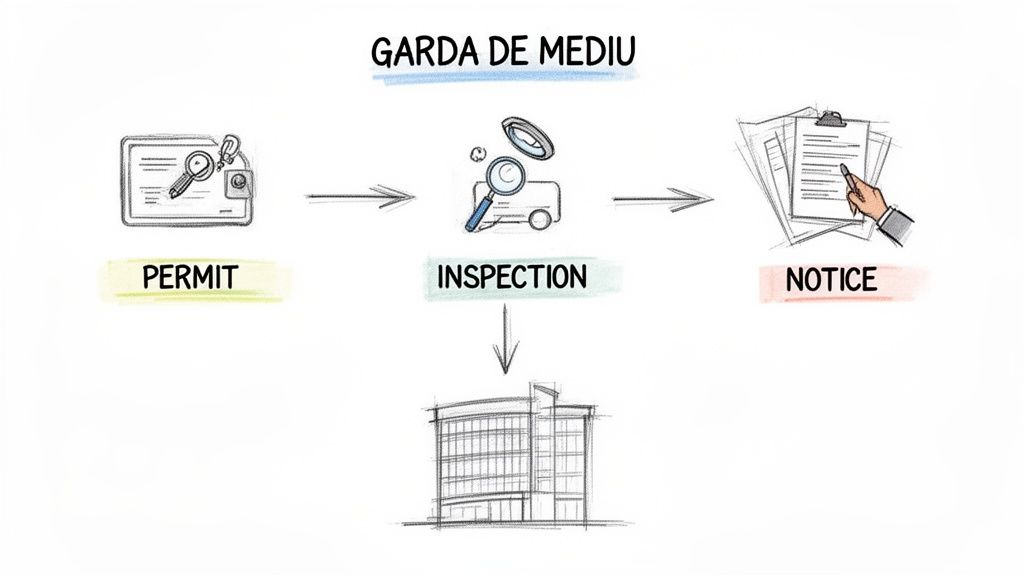
Dealing with the Garda de Mediu București can seem intimidating, but most interactions follow a standard playbook. Understanding this playbook builds confidence and reduces uncertainty.
Think of it this way: the Environmental Protection Agency (APM) grants you the environmental authorisation (autorizație de mediu), which is your rulebook. The Garda de Mediu’s job is to show up and check that you’re actually following those rules. Their most direct tool for this is the inspection.
Navigating these interactions, especially with regulatory bodies, can be complex. You can leverage conversation intelligence to help transform these dialogues into structured, actionable insights.
Here’s a breakdown of the most common interactions your business will have with the Garda de Mediu.
Common Interactions with the Garda de Mediu Bucuresti
Each of these has its own rules. Let's focus on the most critical one: the inspection.
What to Expect From an Environmental Inspection
An inspection is a formal audit of your company’s real-world compliance. A commissioner from the Garda de Mediu has the authority to enter your site and examine your operations, equipment, and records.
These visits don’t happen randomly. They’re usually triggered by one of three things:
- Routine Checks: These are scheduled audits, part of a wider plan to ensure businesses are on track.
- Incident Response: If there’s been an event—like a chemical spill—an inspection is almost sure to follow.
- Complaints: A report from an employee, a neighbour, or another public institution is a common reason for an inspector to show up.
No matter the trigger, the inspector's goal is the same: to confirm that your day-to-day activities match what’s written in your environmental permit and the law. They’ll look at everything from how you sort waste to the logbooks for your monitoring equipment.
Your Rights and Responsibilities During a Visit
When an inspector arrives, it’s a two-way street. Your team has responsibilities, but you also have rights. Being prepared is about managing the interaction professionally.
Your Responsibilities:
- Grant Access: You are legally required to allow the inspector onto the premises covered by your environmental authorisation.
- Provide Documents: Be ready to present all relevant paperwork, including your permit, waste management records, and monitoring data.
- Collaborate: Your designated environmental manager should be present to guide the inspector and answer questions honestly.
Your Rights:
- Verify Identity: You have the right to ask for the inspector’s official identification and the inspection order (ordin de deplasare) that authorises their visit.
- Receive a Report: At the end of the visit, you are entitled to a copy of the official findings report, known as the notă de constatare.
- Contest Findings: If you disagree with the report’s conclusions or any fines, you have a legal right to challenge them in court within a specific timeframe.
Preparing for Environmental Inspections and Sanctions
An unannounced visit from the Garda de Mediu București doesn't have to be a crisis. With the right preparation, an inspection becomes a manageable, routine process. The secret is having your house in order long before an inspector arrives.
Think of an inspection as a live audit of your day-to-day operations. Your team needs to be ready to show, not just tell, that you're compliant. Everything from how you greet the inspector to how quickly you can pull up a document sets the tone.
Managing the On-Site Inspection
When an inspector walks through your door, your designated environmental manager should immediately step in to lead the visit. This person must be ready to accompany the inspector, answer questions clearly, and retrieve any requested documents without delay.
Key documents you must have ready include:
- Your current environmental authorisation (autorizație de mediu).
- Complete records for waste management, including contracts and proof of handover.
- Logs from emissions and effluent monitoring, if required.
- Proof of how you manage chemical substances.
Keeping this organised in a single compliance binder or a dedicated digital folder shows a level of professionalism that makes the process smoother. For a deeper look at a thorough internal check-up, see the details of a full environmental audit.
Common Non-Compliance Issues and Potential Sanctions
In our work, we see inspectors in Bucharest focus on a handful of recurring problems. The most frequent triggers for sanctions are improper waste management, exceeding emission limits, and incomplete environmental paperwork.
Air quality, in particular, is a major focus for the Garda de Mediu București, as the city often struggles to meet EU limits. Regulations like the Corporate Sustainability Reporting Directive (CSRD) now require precise emissions reporting (Scopes 1-3), making your local compliance data a critical piece of your corporate sustainability strategy. For context, you can read the full UNECE report on Romania.
The consequences of an inspection range from recommendations to heavy fines—up to RON 100,000—or, in the worst-case scenario, a temporary suspension of your operations.
This range of outcomes makes it clear that compliance isn't just a legal task. It's fundamental to business continuity. A solid compliance framework doesn't just protect you from fines; it safeguards your ability to operate without disruption.
Your Practical Compliance Checklist
The best way to handle an inspection from the Garda de Mediu București is to be ready long before they arrive. When you stay on top of your compliance, a surprise visit becomes a routine review.
Think of this as a quick self-audit. Use it to walk through your operations, spot weak points, and fix them now—not when an inspector is standing in front of you.
Managing an inspection boils down to three stages: preparing your documents, handling the visit professionally, and acting on any feedback.
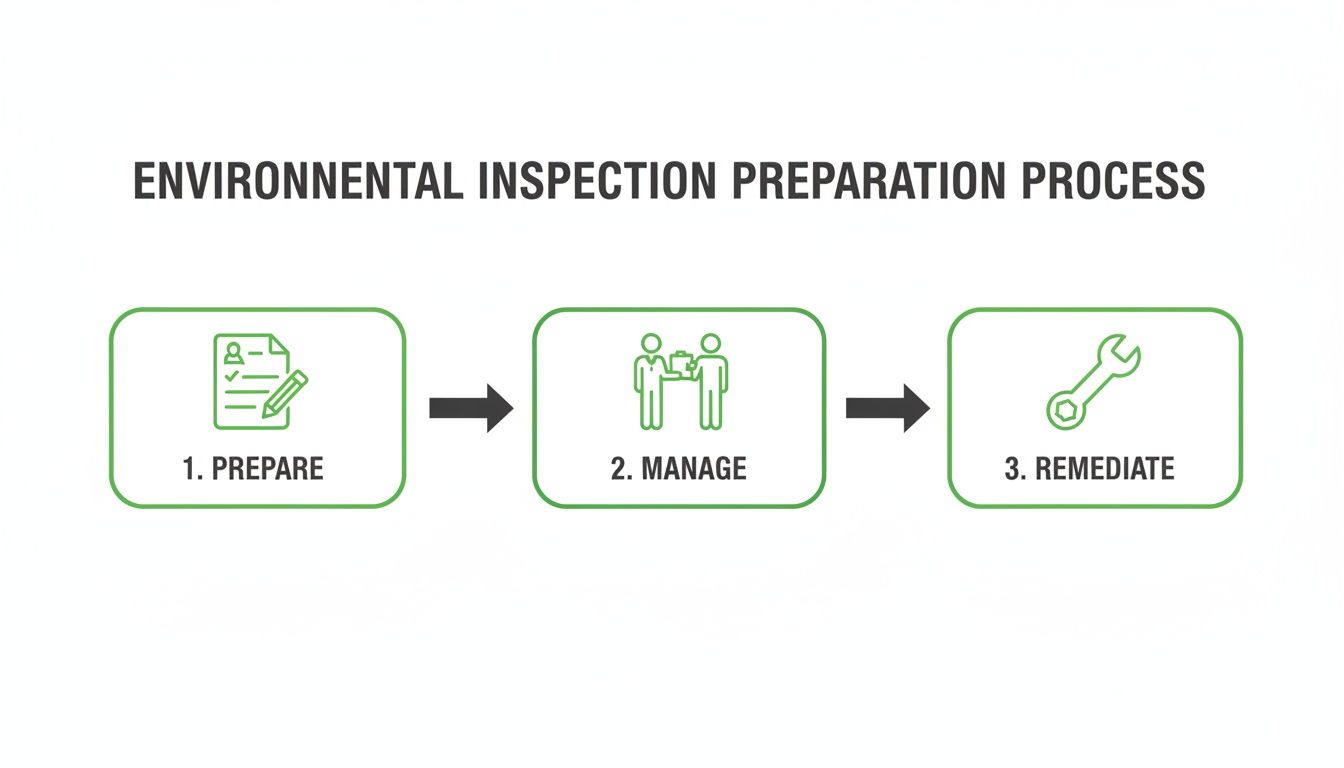
It’s a cycle. What you learn from one inspection feeds directly into making your preparation stronger for the next. To help, we've created a simple checklist to assess your readiness.
Inspection Readiness Checklist
Use this table to quickly review the most common areas checked during an inspection. It’s a simple way to see where you stand.
Any "no" or "unsure" answer is your signal to take action before it becomes a problem.
Waste Management Done Right
From our experience, waste management is where most companies get tripped up. It’s the first thing inspectors look at, and it’s where mistakes are easiest to spot.
Your Task: Ensure all your waste—municipal, recyclable, and hazardous—is sorted into separate, clearly marked containers.
Why it Matters: A messy waste area is a red flag for inspectors. It’s a common and visible mistake that almost guarantees a fine.
How to Fix It: Use clear signs. Hold short, regular training sessions. This is a core duty for your designated Responsabil de Mediu. You can learn more about what’s expected of an environmental manager in our detailed article.
Your Task: Keep active contracts with licensed waste collectors for every type of waste you produce.
Why it Matters: You need to prove a clean chain of custody. You are responsible for your waste until a licensed operator takes it away.
How to Fix It: Gather all your contracts and annexes into one folder. You must have a handover document, the formular de transport, for every single pickup.
Air and Water Emissions Records
If your business has activities that could affect air or water quality, your data logs are everything.
A classic mistake our team sees is companies with the right monitoring gear but messy or incomplete records. An inspector needs to see your history at a glance.
- Your Task: Check that your monitoring equipment is working and calibrated. Keep detailed and consistent logs of every measurement.
- Why it Matters: Gaps in your data or uncalibrated equipment are treated as serious violations of your permit.
- How to Fix It: Schedule and document routine maintenance. Store your logs in chronological order so they are ready for immediate review.
Your Permits and Paperwork
The autorizație de mediu is the heart of your compliance. All related paperwork must be current, complete, and available on site.
- Your Task: Double-check that your environmental authorisation is valid and matches what you do today.
- Why it Matters: If you’ve added new equipment or changed a process, an old permit instantly creates non-compliance.
- How to Fix It: Set a calendar reminder at least six months before your permit expires to start the renewal process. Once a year, review the permit to ensure it still reflects your reality.
Turning Compliance into a Competitive Advantage
Dealing with the Garda de Mediu București is often seen as a cost of doing business. But what if that compliance folder was a hidden strategic asset?
This shift starts with data. The information you collect for local inspections—waste logs, emissions data, resource consumption—is the same verifiable data that global Environmental, Social, and Governance (ESG) frameworks demand.
Aligning Local Compliance with Global Standards
The data you gather for a local inspector is the foundation for your entire ESG reporting strategy, whether for the Corporate Sustainability Reporting Directive (CSRD) or platforms like EcoVadis.
- Waste Management Data: Your records are direct inputs for circular economy metrics and waste reduction targets under CSRD.
- Energy and Water Consumption: These are the building blocks for calculating your Scope 1 and Scope 2 carbon footprint.
- Emissions Monitoring: This data is critical for proving you meet pollution prevention standards required by both local permits and international reporting.
By treating local compliance data as a strategic asset, you prepare for inspections while building the data infrastructure for ESG disclosures. This approach saves time, reduces redundant work, and ensures sustainability claims are backed by audit-ready proof.
A strong compliance record isn't just about avoiding penalties. It's tangible proof of operational excellence that speaks to investors, customers, and partners.
From Cost Centre to Value Driver
A well-run environmental management system is also a tool for operational efficiency. By forcing you to track resource use, it uncovers waste and cuts costs. For example, monitoring water usage to meet permit limits might reveal a hidden leak, leading to immediate savings.
A stellar compliance history strengthens your position in competitive supply chains where major partners demand proof of sustainability. To make the most of this, it's essential to integrate these efforts into your company's broader strategic planning process steps. A strong track record can even make your business more attractive for green financing, as banks are more willing to fund companies that can prove they have low environmental risk.
Ultimately, mastering local compliance with the Garda de Mediu București isn’t just a defensive move. It’s the first step toward building a resilient and competitive business.
How a Sustainability Partner Helps You Stay Prepared
Dealing with the Garda de Mediu București can feel like a high-stakes challenge. But you don’t have to face it alone. An experienced sustainability partner helps you shift from reacting to problems to proactively managing compliance.
This isn't about outsourcing responsibility. It's about bringing in a specialist to strengthen your own team, focusing on preparing for an inspection, responding when it happens, and building a long-term strategy.
Our team focuses on delivering results while training your teams to become self-sufficient. The goal is for the knowledge we build to stay with you long after our project ends, giving your people the confidence to manage compliance on their own.
Preparing for an Inspection
The best way to handle an inspection is to be ready long before inspectors arrive. A good partner will run mock audits that mirror a real visit from the Garda de Mediu București. Think of these as "fire drills" for your environmental compliance.
These drills test everything in a controlled setting—from your paperwork to how your team responds under pressure. We find the gaps before they become expensive fines. It also means setting up a solid data management system, so your records are always organised and ready for scrutiny.
Responding and Remediating
If an inspector finds a non-conformity, the clock starts ticking. A partner provides immediate, critical support. They help decode the official findings (notă de constatare) and turn vague regulatory demands into a step-by-step action plan.
The objective is not to fight the authorities, but to resolve the issue correctly and quickly. An expert can help you design a corrective plan that not only satisfies the Garda de Mediu but also fixes the root cause, getting your operations back to normal with minimal disruption.
Integrating Compliance into Long-Term Strategy
Finally, a true partner helps you connect the dots. The detailed data you gather for a local inspection is the very same information you need for your company's broader ESG and sustainability goals.
Our team can help you turn that compliance data into a verified carbon footprint (Scopes 1, 2, and 3) and a practical decarbonisation roadmap. This transforms a regulatory headache into a strategic advantage, making your ESG reports more credible and strengthening your market position.
Frequently Asked Questions
When it comes to the Garda de Mediu București, it’s normal to have questions. Here are answers to the most common issues we see businesses run into.
What Is the Difference Between the Garda de Mediu and APM?
It helps to think of it this way: The Environmental Protection Agency (Agenția pentru Protecția Mediului - APM) is the one that sets the rules and issues your environmental permits (autorizație de mediu). You go to the APM to get permission to operate.
The Garda de Mediu, on the other hand, is the enforcement arm. They are the inspectors who show up at your facility to make sure you’re following the conditions laid out in those permits. One writes the rules; the other checks that you’re playing by them.
What Are the Most Common Reasons for Fines in Bucharest?
From our team's experience, most fines from the Garda de Mediu București boil down to a few recurring problems:
- Improper waste management, most often incorrect sorting or not having up-to-date contracts with authorised collectors.
- Exceeding air or water emission limits specified in your environmental permit.
- Incomplete or disorganised environmental records, especially waste handover forms (formular de încărcare-descărcare deșeuri).
There's a clear pattern here. Meticulous record-keeping and regular internal checks are your best defence against these common mistakes.
It's important to know you can challenge a sanctioning report (proces-verbal de contravenție) in court. You typically have 15 days from the date you receive it to file a challenge, but you'll need a solid legal case and clear evidence that the inspector's findings were wrong.
For minor issues, it’s almost always more practical to fix the problem immediately. Proactive compliance is far less expensive than a reactive legal fight.
Are you ready to turn compliance into a competitive advantage? ECONOS 🌱 helps you build a robust environmental management system that keeps you prepared for inspections and aligns with ESG reporting demands.
Find out how we can support your business at https://www.econos-esg.com.