
.png)
Getting your coduri deseuri intepatoare (sharps waste codes) right is no longer just a compliance task. It's about operational progress. While 18 01 03* (hazardous sharps) has always been a key code for safety, it now represents a critical data point for building trust with auditors, investors, and supply chain partners.
We see that many organisations treat waste classification as a purely operational issue, disconnected from their broader Environmental, Social, and Governance (ESG) strategy. This leads to data gaps and missed opportunities. So, how can companies turn a routine compliance process into a scalable and affordable part of their sustainability reporting? The answer lies in connecting daily execution to long-term goals, turning waste logs into proof of operational control.
Here are three key takeaways for any business managing sharps waste:
- Waste data is business-critical. Misclassifying hazardous items under code 18 01 03* with non-hazardous streams creates a chain of risks beyond just fines. It undermines the credibility of ESG reports and can distort your company’s carbon footprint, eroding trust with stakeholders who now see waste management as a sign of operational maturity.
- Compliance is the foundation, not the ceiling. Meeting legal duties for waste segregation, labelling, and record-keeping is the first step. This data directly feeds into mandatory reporting under the Corporate Sustainability Reporting Directive (CSRD), specifically for disclosures on hazardous waste under ESRS E5 - Resource use and circular economy. This demonstrates strong environmental governance.
- Segregation at the source builds internal capability. The most common error is mixing hazardous and non-hazardous waste. By implementing clear procedures and training teams to segregate waste immediately, you not only ensure safety but also build the internal skills needed for accurate data collection. We combine delivery with training so teams become autonomous.
What does this mean for your company? It’s time to view waste management through a business lens. This requires clear ownership of waste data, a realistic timeline for improving data collection, and the right tools to connect operational logs to ESG reporting platforms like EcoVadis or CDP.
Ultimately, a well-managed waste inventory is not about perfect reporting; it's about making operational progress visible and auditable.
The Business Impact of Waste Data
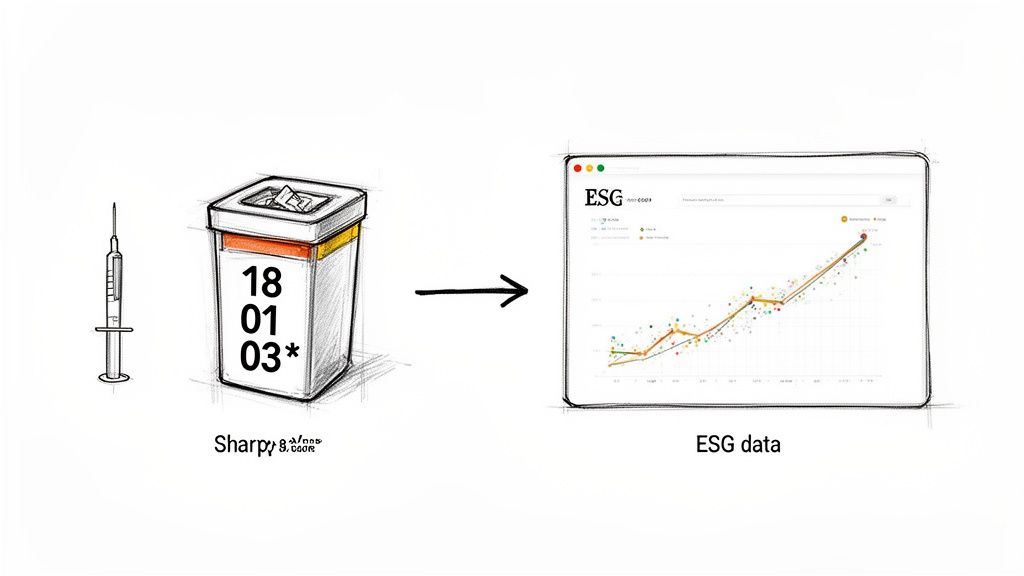
Managing sharps waste has moved from a simple operational task to a key data point in your company’s ESG performance. So, how do you make sure your day-to-day waste practices actually back up your big-picture sustainability goals?
The answer is to treat waste classification as a strategic priority. Especially for companies now dealing with regulations like the CSRD, accurate waste data isn't just nice to have—it's essential for building trust.
Misclassifying sharps waste, like accidentally mixing hazardous items under code 18 01 03* with non-hazardous waste streams, triggers a chain reaction of business risks. You might face compliance fines, sure, but the fallout now goes much further. Messy waste logs directly undermine the credibility of your ESG reports and can even throw off your organisation’s entire carbon footprint calculation.
Investors, auditors, and even customers now look at waste management as a clear sign of operational maturity and risk control. A clean, well-organised waste inventory shows you have a serious grip on your environmental governance.
For a quick reference, here are the primary codes you’ll encounter when managing sharps waste.
Primary Sharps Waste Codes (Coduri Deseuri Intepatoare) and Context
| EWC Code | Waste Description (EN) | Common Sources | ESG Reporting Relevance |
|---|---|---|---|
| 18 01 03* | Wastes whose collection and disposal is subject to special requirements in order to prevent infection | Needles, syringes, scalpels, lancets, and contaminated glass from human healthcare. | Hazardous Waste: Directly reported under CSRD/ESRS E5. Key for pollution metrics. |
| 18 01 04 | Wastes whose collection and disposal is not subject to special requirements (e.g. dressings, plaster casts) | Not for sharps. Used for non-infectious medical waste. Sharps should never be in this stream. | Important for demonstrating proper waste segregation and avoiding misclassification. |
| 18 02 02* | Wastes whose collection and disposal is subject to special requirements in order to prevent infection | Sharps from veterinary care or animal research. | Hazardous Waste: Also reported under CSRD/ESRS E5 if generated by the organisation. |
This table makes it clear why segregation is so important. Getting it wrong doesn't just create a safety hazard; it directly impacts your sustainability reporting.
Connecting Waste Codes to ESG Reporting
The data you collect on coduri deseuri intepatoare feeds directly into major sustainability frameworks. It's a critical input for disclosures on resource use and pollution under the European Sustainability Reporting Standards (ESRS).
- CSRD/ESRS: You are required to report accurate volumes of hazardous waste under ESRS E5. Code 18 01 03* is a perfect example of data needed here.
- Carbon Footprint: Waste disposal is a component of your Scope 3 emissions (Category 5: Waste generated in operations). Incorrect coding leads to flawed emissions calculations.
- EcoVadis & CDP: Strong waste management practices and transparent data will boost your scores on assessment platforms and strengthen your CDP disclosures.
When you start looking at sharps waste through an ESG lens, a routine task becomes a strategic advantage. It builds the foundation for auditable, transparent reporting that strengthens trust with regulators, investors, and customers alike, marking your company as a responsible leader.
Navigating Your Legal Obligations for Sharps Waste
Understanding your legal duties for sharps waste isn't just about avoiding fines; it’s a critical part of corporate risk management. The laws governing hazardous materials, including those with coduri deseuri intepatoare, are incredibly strict and place the full responsibility on the waste generator—from the moment the waste is created until its final disposal.
In Romania, these obligations are spelled out in national legislation that is directly aligned with the EU Waste Framework Directive. This means businesses, whether they're healthcare clinics or manufacturing plants, must navigate a dual layer of requirements. The core principle is simple but non-negotiable: the producer of the waste is responsible for its safe management.
Key Generator Responsibilities
Your legal responsibility kicks in the second a sharp object is discarded. A misstep at any point can lead to serious liabilities, including steep penalties and significant damage to your company's reputation. These duties are clear and absolute.
Your main obligations include:
- Segregation at the source: You are required to separate sharps waste from all other waste streams immediately. Mixing hazardous and non-hazardous waste is a major compliance violation.
- Correct container use: Sharps must go into designated, puncture-proof containers that are clearly marked as hazardous. These are usually yellow and feature the universal biohazard symbol.
- Accurate labelling: Every container needs a proper label detailing the waste type, its specific EWC code (like 18 01 03*), where it was generated, and the date.
- Mandatory record-keeping: You must keep a precise, detailed log of the types and amounts of waste you generate and hand over for disposal. These records are vital for any audit or regulatory report.
The Significance of HP9 'Infectious'
Most sharps from healthcare environments fall under the hazardous property HP9 'Infectious'. This classification is what triggers the need for a much stricter, more controlled disposal process. Because these items could potentially transmit disease, they simply cannot be handled like regular waste.
The HP9 classification means the waste demands specialised transport by an authorised contractor. It must then be treated to make it non-infectious, usually through high-temperature incineration or sterilisation. To successfully manage all these legal duties, organisations often find it helpful to work from a detailed compliance audit checklist.
Ultimately, meeting these legal requirements is the first step in building a credible, auditable ESG data foundation. It’s direct proof that your organisation has solid operational controls, manages its environmental risks responsibly, and is committed to protecting both public health and its own legal standing.
Decoding EWC Chapter 18 Sharps Waste Codes
When it comes to managing and reporting waste for your environmental or ESG disclosures, getting the codes right is everything. This is especially true for the coduri deseuri intepatoare (sharps waste codes) found in Chapter 18 of the European Waste Catalogue (EWC), which covers all waste from human and animal healthcare. For any compliance officer, facility manager, or sustainability professional, a solid grasp of these codes isn't just helpful—it's non-negotiable.
Getting a code wrong isn't a simple admin slip-up. It contaminates your environmental data, opens your organisation up to potential legal fines, and ultimately misrepresents your true impact. The most important distinction to make is between hazardous and non-hazardous waste, which is always marked with an asterisk (*).
Hazardous Sharps Code: 18 01 03*
This is the code you will encounter most frequently for sharps waste generated in human healthcare.
- Official Description: Wastes whose collection and disposal is subject to special requirements in order to prevent infection.
- What this actually means: Think of any sharp item that has become contaminated. This includes needles, syringes still attached to needles, scalpels, lancets, and anything else that might carry blood, bodily fluids, or other infectious material.
- How to handle it: Because of its infectious properties (HP9 'Infectious'), this waste is classified as hazardous. It must be segregated immediately into yellow, puncture-proof containers and collected by an authorised partner for specialised treatment, which is usually incineration or sterilisation.
Non-Hazardous Sharps Code: 18 01 01
While it’s far less common in day-to-day clinical settings, this code exists for sharps that are definitively not infectious.
- Official Description: Sharps (except 18 01 03*).
- What this actually means: This code applies to unused and expired sharps that never came into contact with a patient or any infectious agents. A classic example would be finding a box of sterile, but expired, lancets during a stocktake.
- How to handle it: Although this waste is non-hazardous, the physical injury risk is still there. It must be disposed of in puncture-proof containers to protect staff. Be warned: classifying genuinely hazardous sharps under this code is a serious compliance breach.
Veterinary and Research Sharps Code: 18 02 02*
This code is essentially the twin of 18 01 03*, but it's specifically for waste from veterinary services and animal-related research.
- Official Description: Wastes whose collection and disposal is subject to special requirements in order to prevent infection.
- What this actually means: It covers all the contaminated sharps from veterinary clinics, animal hospitals, and research labs—needles, scalpels, and similar items.
- How to handle it: This is also classified as hazardous waste (HP9 'Infectious'). The handling protocol is just as strict as its human healthcare counterpart, requiring proper segregation, handling, and disposal. You can dive deeper into the broader categories by reviewing our complete guide on medical waste codes.
Applying these coduri deseuri intepatoare correctly is the bedrock of an accurate waste inventory. This level of detail is crucial for reporting, especially since these hazardous streams have a significant environmental footprint. In Romania, for instance, waste management activities contributed 6.53 Mt CO₂eq in 2021, accounting for 5.7% of the country's total emissions. This figure alone highlights why precise data is so important for both national goals and corporate sustainability efforts.
Integrating Sharps Waste Data Into Your CSRD Reporting
Properly managing your coduri deseuri intepatoare (sharps waste codes) is no longer just an operational task. It has become a central part of your company's strategic sustainability reporting. The data from your sharps waste logs isn't just for internal files anymore; it's now a mandatory input for creating credible, audit-ready ESG disclosures.
Under the Corporate Sustainability Reporting Directive (CSRD), your organisation must report on its environmental impacts using verifiable data. This is where your day-to-day waste management process connects directly with high-level corporate strategy.
Connecting Waste Data to ESRS E5
The European Sustainability Reporting Standard (ESRS) E5, which covers Resource Use and Circular Economy, explicitly requires companies to disclose detailed information about their waste streams. Data on hazardous waste volumes, carefully classified with codes like 18 01 03*, is absolutely essential for this disclosure.
Without this level of accurate tracking, your sustainability report will lack the granular detail it needs to be compliant and credible. This makes a robust waste management system a cornerstone of your entire CSRD reporting framework.
Accurate waste classification is no longer just a legal requirement. It's a clear demonstration of strong environmental governance. It proves your organisation has control over its operational footprint and is actively managing material risks.
This decision tree below helps visualise the classification process for sharps waste, showing how to determine whether it is hazardous or non-hazardous.
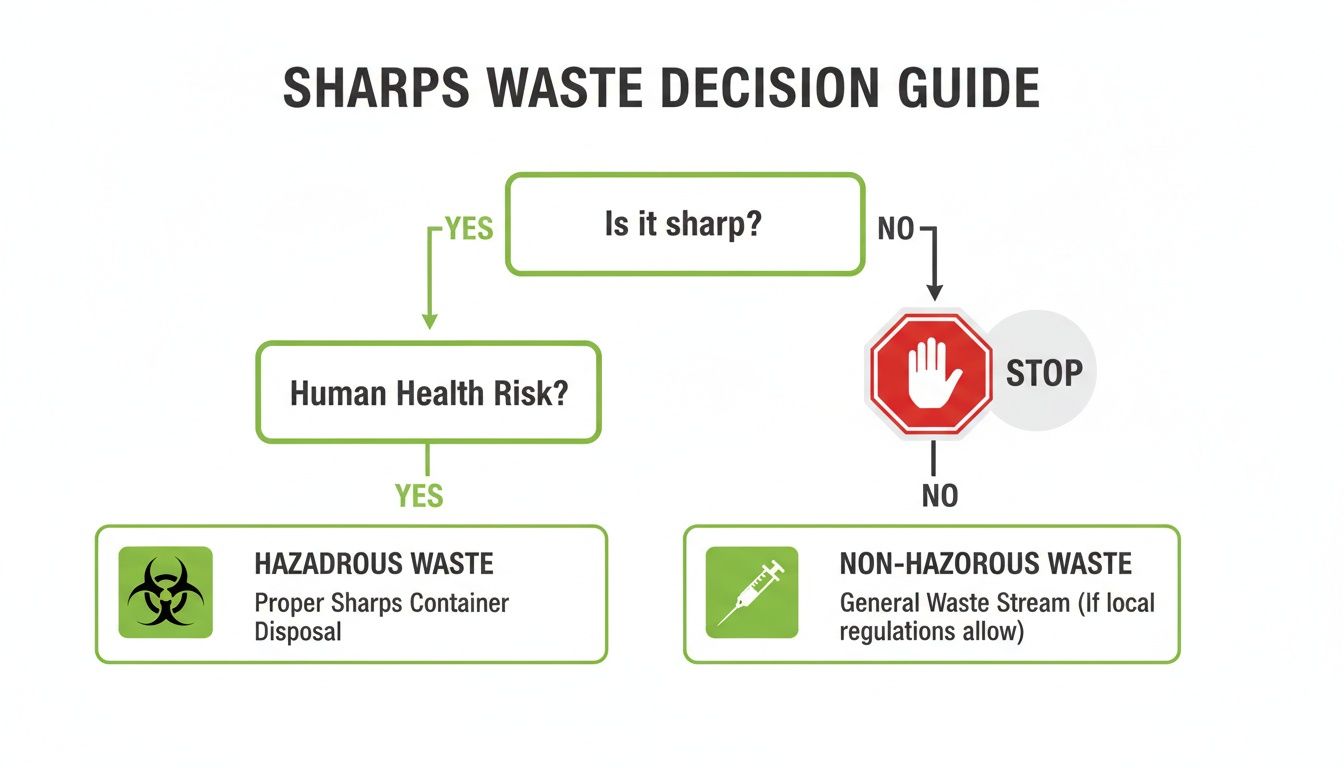
As the chart shows, the key difference is whether the sharp is contaminated and poses an infection risk. This single factor directly dictates the required disposal route and, in turn, its reporting implications. Bringing this data together effectively relies on strong data management systems; you may find it helpful to look into modern knowledge management and AI strategies to handle this complexity.
From Waste Logs to Carbon Footprint
Your sharps waste data also feeds directly into your company’s carbon footprint calculations. Under the GHG Protocol, the waste generated from your operations is a required metric for Scope 3, Category 5 emissions. Improper disposal, especially sending waste to landfill, can lead to significant methane (CH4) emissions—a powerful greenhouse gas. For a deeper dive on how these records fit together, check our guide on maintaining waste management records.
In Romania, the waste sector is a critical area for emissions reduction, accounting for 6.53 Mt CO₂eq in 2021. That's roughly 5.7% of the nation’s total emissions. By accurately tracking and managing hazardous wastes, your business can directly contribute to lowering this national figure, which significantly strengthens your ESG profile. You can explore more about these trends and other insights on Romania's emission profile on Our World in Data.
Mapping Sharps Waste Data to ESG Frameworks
This table shows how data collected on sharps waste directly feeds into key sustainability reporting standards, helping teams connect compliance tasks with strategic goals.
| Waste Data Point | CSRD/ESRS Standard | GHG Protocol | EcoVadis Relevance |
|---|---|---|---|
| Total hazardous waste volume | ESRS E5-4: Reporting on waste streams | Scope 3, Category 5: Waste from operations | Environment Pillar: Waste management policies and performance |
| Waste classification code (e.g., 18 01 03*) | ESRS E5-4: Breakdown by hazardous status | Not directly applicable | Environment Pillar: Proof of correct hazardous waste handling |
| Disposal method (e.g., incineration, landfill) | ESRS E5-4: Reporting on recovery/disposal operations | Scope 3, Category 5: Emission factors depend on disposal method | Environment Pillar: Evidence of responsible disposal practices |
| Costs of waste management | ESRS E1-4: Financial effects from climate-related risks/opportunities | Not directly applicable | Sustainable Procurement: Indirect cost indicator in supply chain |
Making these connections visible is key. It transforms what might seem like a simple compliance exercise into a strategic asset, providing the hard data needed to build trust with investors, clients, and regulators.
Best Practices for On-Site Waste Handling and Disposal
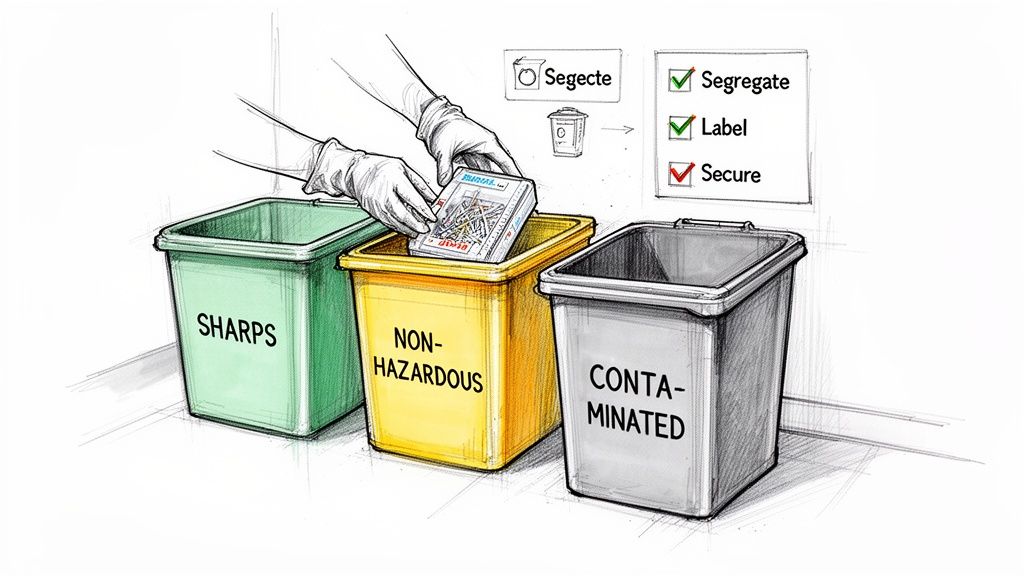
Knowing the right coduri deseuri intepatoare is only half the battle. What truly matters for safety, compliance, and even your ESG reporting is how you manage this waste on-site, from the moment it’s generated until it leaves your facility.
It all starts with one non-negotiable step: segregation at the source. Sharps waste has to be separated from everything else, immediately. This isn’t a suggestion; it’s a critical control point that depends on having a clear, colour-coded container system that everyone understands and follows.
Implementing a Safe Handling System
A robust handling system isn’t just about having the right bins. It’s built on clear procedures and the right equipment, designed to protect your team and ensure every step is auditable, especially when dealing with infectious materials.
The core elements are straightforward but essential:
- Puncture-Proof Containers: All sharps go into rigid, puncture-resistant containers. These are almost always yellow and must display the international biohazard symbol.
- Correct Labelling: Every container needs to be clearly marked. This includes the EWC code (like 18 01 03*), where the waste came from, and the date it was sealed for disposal.
- Safe Handling Procedures: Train your staff to never fill containers more than three-quarters full. This simple rule prevents injuries and spills, directly supporting occupational health and safety standards.
Properly managing the entire life cycle of medical waste is a core responsibility for healthcare facilities. To learn more, read our detailed guide on managing medical waste, which covers everything from classification to disposal.
From Temporary Storage to Final Disposal
Once a sharps container is full and sealed, its journey isn't over. The pathway to final disposal involves specific rules for temporary storage and treatment, and you need a documented trail for the entire process.
Your temporary storage area has to be secure and well-ventilated, kept separate from patient areas and public access. Be aware that regulations strictly limit how long you can store this waste on-site before it must be collected.
Finally, the waste must be handed over to an authorised waste management partner for transport and treatment. They are responsible for moving it safely and treating it according to legal standards, usually through high-temperature incineration or sterilisation. Verifying your contractor's authorisations isn't just a box-ticking exercise—it’s a critical due diligence step for any organisation generating hazardous waste.
Common Mistakes in Sharps Waste Classification
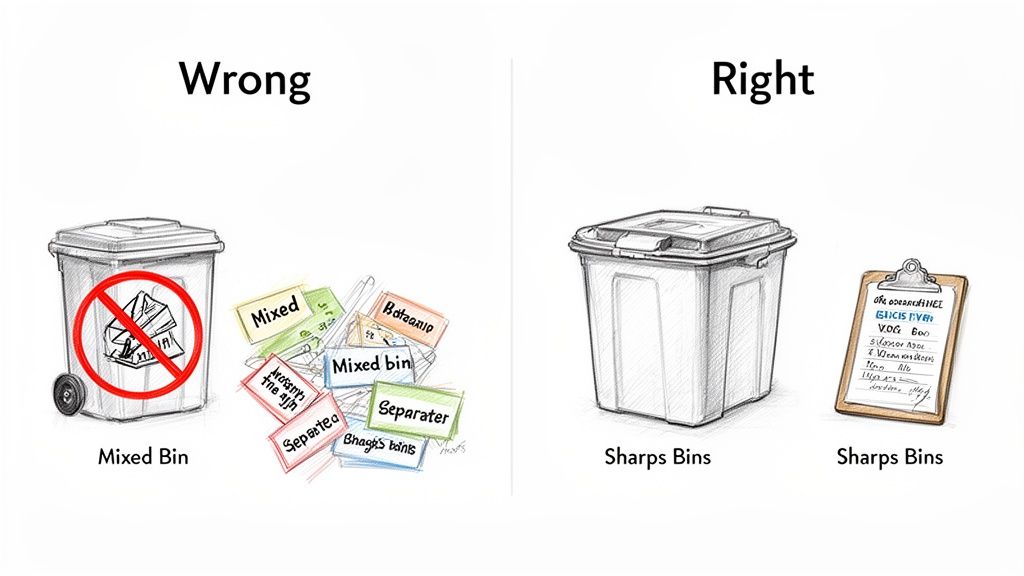
Even the most diligent organisations can get things wrong when managing coduri deseuri intepatoare (sharps waste codes). These mistakes aren't just minor slip-ups; they create genuine compliance vulnerabilities and can seriously undermine the integrity of your sustainability data, leading to flawed ESG reports and the risk of fines.
Finding and fixing these gaps before an audit is the only effective way to strengthen your waste management framework. It’s not just about avoiding penalties. It’s about reinforcing a culture of diligence and ensuring every staff member who handles hazardous materials understands what's at stake.
Mixing Waste Streams
This is one of the most frequent and critical errors we see. It’s the simple act of mixing hazardous sharps with non-hazardous waste streams, and it usually stems from a lack of ongoing training or poorly labelled containers at the point of care.
- What Not to Do: Allowing used needles, classified under the hazardous code 18 01 03*, to be tossed into a container meant for non-hazardous clinical waste like bandages (18 01 04).
- What to Do Instead: Make sure clearly marked, puncture-proof yellow containers are always within arm's reach where sharps are used. More importantly, reinforce through regular training that absolutely no sharps, under any circumstances, go into general or non-hazardous waste bins.
Using Incorrect EWC Codes
Applying the wrong European Waste Catalogue (EWC) code is another common pitfall. This single action can skew your entire waste inventory, leading to inaccurate internal tracking and incorrect reporting. A classic example is the misclassification of expired but unused sharps.
Mistake Scenario: A box of expired, sterile needles is incorrectly logged under the hazardous infectious waste code 18 01 03*.
Correction: Because these items pose no infection risk, they should be classified under the non-hazardous sharps code 18 01 01. They still need to go into a puncture-proof container for physical safety, but they must be recorded as non-hazardous to ensure your data is accurate.
Failing to Maintain Accurate Records
Incomplete or messy waste logs make it impossible to track your performance, prove compliance, or produce an audit-ready report. This data gap has a direct and increasingly scrutinized impact on your climate disclosures.
Romania's waste sector emissions dropped to 6.53 Mt CO₂eq in 2021, and precise corporate data is essential for the country to sustain that progress. When sharps are mismanaged or misreported, they can introduce unaccounted for methane (CH4) leaks from improper disposal routes, creating risks under frameworks like CBAM. You can dig deeper into how waste contributes to national emissions in this official EU climate factsheet.
Answering Your Key Questions on Sharps Waste
When it comes to coduri deseuri intepatoare, the details are what protect you from compliance risks. Let's clear up a few of the most common questions we hear from businesses managing this critical waste stream.
How Long Can We Store Sharps Waste Before Disposal?
Romanian law is very clear on this. Any hazardous infectious waste, including sharps correctly classified under 18 01 03*, has a maximum temporary storage limit of just 48 hours.
It's possible to extend this period, but only if you have a specially authorised, refrigerated storage area that prevents decomposition. Without that specific setup and approval, the 48-hour rule is absolute.
Can Expired, Unused Needles Be Mixed with Used Ones?
Absolutely not. This is a common and costly mistake. Expired but completely unused needles are sterile, so they don’t carry an infection risk. They fall under the non-hazardous code 18 01 01.
While they still need to be collected in puncture-proof containers for physical safety, their disposal path is far less stringent and less expensive than that for contaminated sharps (18 01 03*). Mixing them contaminates your entire batch, inflates your disposal costs, and corrupts your waste data.
Who Is Liable if Our Waste Contractor Handles It Incorrectly?
The legal principle of "generator responsibility" means that you, as the waste producer, hold the ultimate liability until that waste is fully treated and destroyed.
Even after an authorised contractor takes possession, if that waste is dumped illegally or mishandled, your organisation can still face significant legal and financial consequences. This is precisely why vetting your waste management partner is a non-negotiable step in your risk management process.
How Do I Find an Authorised Waste Management Partner?
The definitive source is the national registry maintained by the National Agency for Environmental Protection (ANPM). You can consult their official website to find a complete list of companies licensed to collect, transport, and treat hazardous waste in Romania.
Before signing any contract, always verify that the company's licence is current and explicitly covers the EWC codes your facility generates.
At ECONOS 🌱, we help you move from basic compliance to strategic ESG excellence. We combine delivery with training so your team becomes autonomous, ensuring your waste management data is not just compliant, but a cornerstone of your credible sustainability reporting. Learn how we can support your ESG journey.