
.png)

Securing an environmental permit isn't just a compliance task. We're seeing across our client work—from manufacturing to waste management—that the data required for an authorization is the same data needed for credible ESG reporting and operational improvement.
Many teams struggle to connect their coduri CAEN (activity codes) to specific environmental requirements, leading to operational risks and missed opportunities. The core challenge isn't just getting the permit; it's using the process to build a stronger business. So, how can companies turn this regulatory obligation into a strategic asset?
Here are three takeaways we've gathered from helping teams manage their environmental permits:
Permit data is your ESG baseline. The information you collect for an environmental authorization—energy and water use, waste volumes, air emissions—is the foundation for any credible sustainability report. This data directly feeds into key disclosures for frameworks like the Corporate Sustainability Reporting Directive (CSRD) and platforms like CDP, turning compliance paperwork into your starting point for transparent reporting.
Compliance builds operational capability. The process of obtaining and maintaining an autorizație de mediu forces a deep look into operational efficiency. By measuring resource consumption and emissions, you uncover opportunities to reduce waste, cut energy costs, and optimize processes. It’s the first step toward operational progress, not just perfect reporting.
A strong permit process signals low risk. In discussions with banks and procurement teams, we see that a well-managed environmental compliance history is viewed as a sign of low operational risk. It demonstrates proactive governance and builds trust with investors, lenders, and customers who are increasingly scrutinizing the environmental resilience of their partners.
What does this mean for your company? It means ownership of environmental data needs to move beyond the compliance department. The data gathered for your permit should inform decisions on budget, timelines, and operational priorities. We combine delivery with training so teams become autonomous in managing these processes over time.
Ultimately, your environmental permit is more than a license to operate—it's a roadmap for building a more resilient and competitive business.
1. CAEN 3511 - Electric Power Generation from Thermal Sources (Coal, Gas, Oil)
The CAEN code 3511 covers the generation of electric power from thermal power stations, which typically use the combustion of fossil fuels such as coal, natural gas, or oil. These facilities are among the most scrutinised from an environmental standpoint due to their significant impact on air quality, water resources, and greenhouse gas (GHG) emissions.
Under Romanian and EU legislation, these operations are classified as Category A activities. This means they are subject to the most rigorous environmental assessment and permitting procedures. The primary authorisation needed is the Integrated Environmental Authorisation (Autorizația Integrată de Mediu), which consolidates various permits into a single document covering air and water pollution, waste management, and energy efficiency. These facilities are also cornerstone participants in the EU Emissions Trading System (ETS), requiring them to monitor, report, and surrender allowances for their CO2 emissions.
Key Considerations and Practical Steps
Operating under this CAEN code necessitates a robust environmental management system. Companies must go beyond basic compliance to manage significant financial and reputational risks associated with their carbon footprint.
- Baseline GHG Inventories: A critical first step is to conduct a detailed GHG inventory covering all sources. This includes direct Scope 1 emissions from fuel combustion, Scope 2 from purchased electricity, and Scope 3 emissions from the value chain, such as fuel extraction and transport.
- EU ETS Optimisation: Map your EU ETS allowance needs against actual, verified emissions. A precise understanding of your emissions profile allows for cost optimisation through strategic allowance purchasing or banking.
- Continuous Monitoring: Implement Continuous Emissions Monitoring Systems (CEMS) for pollutants like SOx, NOx, and particulate matter. This ensures real-time compliance with the strict limits set in the environmental authorisation and helps prevent costly fines.
- Strategic Decarbonisation: Develop a science-based decarbonisation roadmap aligned with frameworks like the Science Based Targets initiative (SBTi). This is becoming a key requirement for maintaining credibility with investors, customers, and financiers. It also prepares the business for reporting under ESRS E1 (Climate Change) and E5 (Resource Use and Circular Economy).
Given the complexity, many companies find the process of obtaining and maintaining compliance challenging. The path for CAEN 3511 is not just about securing a permit; it is about building a long-term strategy for operational resilience in a decarbonising economy.
2. CAEN 3821 - Waste Treatment and Disposal (Hazardous and Non-Hazardous)
The CAEN code 3821 covers the treatment and disposal of both hazardous and non-hazardous waste. This includes a wide range of activities such as incineration, landfilling, physical-chemical treatment, and the operation of recycling or composting facilities. These operations are fundamental to public health and environmental protection, but they also carry significant risks related to air emissions, soil and groundwater contamination from leachate, and methane release.
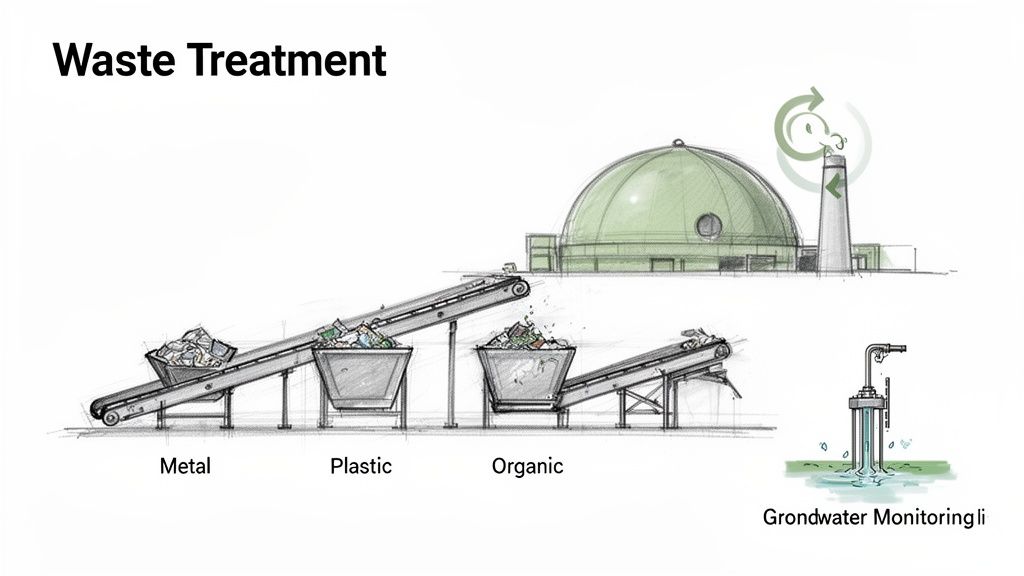
Under Romanian and EU law, waste management facilities are subject to strict environmental permitting. Depending on the scale and nature of the waste handled, they may require either a standard Environmental Authorisation (Autorizație de Mediu) or, for larger and more complex sites like hazardous waste incinerators or major landfills, an Integrated Environmental Authorisation (Autorizația Integrată de Mediu). This authorisation sets precise operational conditions, emission limit values, and monitoring requirements to minimise environmental impact. These activities are also central to the circular economy, influencing the Scope 3 emissions of countless other businesses.
Key Considerations and Practical Steps
For operators in the waste sector, compliance is not just about securing a permit; it is about demonstrating a credible contribution to a circular and low-carbon economy. This requires a sophisticated approach to data management and reporting.
- Waste Composition Analysis: Regularly conduct detailed analyses of incoming waste streams. This data is essential for optimising treatment routes, maximising recovery rates, and providing accurate reporting to authorities and clients, aligning with the EU's Circular Economy Action Plan.
- Accurate Emissions Monitoring: Monitor methane (CH4) emissions from landfills using up-to-date methodologies, such as those informed by IPCC AR6 emission factors, for greater accuracy. For incinerators, implement Continuous Emissions Monitoring Systems (CEMS) for pollutants like dioxins, furans, and heavy metals.
- Quantify Avoided Emissions: Use the GHG Protocol's Scope 3 methodology to calculate and report on the "avoided emissions" generated by your recycling and recovery operations. This turns your environmental compliance into a value proposition for clients looking to reduce their own carbon footprint.
- ESRS Alignment: Systematically document how your operations and data management practices meet the disclosure requirements of ESRS E2 (Pollution) and E5 (Resource Use and Circular Economy). This prepares your business and your clients for CSRD audit-readiness.
Effective waste management is a cornerstone of modern supply chains. For companies under CAEN 3821, the challenge is to transform a regulatory obligation into a strategic asset.
3. CAEN 2011 - Manufacture of Basic Chemicals (Nitrogen, Phosphorus, Oxygen Compounds)
The CAEN code 2011 covers the production of basic organic and inorganic chemical compounds, including industrial gases, dyes, pigments, and the foundational chemicals for fertilisers like nitrogen and phosphorus. Facilities operating under this code, such as the large-scale Azomureș plant in Romania, are central to agricultural and industrial supply chains but are also sources of significant environmental pressures. These include air emissions (volatile organic compounds, ammonia, NOx, SOx), wastewater discharges, and the generation of hazardous waste.
Due to their substantial environmental impact, these operations are classified as Category A activities under the Industrial Emissions Directive (IED). This mandates the acquisition of an Integrated Environmental Authorisation (Autorizația Integrată de Mediu). This permit is a comprehensive document that regulates all environmental aspects of the operation based on the application of Best Available Techniques (BAT). It sets strict emission limit values for air and water and imposes rigorous requirements for waste management, accident prevention, and site restoration upon closure.
Key Considerations and Practical Steps
For companies in the chemical sector, environmental authorisation is deeply intertwined with business strategy, especially concerning the EU Green Deal and sustainable chemistry goals. Managing these coduri CAEN pentru autorizatie mediu requires a forward-looking approach to compliance and market positioning.
- Implement Mass Balance Calculations: To accurately quantify Scope 1 emissions, use a mass balance approach. This involves tracking the chemical inputs (e.g., natural gas for ammonia production) and outputs, allowing for precise calculation of greenhouse gas (GHG) emissions per tonne of product. This data is essential for both compliance and product carbon footprinting.
- Track Energy Consumption by Source: For precise Scope 2 reporting, segregate energy consumption data. Distinguish between electricity purchased from renewable sources versus fossil-fuel sources. This detailed tracking is critical for accurate GHG inventories and for substantiating green marketing claims.
- Conduct Product Life Cycle Assessments (LCA): Go beyond facility-level emissions by performing LCAs for key products. This provides customers with transparent upstream Scope 3 emissions data, supporting their own decarbonisation efforts and strengthening your position as a sustainable supplier.
- Align with CSRD and ESRS Standards: Proactively document compliance activities in line with the European Sustainability Reporting Standards (ESRS). Focus on documenting performance under ESRS E1 (Climate Change), ESRS E2 (Pollution), and ESRS E5 (Resource Use and Circular Economy), as these are directly relevant to chemical manufacturing operations and their associated environmental authorisations.
4. CAEN 3511 - Renewable Energy Generation (Wind, Solar, Hydroelectric)
The CAEN code 3511 also covers the generation of electricity from renewable sources like wind, solar, and hydroelectric power. Although these projects are central to decarbonisation and carry a significantly lower environmental footprint than fossil fuels, they are not exempt from environmental scrutiny. Large-scale renewable installations require specific authorisations, primarily related to land use, potential impacts on biodiversity, and effects on local ecosystems during construction and operation.
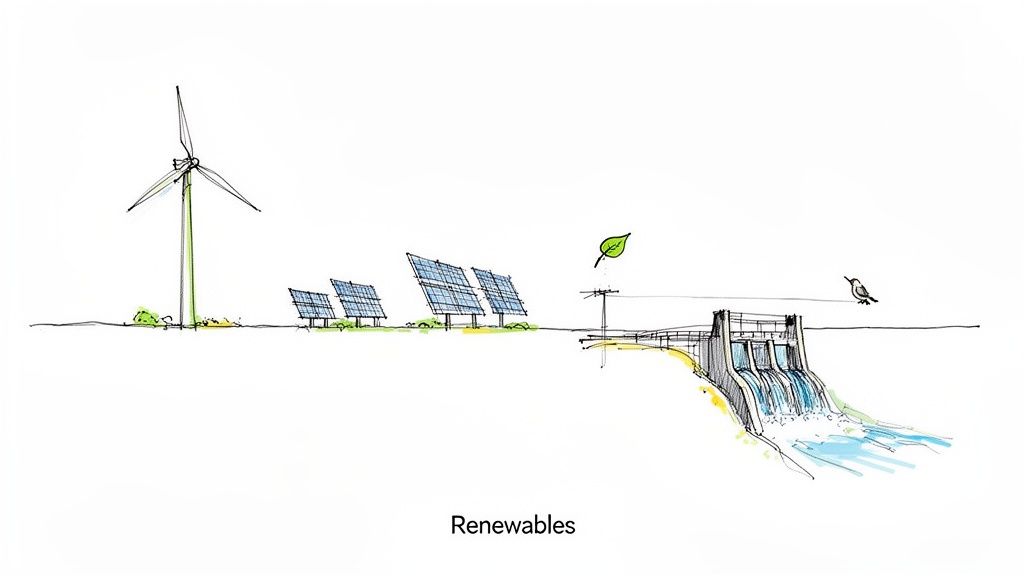
Unlike thermal power plants, renewable energy projects typically require a standard Environmental Authorisation (Autorizația de Mediu) rather than an integrated one, unless they meet specific size or location criteria that trigger a more complex assessment. The process often involves an Environmental Impact Assessment (EIA) to evaluate and mitigate potential harm to flora, fauna, and water bodies. For businesses, investing in or procuring energy from these sources is a primary method for reducing Scope 2 emissions and demonstrating progress toward net-zero targets under frameworks like the EU's Corporate Sustainability Reporting Directive (CSRD).
Key Considerations and Practical Steps
Operating or developing projects under this CAEN code is about balancing green energy production with ecological responsibility. The focus shifts from managing emissions to managing land and biodiversity impacts, which requires a different set of tools and metrics.
- Robust Impact Assessments: Before construction, conduct thorough biodiversity studies and landscape impact assessments. This data is essential for securing the initial environmental permit and for creating effective mitigation and site restoration plans post-commissioning.
- Demonstrate Additionality: When claiming emissions reductions from renewable energy procurement, ensure your claims are robust by applying additionality criteria as defined by the GHG Protocol. This proves that your investment led to new renewable capacity being added to the grid.
- EU Taxonomy Alignment: Document how your renewable energy project aligns with the EU Taxonomy criteria for climate change mitigation. This is critical for accessing green financing and demonstrating sustainable investment credentials to stakeholders.
- Track Performance with KPIs: Monitor the project's environmental performance beyond the initial authorisation. Implement Key Performance Indicators (KPIs) related to biodiversity, land restoration, and water use to manage ongoing impacts and report credibly under standards like ESRS E4 (Biodiversity and Ecosystems).
For companies operating under these coduri CAEN pentru autorizatie mediu, the goal is to prove that their contribution to the energy transition is genuinely sustainable.
5. CAEN 2820 - Manufacture of Machinery for Metal and Woodworking
The CAEN code 2820 covers the production of machinery and equipment used in metal and woodworking. These manufacturing operations often involve processes with significant environmental footprints, including metal coating, solvent use for cleaning and finishing, and the generation of specific waste streams. Consequently, facilities operating under this code frequently require an Environmental Authorisation (Autorizație de Mediu).
The need for this authorisation stems from the potential for air pollution, particularly Volatile Organic Compounds (VOCs) from solvents and coatings, and the discharge of industrial wastewater containing oils, coolants, and heavy metals. Robust management of hazardous waste, such as used lubricants and contaminated materials, is also a core compliance requirement. For end-customers, the manufacturing impacts of these machines are a key component of their Scope 3 emissions, making the producer's environmental performance a critical factor in supply chain decisions.
Key Considerations and Practical Steps
For manufacturers under CAEN 2820, environmental compliance is foundational to market access and competitiveness. It is not just about securing a permit but about demonstrating operational excellence to customers who are increasingly scrutinising their suppliers' ESG credentials.
- Implement an ISO 14001 System: An ISO 14001 certified environmental management system provides a structured framework to manage compliance with multiple permits, including those for air emissions, water discharge, and waste. It streamlines documentation, helps identify risks, and supports continuous improvement, often simplifying interactions with environmental agencies.
- Conduct Product-Level Carbon Footprints: Calculate the carbon footprint for your main product lines. This data is essential for supporting your customers' sustainability claims and for improving your score on platforms like EcoVadis. It demonstrates transparency and provides a competitive advantage.
- Map Scope 3 Material Inputs: Use cradle-to-gate Life Cycle Assessment (LCA) data to map the embedded emissions of your primary raw materials, such as steel, aluminium, and polymers. This gives you a clear picture of your upstream Scope 3 impact and identifies opportunities for sourcing lower-carbon alternatives.
- Benchmark Energy Intensity: Measure and compare your energy consumption against industry peers, using sector-specific metrics like megajoules (MJ) per unit produced or per tonne of finished product. This helps identify inefficiencies and sets a baseline for energy reduction targets, directly impacting Scope 1 and 2 emissions and operational costs.
The journey for a company in this sector involves moving beyond basic permit holding towards embedding sustainability into its core production processes. By taking these steps, a manufacturer not only secures its licence to operate but also builds resilience and strengthens its position within a more demanding, transparent, and sustainability-focused industrial value chain.
6. CAEN 4671 - Wholesale of Waste and Scrap Materials Recovery
The CAEN code 4671 is assigned to the wholesale of waste and scrap, a critical function in the circular economy. This includes the collection, sorting, baling, and trading of secondary raw materials such as metals, paper, plastics, and glass. From an environmental perspective, these operations are scrutinised for their storage practices, potential for soil and water contamination, emissions from processing equipment (e.g., shredders, balers), and the management of non-recyclable or hazardous fractions.
Operations under this CAEN code typically require an Environmental Authorisation (Autorizație de Mediu). The level of regulatory oversight depends on the scale of the facility, specifically its storage capacity and the types of waste handled. If hazardous wastes are processed or stored above certain thresholds, or if processing activities have a significant impact, a more complex assessment might be necessary. These activities are fundamental for enabling Scope 3 emissions reductions in other industries by providing recycled content, which displaces the need for virgin materials.
Key Considerations and Practical Steps
For companies operating under CAEN 4671, demonstrating robust environmental control is not just a compliance task; it is central to their business model and value proposition as sustainability enablers.
- Material Flow Accounting: Implement a rigorous material flow accounting system. This involves meticulously tracking the weight, type, and purity of incoming waste streams and outgoing sorted materials. This data is essential for calculating recovery rates, demonstrating efficiency to buyers, and providing auditable proof for sustainability claims.
- Quantify Avoided Emissions: Go beyond internal reporting by calculating the Scope 3 avoided emissions your activities enable for your clients. Use established life cycle inventory (LCI) data and recycled content factors to quantify the GHG savings achieved when a manufacturer uses your secondary raw materials instead of virgin resources. This becomes a powerful marketing and sales tool.
- Traceability for Value Chains: Implement traceability systems to document the journey of materials from collection to their final use in new products. Technologies like blockchain are increasingly used for high-value materials (e.g., metals, certain plastics) to provide verified proof of origin and recycling, supporting clients' "closed-loop" or circularity claims.
- Supplier and Buyer Engagement: Work closely with downstream buyers to document the end-of-life pathways and applications of your sorted materials. This collaborative data sharing strengthens the integrity of the entire value chain and is crucial for companies reporting under frameworks like CSRD, where supply chain transparency (ESRS E5) is mandatory.
Securing the correct autorizatie mediu for these coduri CAEN is the first step. The real opportunity lies in positioning the business as a strategic partner in decarbonisation, providing the data and materials necessary for a functioning circular economy.
7. CAEN 3600 - Sewerage and Treatment of Wastewater (Industrial and Municipal)
The CAEN code 3600 applies to the collection and treatment of wastewater, covering both municipal and industrial systems. These facilities, particularly large-scale wastewater treatment plants (WWTPs), are essential infrastructure but also represent significant environmental pressure points. They manage water pollution, but in doing so, can generate direct and diffuse emissions, primarily methane (CH4) and nitrous oxide (N2O), and produce large quantities of sewage sludge that require careful management.
Under Romanian and EU law, major WWTPs are classified as Category A activities and fall under the Industrial Emissions Directive (IED). This requires them to obtain an Integrated Environmental Authorisation (Autorizația Integrată de Mediu). This permit sets strict limits on the quality of discharged water (effluent), mandates specific management protocols for sludge and biosolids, and regulates air emissions, including odours and greenhouse gases. These operations are increasingly relevant for assessing water stress and pollution impacts under CSRD standards like ESRS E2 (Pollution) and E3 (Water and Marine Resources).
Key Considerations and Practical Steps
Operating a WWTP is no longer just about water purification; it’s about resource recovery and minimising secondary environmental impacts. A modern approach involves turning the facility from a cost centre into a potential source of recovered energy and nutrients.
- GHG Emission Quantification: Apply the IPCC 2019 Refinement methodologies for a more accurate calculation of CH4 and N2O emissions from wastewater treatment processes. These guidelines provide specific emission factors based on the type of treatment (e.g., anaerobic vs. aerobic) and the composition of the incoming wastewater.
- Wastewater Composition Baseline: Establish a detailed baseline of the influent, focusing on Chemical Oxygen Demand (COD) and nitrogen content. This data is critical not only for process control but also for calculating the potential for nutrient recovery and optimising treatment efficiency.
- Energy and Resource Recovery: Implement biogas capture systems for anaerobic digestion processes. The captured methane can be used to generate heat and electricity, reducing the facility's Scope 2 emissions. Documenting this energy recovery provides clear evidence of circular economy practices.
- Sludge Management Strategy: Track the final destination of all produced sludge. Account for the avoided emissions based on the disposal method, comparing options like agricultural use (with controlled application) versus landfilling (which generates landfill methane) or incineration. This data is vital for a complete Scope 3 emissions profile.
- ESRS Documentation: Proactively document compliance and performance data relevant to ESRS E2 (Pollution) and E3 (Water and Marine Resources). This information can be integrated into your own corporate sustainability reports or provided to industrial clients who need to assess water and pollution impacts within their supply chain.
8. CAEN 2410 - Production of Basic Iron and Steel (Smelting and Casting)
The CAEN code 2410 covers the production of basic iron and steel, from primary steelmaking using iron ore to secondary production from scrap metal. These operations, including steel mills and iron foundries, are fundamental to the construction, automotive, and machinery sectors. Due to their energy intensity and use of raw materials, they are under intense environmental scrutiny for their substantial impact on air quality, water use, and carbon emissions.
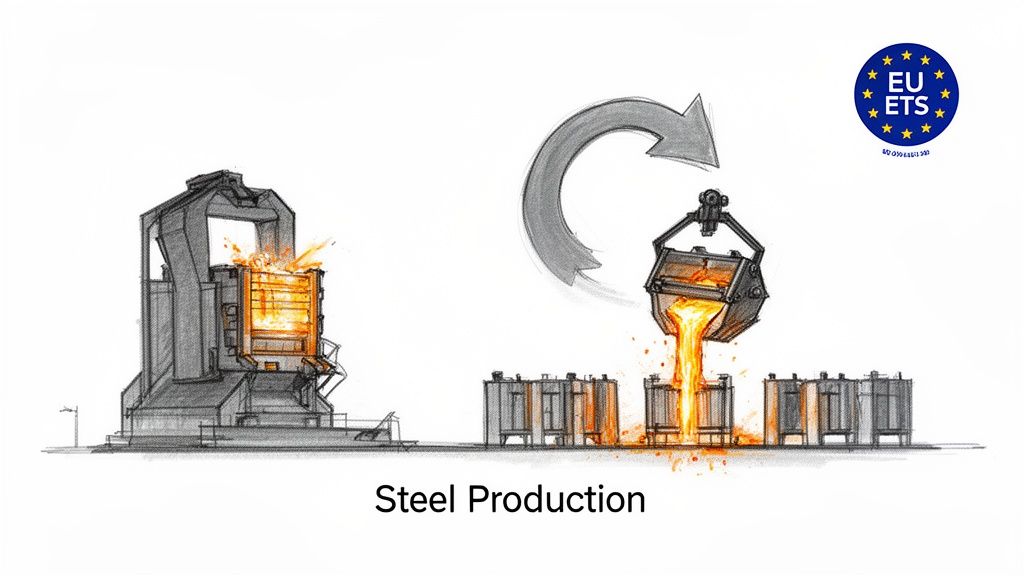
Under Romanian and EU law, these facilities are classified as Category A installations, requiring an Integrated Environmental Authorisation (Autorizația Integrată de Mediu). This permit governs all major environmental aspects in a single document, including air emissions (dust, CO, CO2, dioxins), wastewater from cooling and pickling processes, and the management of hazardous waste like slag and sludge. These installations are also central to the EU Emissions Trading System (ETS) and are directly impacted by the Carbon Border Adjustment Mechanism (CBAM), which places a price on the carbon embedded in imported goods.
Key Considerations and Practical Steps
Operating a steel production facility under these coduri caen demands more than just a permit; it requires a proactive strategy for decarbonisation and operational resilience. The focus is shifting from basic compliance to future-proofing the business against carbon pricing and supply chain pressures.
- Establish a Detailed Emissions Baseline: A crucial first step is to conduct a thorough inventory of Scope 1 emissions. It is important to distinguish between combustion emissions (from fuel use) and process emissions, which arise from chemical reactions like the reduction of iron ore with coke and the use of limestone.
- Analyse Carbon Cost Impact: Map your EU ETS allowance needs precisely and model the financial impact of carbon pricing on production costs and profit margins. This analysis is essential for strategic planning and communicating with investors about climate-related financial risks.
- Benchmark Against Best Available Techniques (BAT): Compare your plant's energy efficiency, measured in MWh per ton of steel, against the standards defined in the Best Available Techniques Reference Documents (BREF). Adherence to BAT is a core requirement of the integrated environmental permit.
- Develop a Science-Based Decarbonisation Roadmap: Create a long-term plan aligned with criteria from the Science Based Targets initiative (SBTi). Prioritise investments with the highest impact, such as transitioning from blast furnaces to Electric Arc Furnaces (EAF) or exploring green hydrogen technologies. This roadmap is vital for engaging with customers in supply chains pursuing their own net-zero targets.
Environmental Permit Comparison: 8 CAEN Codes
From Compliance to Competitiveness: Integrating Permits into Your Strategy
Navigating the complex matrix of coduri CAEN autorizatie mediu can often feel like a purely administrative exercise. However, the process of obtaining an environmental permit is a fundamental building block for long-term business resilience and a strategic advantage in a market that increasingly values transparency and sustainability.
The detailed documentation required for an autorizație de mediu or an acord de mediu forces an organisation to meticulously quantify its operational footprint. This includes data on energy consumption, water usage, waste generation, and atmospheric emissions. This isn't just paperwork for the authorities; it's business intelligence.
Turning Regulatory Data into a Strategic Asset
The true value emerges when you shift your perspective. View the authorisation process not as an endpoint, but as the starting point for operational excellence. The very data you gather for compliance is the same data required for a host of strategic business initiatives.
- Foundation for ESG Reporting: The information compiled for your permit directly feeds into key performance indicators (KPIs) needed for sustainability reports. This is critical for companies subject to the Corporate Sustainability Reporting Directive (CSRD) or those looking to disclose information to frameworks like CDP.
- Improving EcoVadis Scores: Suppliers in global supply chains are frequently assessed on their environmental performance via platforms like EcoVadis. The data and management systems documented in your permit application are central to demonstrating the robust environmental policies that lead to higher scores.
- Driving Decarbonisation: You cannot manage what you do not measure. The energy and emissions data collected for compliance provides the essential baseline for setting realistic carbon reduction targets and developing a credible decarbonisation strategy.
- Enhancing Credibility: A well-managed and transparent approach to environmental compliance builds trust with key stakeholders. Investors, financial institutions, and B2B customers are increasingly scrutinising the environmental risk profiles of their partners. Demonstrating proactive management, backed by official permits, reduces perceived risk and can unlock better financing terms or new business opportunities.
Actionable Next Steps: From Permit to Progress
With the knowledge of which coduri CAEN autorizatie mediu apply to your operations, the next step is to integrate this process into your broader business strategy.
- Centralise Your Data: Create a single source of truth for all environmental data collected during the permit application. This avoids departmental silos and ensures that the information is accessible for strategic planning, reporting, and operational improvements.
- Assign Clear Ownership: Move responsibility for environmental data beyond the compliance department. Involve operations, finance, and procurement teams to ensure the data is understood and used to drive efficiency and cost-saving initiatives.
- Link Compliance to Business Goals: Explicitly connect the renewal of your environmental permit to larger objectives. For example, set a goal to reduce a specific emission by 5% before the next permit renewal, using the compliance cycle as a performance milestone. For businesses with a global footprint, understanding how local permits fit into wider schemes is crucial. Beyond local environmental permits, understanding broader regulatory frameworks, such as obtaining a global compliance certification, can be a strategic move for businesses operating internationally.
By treating the acquisition of an environmental authorisation as a strategic data-gathering exercise, your organisation transforms a regulatory burden into a clear path toward improved efficiency, reduced operational risk, and greater competitiveness. The goal is not just to hold a permit, but to use the insights gained to drive tangible business progress.
At ECONOS 🌱, we help you move beyond simple compliance. We partner with your teams to translate the data from your "autorizatie mediu" into actionable ESG strategies, building internal capability so you become autonomous. Discover how we turn regulatory requirements into your competitive advantage.