
.png)
When companies ask "what does ISO 9001 mean," they are often looking for a practical business advantage, not just a definition. Real progress comes from execution, not just frameworks. ISO 9001 is a globally recognized standard for a Quality Management System (QMS), and we see companies using it to build operational discipline that translates directly into trust, efficiency, and competitiveness.
What ISO 9001 Means for Your Business Today

Forget the complex jargon for a moment. Think of ISO 9001 as the operating system for your company’s quality. It provides a structured, common-sense approach to ensure your processes are defined, controlled, and always getting better. The whole standard is built on a simple, powerful idea: systematic management leads to predictable, high-quality results.
For Romanian companies, especially since joining the European Union, the standard has become a critical business tool. It’s no longer a "nice-to-have" but a clear signal to partners, customers, and regulators that your organisation is serious about operational excellence.
Building Trust and Earning a Competitive Edge
A certified QMS is a powerful way to stand out. It proves your business has put in the work to build robust processes that effectively manage quality. This builds immediate trust with potential clients, who see you have a formal system for:
- Consistently meeting their requirements
- Identifying and managing business risks
- Driving continuous improvement across all operations
This trust isn't just a feeling—it translates directly into a competitive advantage. It can open doors to new markets, particularly within EU supply chains where certification is often a non-negotiable requirement for doing business.
By standardising how you work, you reduce errors, cut down on waste, and build a culture of accountability. This isn’t just a compliance exercise; it’s the engine that drives sustainable growth and makes your business more resilient.
A Foundation for Modern Compliance
The process-based approach of ISO 9001—with its focus on customer satisfaction and leadership commitment—has seen huge adoption in Romania as EU accession pushed quality demands higher. A great example is the Authority for the Digitization of Romania (ADR), which became the country's first public digital transformation body to earn this certification. An audit confirmed its quality system was fully implemented and effective, showcasing a national drive toward international standards even in public administration. You can read more about how this reflects a wider trend on Outsourcing Today.
Ultimately, implementing ISO 9001 instils the organisational discipline needed to tackle other modern demands, like Environmental, Social, and Governance (ESG) reporting, where auditable data and controlled processes are absolutely essential.
The 7 Core Principles Driving Quality Management
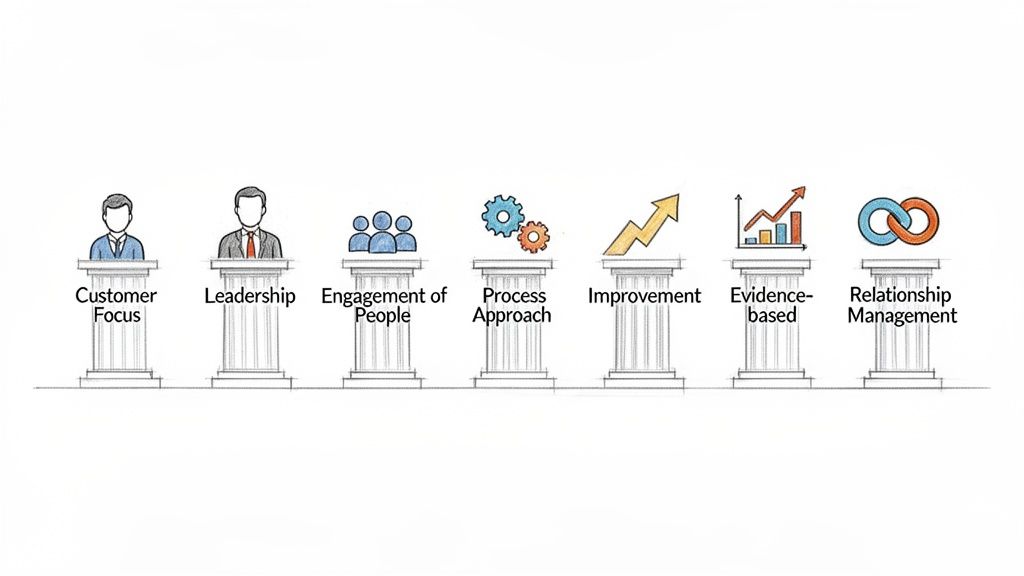
The ISO 9001 certificate itself is just paper. The real value comes from embedding its seven core principles into the fabric of your business. These aren't just abstract rules; they are the strategic pillars that support an effective Quality Management System (QMS).
Think of them as the operating system for a quality-focused company. They guide decisions, shape your culture, and ensure everyone is pulling in the same direction. When properly implemented, these principles transform a QMS from a dusty binder on a shelf into a living, breathing part of your daily work.
1. Customer Focus
This is the North Star of ISO 9001. A business only exists because it serves customers, so understanding their current and future needs is absolutely critical. This goes far beyond good customer service—it means actively seeking feedback and using that intelligence to make your products and processes better.
2. Leadership
A quality management system will fail without commitment from the top. It’s that simple. Leadership must set a clear, unwavering vision for quality and create an environment where people feel empowered and engaged in achieving the company’s goals. They set the tone and, crucially, provide the resources needed for success.
3. Engagement of People
Competent, empowered, and engaged people are the engine of quality. When employees at every level are involved in the process and recognized for their contributions, they become far more motivated to deliver value and drive continuous improvement.
An engaged team is the difference between a system that merely exists on paper and one that actively improves the business and delights clients every single day.
4. Process Approach
ISO 9001 encourages you to see your business not as a collection of departments, but as a system of interconnected processes. When you manage activities as a cohesive flow of work, you get far more consistent and predictable results. This means mapping out how work actually gets done to spot bottlenecks, cut waste, and boost efficiency.
5. Improvement
Successful companies never stand still; they have a relentless focus on improvement. This isn't about achieving perfection overnight. It's about making small, consistent steps forward, reacting intelligently to market changes, and constantly seeking new opportunities to do things better.
6. Evidence-Based Decision Making
Decisions backed by data simply get better results. A cornerstone of ISO 9001 is moving away from gut feelings and institutional habits toward structured, evidence-based choices. This approach is powerfully enhanced by modern data-driven decision making techniques.
7. Relationship Management
Finally, a business does not operate in a vacuum. To succeed, you must carefully manage relationships with all interested parties, especially suppliers and partners. Building strong, collaborative ties with key suppliers is essential for a reliable supply chain and for guaranteeing the quality of your final product or service.
To bring these ideas to life, here’s how each principle looks in a real-world business setting.
The 7 Principles of Quality Management in Practice
| Principle | What It Means | Practical Business Example |
|---|---|---|
| Customer Focus | Everything starts and ends with the customer’s needs and satisfaction. | Conducting regular customer surveys and using the feedback to prioritise new product features or service improvements. |
| Leadership | Top management is actively involved and visibly committed to quality. | The CEO regularly communicates the company's quality policy in all-hands meetings and allocates budget for new training. |
| Engagement of People | Employees at all levels are empowered to contribute to quality. | Forming cross-departmental teams to solve recurring problems, and rewarding employees who suggest process improvements. |
| Process Approach | Work is managed as a system of interconnected activities. | Creating a visual flowchart for the entire order-to-delivery process to identify and remove delays or sources of error. |
| Improvement | The organisation is always seeking ways to get better. | Holding monthly "Kaizen" events where teams identify small, incremental improvements to their daily workflows. |
| Evidence-Based Decision Making | Decisions are made based on data and analysis, not assumptions. | Instead of guessing why sales are down, the team analyses market data and customer behaviour to pinpoint the exact cause. |
| Relationship Management | The company builds mutually beneficial relationships with suppliers. | Partnering with a key supplier to co-invest in new technology that improves the quality and consistency of raw materials. |
By translating these seven principles into concrete actions, any organisation can build a powerful QMS that delivers real, measurable business value.
Navigating the ISO 9001 Standard Structure
At first glance, the official ISO 9001 document can look a bit dense. But its structure is actually quite logical, especially since its major update in 2015. That update introduced what’s known as the High-Level Structure (HLS), or Annex SL.
Think of the HLS as a common blueprint with ten core sections, or clauses. This same blueprint is now used for all modern ISO management standards, and that consistency is a huge advantage for any business.
This shared framework makes it much easier to run an integrated management system. If your company also needs to follow ISO 14001 for environmental management or ISO 45001 for health and safety, you'll find the structure is almost identical. You aren't starting over every time; you’re building on a foundation you already know.
Understanding the 10 Core Clauses
The ten clauses of ISO 9001 guide you through setting up a Quality Management System (QMS). While the first three are introductory, the real work happens in Clauses 4 through 10. These aren't just a list of rules to check off; they bring the PDCA (Plan-Do-Check-Act) cycle to life within your business.
Let’s break down what each clause means in practice.
Clause 4: Context of the Organization
This is where it all starts. It forces you to look both inside and outside your business. You have to identify all "interested parties"—your customers, suppliers, employees, and even regulators—and understand what they need from you. For a company asking ce inseamna iso 9001, this means one thing: quality can't exist in a bubble. It must be woven directly into your business strategy.Clause 5: Leadership
This clause makes it clear that top management must lead the charge, not just delegate quality to someone else. Leaders have to set the quality policy, make sure it lines up with the company's goals, and show everyone they’re committed to making it work. This was a major shift from older versions, putting accountability right at the top.
A QMS without leaders who are actively involved is just a paper-pushing exercise. Clause 5 makes quality a boardroom topic, giving it the authority and resources needed to succeed.
- Clause 6: Planning
With context understood and leadership on board, you can start planning. This means setting clear quality objectives and—just as importantly—figuring out the risks and opportunities that could affect them. It’s all about being proactive instead of just reacting to problems.
From Planning to Action and Improvement
The final clauses are where you turn those plans into results and build a system that gets better over time.
Clause 7: Support
This covers all the resources you need to keep the QMS running. Think competent people, the right tools and infrastructure, a safe work environment, and clear communication channels.Clause 8: Operation
This is the "Do" part of the cycle. It’s the heart of your business—the core processes that create and deliver your product or service. This clause covers everything from design and development to production, making sure you have control over how the work gets done.Clause 9: Performance Evaluation
Now it's time to "Check." Here, you monitor, measure, and analyze how well your QMS is performing. This is where you conduct internal audits and management reviews to see if you’re actually hitting your targets.Clause 10: Improvement
Finally, you "Act." Based on what you found during your performance evaluation, you take concrete steps to get better. This involves correcting anything that went wrong and putting measures in place to make sure your QMS is always improving.
A Practical Roadmap to ISO 9001 Certification
Getting certified for ISO 9001 is a structured project, not an impossible marathon. Understanding ce înseamnă ISO 9001 in the real world means turning the standard’s clauses into a clear, step-by-step plan. It’s about building real value and making sure the system lasts long after the certificate is hanging on the wall.
The path to certification follows a logical sequence. Each step builds on the last, creating a solid Quality Management System (QMS) that is actually tailored to your business, not just a generic template.
1. Gaining Leadership Buy-In and Defining Your Scope
First things first: you need genuine commitment from your top management. This isn’t just about getting a signature; it’s about leaders actively supporting the process and dedicating the people and resources needed to get it done.
Once leadership is on board, you have to clearly define the scope of your QMS. Will it cover the entire organisation, or just a specific division, product line, or location? A clear scope prevents confusion and keeps everyone focused on the same goal.
2. Conducting a Gap Analysis
Before you can build anything, you need a blueprint. A gap analysis is basically an audit of your current processes measured against the ISO 9001 requirements. It answers one simple question: where are we now, and where do we need to be?
This step shows you what you're already doing right and pinpoints the exact areas that need work. It saves a huge amount of time and money by stopping you from reinventing processes that already meet the standard.
3. Planning and Documenting Your QMS
With the gaps identified, you can build your action plan. This is where you design and document the necessary processes and procedures. The goal here is clarity and efficiency, not creating a mountain of paperwork. Keep it lean and practical.
A common mistake is over-documenting. Your QMS should serve the business, not the other way around. Focus on creating simple, useful documents that your teams will actually use to guide their work.
4. Implementation and Team Training
This is where the documented QMS comes to life. New processes are rolled out, and teams are trained on their specific roles and responsibilities. This phase is absolutely critical for making sure everyone understands the "why" behind the changes and can run the system on their own. We combine delivery with training so teams become autonomous.
5. Running Internal Audits
Before you face an external auditor, you need to test your own system. Think of internal audits as a dress rehearsal. They are run by your own trained staff (or a consultant) to confirm the QMS is working as designed and meets all the ISO 9001 requirements. You can learn more about managing this crucial step in our guide to effective risk management services.
6. The External Certification Audit
This is the final step. An independent certification body sends an auditor to evaluate your QMS against the standard. Successfully passing an ISO 9001 audit is the key to both gaining and keeping your certification.
If your system is compliant, you’re awarded the certificate. But this isn't the end of the journey—it's the beginning of a long-term commitment to getting better every day.
The Strategic Business Benefits of ISO 9001
So, you're considering a Quality Management System (QMS). The big question every leadership team eventually asks is simple: why? What's the actual return on the time and money you invest? The answer goes far beyond just "improving quality." To really understand ce inseamna ISO 9001 for a business, you have to look at the tangible, bottom-line results it delivers.
For the companies we work with, these benefits aren't abstract concepts. They show up as measurable gains in efficiency, client trust, and market access. Pursuing this standard isn’t a cost centre; it’s a strategic investment in the long-term resilience and health of your organisation.
The journey to certification follows a proven, logical path. It’s a clear roadmap that moves from understanding where you are today to building a system that works, and finally, getting it audited.
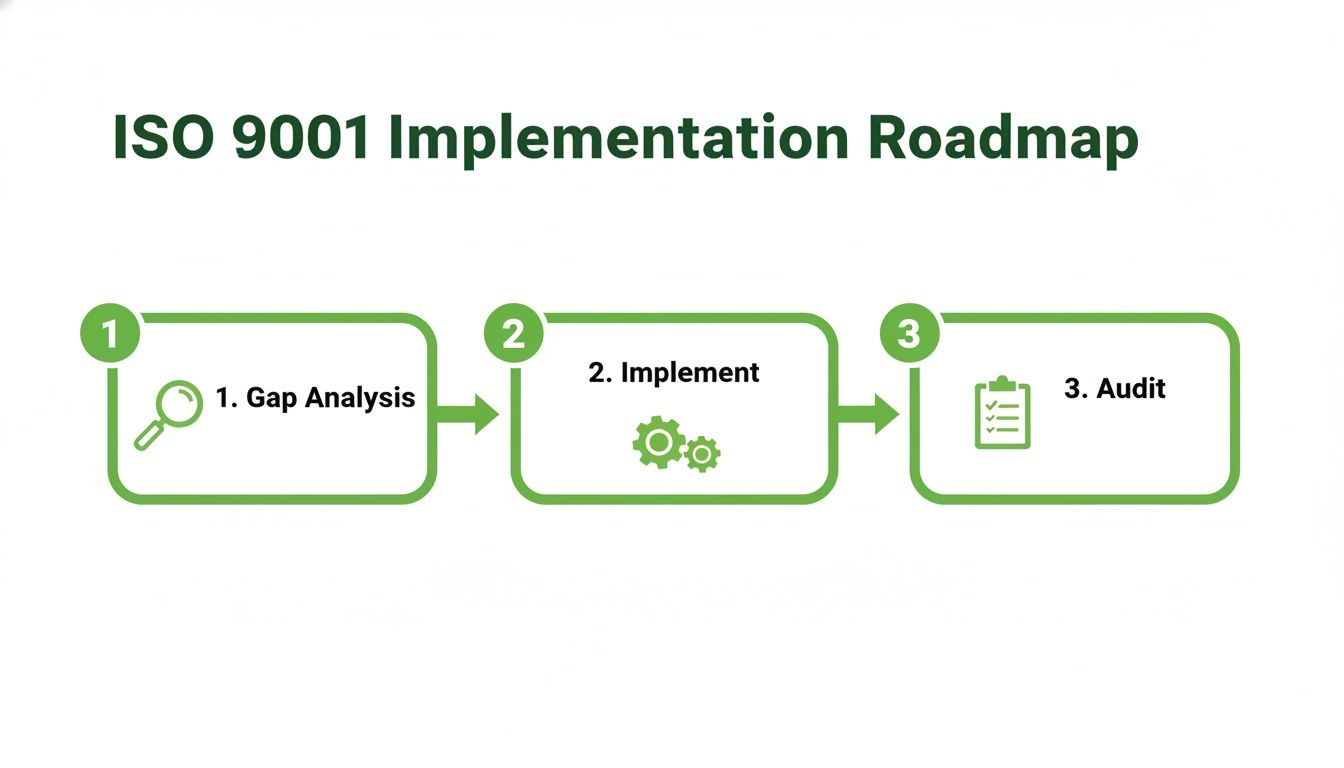
This structured approach makes sure the implementation process itself is targeted and efficient, focusing your resources on building a QMS that’s both robust and effective.
Enhanced Customer Trust and Satisfaction
At its heart, ISO 9001 is about one thing: making sure you consistently deliver on your promises to your customers. A certified QMS is a powerful signal to the market that your company is built on a foundation of reliability.
This commitment translates directly into greater customer satisfaction, which in turn fuels loyalty and repeat business. When clients know you have dependable processes for managing quality and resolving issues, their confidence in you grows. That’s the bedrock of any strong, lasting partnership.
Greater Operational Efficiency
By forcing you to adopt a "process approach," ISO 9001 makes you map out, understand, and question how work actually gets done. This systematic review almost always shines a light on hidden inefficiencies, redundant steps, and frustrating bottlenecks you never knew you had.
The result is a leaner, more effective organisation. Optimising your processes cuts down on waste, minimises costly errors, and reduces operational overhead. That frees up resources you can then reinvest into innovation and growth.
Better Risk Management
ISO 9001 fundamentally changes how you deal with risk. Instead of reacting to problems, it requires you to proactively identify what could go wrong—anything that might impact your products, services, or customer satisfaction—and then make a plan to prevent it.
This shifts the entire organisation from a reactive, "fire-fighting" culture to a proactive, forward-looking one. Catching risks early allows you to stop problems before they happen, protecting both your reputation and your bottom line. This focus on proactive management is a core part of building business resilience, a key theme in broader conversations around what sustainability means in today's corporate world.
Access to New Markets
For many organisations, ISO 9001 certification isn't just a "nice-to-have"—it's a ticket to the game. Countless government tenders and major corporate supply chains list it as a non-negotiable requirement for their suppliers.
By getting certified, you unlock doors to new revenue streams and partnerships that were completely closed off before. It serves as proof that your business operates at an internationally recognised standard, giving you a powerful competitive edge.
The table below gives you a clear "before and after" picture, showing how a structured QMS solves common business problems and drives real transformation.
Business Transformation with ISO 9001
| Business Challenge (Before ISO 9001) | ISO 9001 Solution (After Implementation) | Resulting Business Benefit |
|---|---|---|
| Inconsistent product/service quality leads to customer complaints and rework. | Standardised processes and clear quality criteria for all key activities. | Increased customer satisfaction and loyalty; reduced costs from errors. |
| Hidden inefficiencies, wasted resources, and high operational costs. | Process mapping and a focus on continual improvement (PDCA cycle). | Improved operational efficiency; lower costs and better resource allocation. |
| Reactive "fire-fighting" culture; problems are fixed only after they occur. | Mandatory risk-based thinking to identify and mitigate potential issues proactively. | Enhanced risk management and greater business resilience. |
| Key knowledge is held by a few individuals, creating risk if they leave. | Formalised documentation of processes, roles, and responsibilities. | Improved knowledge management and organisational stability. |
| Unable to bid on large tenders or enter certain regulated supply chains. | Internationally recognised certification that serves as a prerequisite for market entry. | Access to new markets and significant competitive advantage. |
| Decisions are based on gut feeling or incomplete information. | Requirement for monitoring, measurement, analysis, and evaluation of performance data. | Fact-based decision-making that drives strategic improvements. |
Ultimately, implementing ISO 9001 moves a company from a state of ad-hoc operations to one of systematic control and continuous improvement. This shift doesn't just improve quality—it builds a stronger, more competitive, and more resilient business from the inside out.
Connecting ISO 9001 to Modern ESG Demands
ESG existed before regulation, but the goal remains operational progress, not perfect reporting. So how do you ensure the data behind your ESG claims is solid? The discipline, data-driven mindset, and drive for improvement that define quality management are the answer. It’s simple: you can't manage what you don't measure, and you can't measure what you don't control.
Building a Foundation for Audit-Ready Data
ISO 9001 gives you the perfect structure for collecting the kind of reliable, verifiable data that regulators and stakeholders now require. This system of controls is crucial for proving your ESG performance.
Think about the practical connections:
- Environmental: A well-run quality management system is vital for accurately tracking environmental data like energy consumption, waste generation, and greenhouse gas emissions. This is a non-negotiable for regulations like the Corporate Sustainability Reporting Directive (CSRD).
- Social: The standard’s focus on managing supplier relationships and ensuring product conformity directly supports the social side of ESG. It provides a framework for setting up ethical sourcing protocols and making sure your supply chain partners meet the standards you expect.
- Governance: The emphasis on leadership commitment, risk-based thinking, and clear documentation builds the strong governance structure you need to oversee any ESG strategy.
A commitment to quality is directly tied to building a resilient business. An ISO 9001-certified system delivers the audit-ready data that investors, regulators, and customers expect, proving your ESG claims are backed by solid processes.
If your organisation is just starting to get its sustainability efforts in order, our guide on decoding common ESG terms can be a really helpful first step.
Ultimately, ISO 9001 builds the operational rigour needed to turn ESG ambitions into measurable results. It provides the "how" for the "what" of sustainability reporting, making your business better prepared for future compliance and market expectations.
Your ISO 9001 Questions, Answered
When companies first start looking into ISO 9001, a few practical questions almost always come up. Let's tackle them head-on.
How Long Does It Take to Get Certified?
There’s no single answer, as the timeline really depends on your company's size, complexity, and how solid your processes already are. For a small or medium-sized business building a system from the ground up, you should realistically plan for 6 to 12 months.
A proper gap analysis is the only way to get a firm estimate. It shows you exactly where you stand and what’s left to do.
Is ISO 9001 Just for Factories?
Not at all—though that’s a common myth. The standard was designed to be universal, which is why it’s just as valuable for service providers, software companies, hospitals, and even public agencies as it is for manufacturers.
The principles of delivering consistent quality are the same everywhere.
The standard is intentionally flexible. It tells you what you need to achieve—like understanding customer needs or controlling documents—but it never dictates how you must do it. This gives every business the freedom to build a system that actually fits its own culture and operations.
What’s the Difference Between ISO 9001 and ESG?
Think of it this way: ISO 9001 gives you the engine, while ESG provides the roadmap for the entire journey. ISO 9001 is the framework for your Quality Management System (QMS), focused tightly on operational excellence, consistency, and keeping customers happy.
Environmental, Social, and Governance (ESG) is a much broader lens used to evaluate your company’s total impact on the world—from its carbon footprint to its supply chain ethics.
The two are not the same, but they are deeply connected. A strong QMS is what makes your ESG data trustworthy. The process controls, documentation, and audit trails required by ISO 9001 are exactly what you need to accurately report environmental metrics or prove you’re managing your supply chain responsibly.
At ECONOS 🌱, our team specializes in connecting quality management to your broader ESG goals. We help you build audit-ready systems that deliver both market credibility and genuine business resilience. Find out how we do it at https://www.econos-esg.com.