
.png)

An "auditor de mediu" (environmental auditor) is no longer just a compliance function. For Romanian companies, this role is now a strategic partner for managing risk, unlocking capital, and ensuring competitiveness in a complex EU regulatory landscape. The goal is operational progress, not perfect reporting.
An Auditor de Mediu is a Business Navigator for 2026 and Beyond
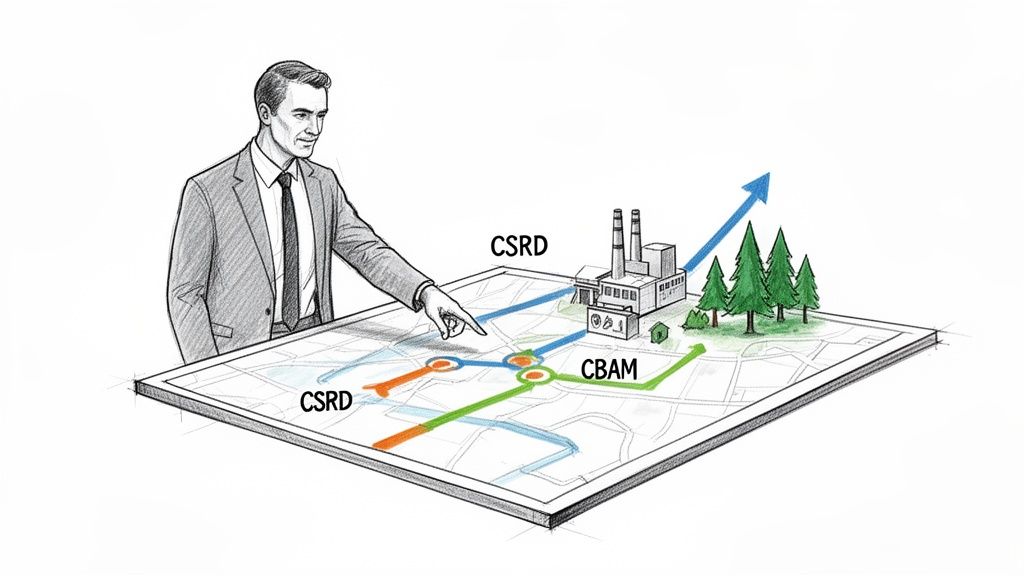
We see companies across manufacturing, retail, and agriculture facing new pressures. EU regulations like the Corporate Sustainability Reporting Directive (CSRD) and the Carbon Border Adjustment Mechanism (CBAM) have moved environmental performance from a secondary concern to a core business driver. It now directly impacts cost, market access, and brand trust.
For many leaders in Romania, the question is no longer if they need to act, but how they can do so in a scalable and affordable way.
This is where a modern auditor de mediu becomes critical. Their role has expanded beyond local permit checks to become a business navigator. Today, a strategic environmental audit provides the foundation for business resilience and growth by focusing on execution, not just frameworks.
A Shift from Compliance to Strategy
Traditionally, an environmental audit focused on fixing non-conformities with local laws. While that remains essential, our team sees the scope expanding daily. The goal has moved from simply avoiding fines to building an operational model that is credible, transparent, and trusted by banks and clients.
A skilled auditor helps you:
- Manage Risk Before It Becomes a Crisis: They identify environmental liabilities in operations and supply chains long before they become financial or reputational problems. This now includes assessing climate-related risks.
- Unlock New Opportunities: A verified environmental track record opens doors to green financing, attracts sustainability-focused investors, and helps win contracts with large buyers who now scrutinize their entire value chain.
- Guarantee Market Access: For exporters, compliance with rules like CBAM is not optional. An auditor provides the verified emissions data required to maintain access to the EU single market.
A modern audit delivers operational progress. The data and insights gathered should be a catalyst for cutting costs, improving efficiency, and strengthening the business for what comes next.
What a Strategic Auditor Does in 2026
The responsibilities of a strategic auditor de mediu now cover everything from compliance to corporate strategy, directly feeding into how a business positions itself for the future.
This table outlines their core functions in today's business climate.
This is a practical roadmap. This guide demystifies the audit process and shows how to use an auditor de mediu to turn regulatory burdens into a competitive advantage. By building internal capability and translating findings into strategy, companies can achieve lasting growth.
We combine delivery with training so teams become autonomous.
Key Responsibilities and Essential Qualifications
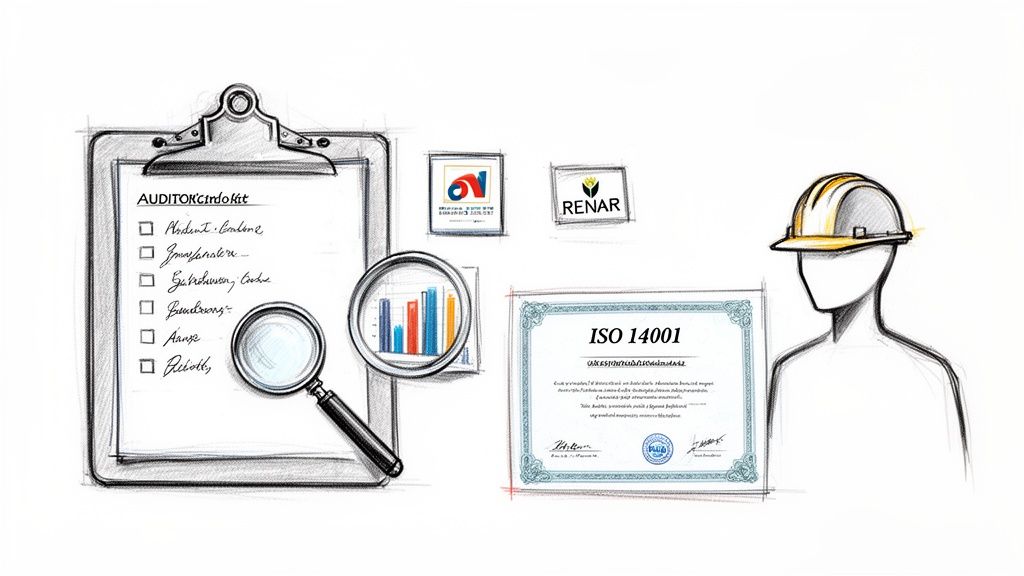
What separates a qualified auditor de mediu from a general consultant? It comes down to specific duties and verifiable credentials that guarantee their work is rigorous, credible, and will stand up to scrutiny from regulators, investors, and partners.
Understanding these functions is the first step for any company looking to hire an expert who delivers business value, not just a certificate. An auditor's role is investigative and analytical, focusing on evidence-based verification.
Their primary mission is to systematically assess an organization's environmental performance against clear criteria, from on-site inspections to data analysis for corporate sustainability reports.
Core On-Site and System Responsibilities
A professional environmental auditor’s job blends deep technical knowledge with procedural discipline. These responsibilities are the backbone of any credible audit.
- Conducting Site Inspections: The auditor physically visits facilities to observe operations, assess environmental controls, and identify potential risks or non-compliance issues.
- Evaluating Environmental Management Systems (EMS): A key task is auditing the effectiveness of an organization's EMS—often against the ISO 14001 standard—to ensure it is functional, not just a document on a shelf.
- Verifying Legal and Regulatory Compliance: The auditor meticulously checks if the company follows all applicable national and EU environmental laws, permits, and authorizations.
- Assessing Data for ESG Reporting: With the arrival of CSRD, auditors are now critical for verifying the accuracy and completeness of environmental data for sustainability reports, including GHG emissions, water usage, and waste generation figures.
A key part of an auditor's competence is knowing how to conduct effective internal audits that build lasting compliance. We work to build this capability within our clients' teams, giving them the tools for long-term autonomy.
Essential Qualifications and Verifiable Credentials
To ensure the person you hire can deliver audit-ready results, look beyond a general background in environmental science. Specific qualifications and certifications are your guarantee of expertise. A qualified auditor de mediu should have a mix of formal education, accredited training, and proven experience.
The credibility of your environmental data is directly tied to the credentials of the person who verifies it. In the context of CSRD and investor due diligence, unsubstantiated claims are a significant business risk.
Look for a professional with a strong academic foundation in environmental engineering, chemistry, or a related science. The real differentiators are official certifications and proven, hands-on regulatory knowledge.
In Romania, accreditation from RENAR (Asociația de Acreditare din România) is the gold standard for verifying the competence of conformity assessment bodies, including those that certify auditors.
When an auditor or their certifying body holds RENAR accreditation, it confirms they operate according to recognized national and international standards—a powerful signal of credibility.
Key Credentials to Look For
When you're ready to hire, prioritize candidates or firms that can show you the following qualifications:
- Formal Auditor Certification: Look for certifications from recognized bodies proving training in audit methodologies, like those aligned with ISO 19011 (Guidelines for auditing management systems).
- RENAR Accreditation: Check if the auditor or their organization is accredited by RENAR for specific scopes, such as ISO 14001 certification. This adds a crucial layer of official validation.
- Demonstrated Experience with EU Regulations: The auditor must have a deep, practical understanding of regulations like CSRD/ESRS, CBAM, and the EU Taxonomy. Ask for case studies or concrete examples of their work.
Hiring the right auditor de mediu is a strategic decision that ensures your organization not only complies with the law but also builds a resilient, credible operational framework for the future.
Navigating Romania's Unique Environmental Landscape
An effective auditor de mediu applies environmental rules within Romania's specific context—its priorities, pressures, and challenges.
A skilled auditor helps a business respond to these local pressures, turning a regulatory burden into an opportunity for smarter operations and a stronger reputation. Their work connects high-level EU directives with the practical realities on the ground, using an execution-first approach.
Their assessments must look at how daily operations impact everything from national circular economy goals to local biodiversity.
Waste Management and the Circularity Gap
One of Romania's biggest environmental hurdles is waste management and circularity. A specialized environmental auditor proves their worth here. Their role is to see how a company’s business model fits with circular economy principles.
For example, an auditor will investigate questions like:
- Material Sourcing: Are you using recycled materials? Are your products designed for disassembly and reuse?
- Production Processes: How much waste are you creating, and what systems are in place to reduce it?
- End-of-Life Management: Do you have effective take-back programs or recycling partnerships?
This focus is essential. Romania has one of the lowest circular material usage rates in the EU, at just 1.3% according to 2023 data. The government has responded with a National Strategy for the Circular Economy and a deposit-return system. For an auditor de mediu, this landscape offers a clear roadmap to help companies improve performance, lift EcoVadis scores, and align with the EU Taxonomy. You can find more details in this report on Romania's circular material usage.
Air and Water Quality Standards
Beyond waste, an auditor must assess compliance with local air and water quality standards, which often requires a granular level of review.
An auditor will meticulously examine permits and authorizations, like the autorizație de mediu, to confirm that every condition is met. If you want to understand this topic better, you can learn more about the environmental authorisation process in our guide.
The audit process involves verifying:
- Emissions Monitoring: Are the systems tracking air pollutants accurate and regularly calibrated?
- Wastewater Discharge: Does the company stay within the discharge limits specified in its water management permit?
- Incident Response Plans: Are there effective, tested procedures for managing accidental spills or excess emissions?
An auditor’s job is to provide objective evidence that a company is not only meeting the letter of the law but is also actively managing its environmental footprint. This verified data builds trust with local authorities and communities.
Impact on Protected Natural Areas
Romania's rich biodiversity and vast network of protected natural areas add another specific layer to environmental audits. Nearly a quarter of the country's territory is under some form of protection, meaning many industrial and agricultural operations are adjacent to sensitive ecosystems.
A forward-thinking auditor de mediu will assess a company's potential impact on these areas, even if a basic permit doesn't demand it. This proactive approach helps businesses get ahead of reputational risks and demonstrate responsible stewardship.
This assessment might include evaluating:
- Proximity to Natura 2000 sites.
- The impact of water usage on local hydrology.
- The potential for noise or light pollution to affect wildlife.
By aligning operations with national conservation goals, a company strengthens its social license to operate. A strategic environmental audit provides the framework for this, turning a potential risk into a demonstration of corporate responsibility. This is how we help clients build resilience—we combine delivery with training so teams become autonomous in managing these local challenges.
The Auditor's Role in CSRD and Green Deal Compliance
The European Green Deal is the new operational reality for businesses in Romania. Directives like the Corporate Sustainability Reporting Directive (CSRD) and mechanisms like the Carbon Border Adjustment Mechanism (CBAM) are turning environmental data into a core business necessity.
This is where the traditional work of an auditor de mediu connects with modern ESG (Environmental, Social, and Governance) reporting.
An auditor’s primary job is verification. Today, that work delivers the foundational data needed for complex EU mandates. Their findings are essential for non-financial reports examined by investors, clients, and regulators across Europe.
Without the rigorous data validation an auditor performs, a company’s sustainability report is built on shaky ground. They are the bridge between factory floor operations and boardroom strategy, making them indispensable for meeting the EU's new transparency demands.
Powering CSRD and ESRS Disclosures
The CSRD requires companies to report on their environmental impacts using the European Sustainability Reporting Standards (ESRS). An environmental audit provides direct, verified data points for several of the most important standards.
Two stand out immediately:
- ESRS E2 - Pollution: This standard demands specific disclosures on pollution to air, water, and soil. An auditor de mediu is perfectly suited to verify this information, as their work already involves checking compliance with emissions limits and water discharge permits.
- ESRS E5 - Resource Use and Circular Economy: Auditors are trained to evaluate waste management systems, material flows, and resource efficiency. Their findings deliver the quantitative data needed for reporting on circularity, from recycled materials used to total waste generated.
This infographic shows how an auditor's work connects directly to Romania's key environmental challenges, which are also central to ESRS reporting.
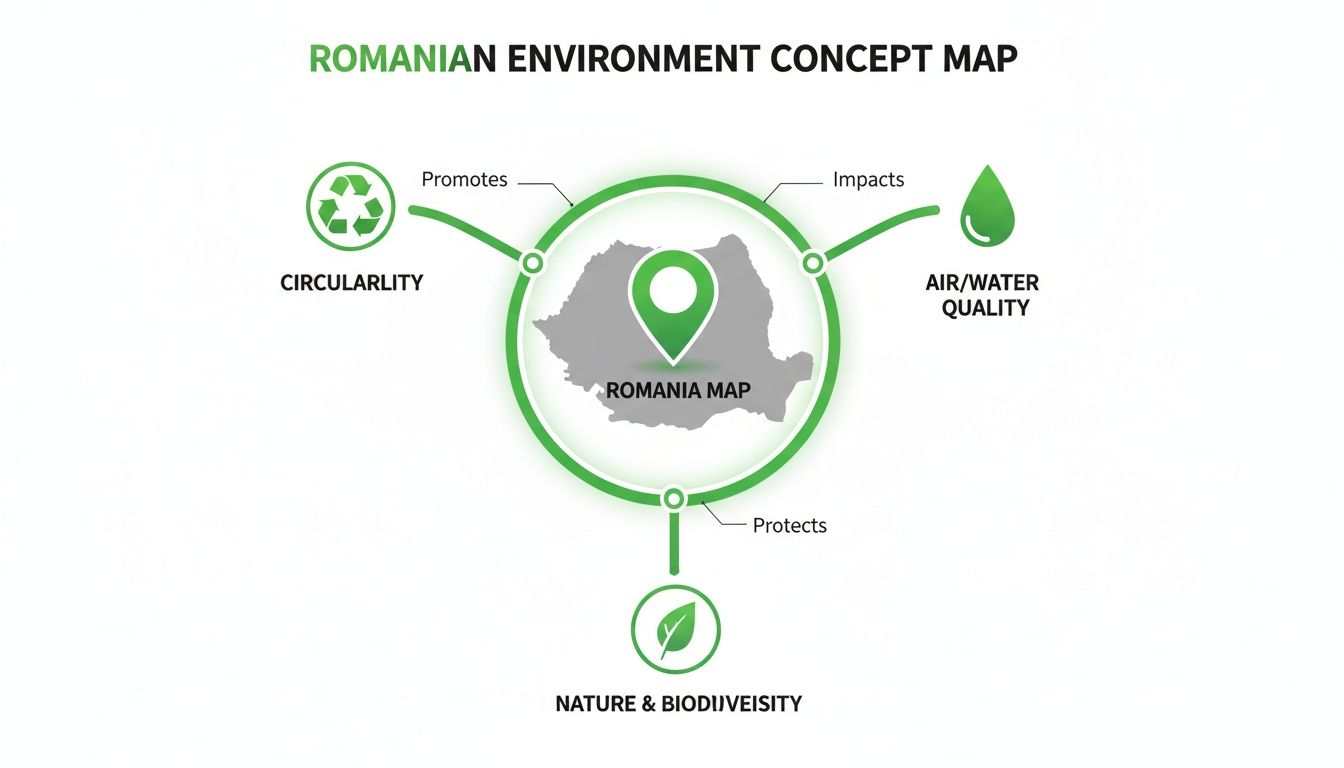
The map highlights how an auditor’s deep dive into circularity, air/water quality, and nature protection provides the evidence-based data you need for a compliant and trustworthy sustainability report.
Below is a quick overview of how standard environmental audit activities feed directly into the major EU regulations.
How Environmental Audits Support Key EU Regulations
This table breaks down the direct link between what an environmental auditor does and the data required by major EU sustainability directives.
The auditor's work is the engine that produces the verified, granular data needed to navigate the entire EU Green Deal framework.
Verifying Data for CBAM Compliance
The Carbon Border Adjustment Mechanism is another area where an environmental auditor's role has become non-negotiable. CBAM places a levy on the embedded carbon emissions of certain goods imported into the EU, including cement, iron, steel, aluminum, fertilizers, and electricity.
For Romanian companies importing these goods—or for local manufacturers supplying them—proving the carbon content is now mandatory. An auditor de mediu with expertise in carbon footprinting is essential to get this right.
Their role here involves three key steps:
- Calculating Embedded Emissions: They analyze production processes to quantify the greenhouse gas (GHG) emissions tied to each specific product.
- Verifying Data Accuracy: They provide crucial third-party verification of the emissions data, ensuring it’s calculated using approved methodologies.
- Preparing for Reporting: They help assemble the necessary documentation for CBAM declarations, which is critical for avoiding trade delays and financial penalties.
A huge part of meeting these new mandates is conducting robust ESG due diligence, making sure all environmental, social, and governance factors are systematically measured and reported.
Audit findings are no longer just about compliance. They are the raw material for a credible non-financial report, an actionable decarbonization roadmap, and proof to the market that your business is prepared for the future.
From Audit Findings to Actionable Strategy
In the era of the Green Deal, the real value of an auditor de mediu is helping you turn audit data into business intelligence. The goal is operational progress, not just perfect reporting. Verified audit information should be the starting point for smarter strategic decisions.
For example, an audit might pinpoint high energy consumption in a specific production line. This isn't just a non-conformity; it's a critical data point that feeds directly into:
- Decarbonization Roadmaps: The company can now set a targeted, measurable goal for cutting energy use in that area, contributing to its Scope 1 and Scope 2 emissions reduction.
- Cost Reduction Initiatives: Lowering energy consumption directly reduces operational costs, delivering a clear financial return.
- Credible Reporting: The company can confidently report on its energy reduction efforts in its sustainability disclosures, backed by solid, verified data. If you want to explore this further, check out our guide on how to build a sustainability report that truly meets stakeholder expectations.
This philosophy is central to how we work. We don't just deliver an audit report; we combine it with training so your internal teams become more autonomous. By understanding how to act on audit findings, companies build the internal muscle to navigate CSRD, CBAM, and other EU regulations on their own, turning compliance into an engine for continuous improvement.
Turning Your Audit Report Into a Business Strategy
An environmental audit report shouldn't be a document that just gathers dust. Its real value comes to life after the fieldwork is done. That report—rich with findings, non-conformities, and recommendations—is a roadmap for making your business smarter, more resilient, and more profitable.
For many companies, the biggest challenge is figuring out where to start. An audit report can feel overwhelming, but a structured approach can turn technical data into a clear, actionable plan. It’s about translating complex details into business decisions that cut risk, lower costs, and build a stronger organization.
This is central to our philosophy. We don’t just hand you a list of problems; our team helps you solve them. We make sure your teams get the training they need to become self-sufficient, turning audit insights into real, lasting progress.
Deconstructing the Audit Report
A high-quality audit report is a structured document designed to guide your next moves. To use it effectively, you first need to understand its parts.
A typical report is organized into three main sections:
- Findings: These are the objective, evidence-based facts discovered during the audit. It could be anything from noting high energy use in a particular machine to confirming waste containers are correctly labeled.
- Non-conformities: This is where the auditor flags any instance where your operations fail to meet a specific legal or procedural requirement. These are often sorted by severity (major or minor) to help prioritize actions.
- Recommendations: This is the most forward-looking part of the report. Here, the auditor suggests specific corrective and preventive actions to fix non-conformities and improve overall environmental performance.
From Data to a Strategic Action Plan
Once you have the report, the next step is to create a formal action plan that prioritizes tasks, assigns clear ownership, and sets realistic deadlines and budgets.
- Prioritize Actions Based on Risk: Not all non-conformities carry the same weight. Work with your auditor to rank them based on risk level, looking at potential legal fines, operational downtime, reputational damage, and financial cost.
- Assign Internal Ownership: Every action item needs a designated owner who is responsible for getting it done. This simple step creates accountability and makes it easy to track progress.
- Set Budgets and Timelines: Define a realistic budget and a clear timeline for each corrective action. This turns a recommendation into a concrete project with measurable goals.
An audit report is a powerful business tool. When its findings are used to drive down energy consumption, reduce waste, or streamline resource use, the result is often a higher EcoVadis score and a stronger bottom line. It’s a direct link between compliance and profitability.
This process is critical in Romania’s shifting climate and economic landscape. While the country's performance in the Climate Change Performance Index (CCPI) has improved in some areas, low ratings in Climate Policy point to an uncertain road ahead. With national environmental protection spending growing, companies must use tools like audit reports to navigate this mixed reality and build credible decarbonization plans. You can find more details on Romania's climate performance on ccpi.org.
Building Internal Capability for Sustained Progress
The ultimate goal isn’t just to pass the next audit. It’s to build the internal muscle to manage environmental performance continuously, making it a natural part of your operations. An audit should be a learning opportunity that makes your team better at spotting risks and opportunities on their own.
This is why we emphasize training and capacity building. When your team understands not just what the findings are but why they matter, they become proactive problem-solvers. They start managing environmental issues with the same seriousness they apply to financial or operational ones.
This creates a culture of continuous improvement, where the audit cycle becomes a positive feedback loop. Each audit makes the organization smarter, more efficient, and better prepared. To get a better handle on the specifics of formal reporting, you might find our guide on creating an environmental report helpful.
How to Hire the Right Environmental Auditor
Choosing the right auditor de mediu or consulting firm is a major business decision. The right expert delivers insights to strengthen operations, manage risk, and find a competitive advantage. A poor choice can lead to superficial reports, wasted money, and missed opportunities.
Making a smart decision means asking the right questions—questions that dig deeper than surface-level qualifications. You need to understand their hands-on experience with new EU regulations, their grasp of your industry’s specific challenges, and how they’ll support your team long after the report is finalized.
Key Questions for Your Potential Partner
Before you sign any contracts, use this checklist to assess any potential auditor or firm. Their answers will tell you whether you’re getting a strategic partner or just another vendor.
How do you support clients with CSRD and CBAM?
- A competent auditor must have concrete experience with these new rules. Ask for specific examples of how they’ve helped other companies verify emissions data for CBAM or prepare pollution and circularity disclosures for ESRS E2 and E5.
What is your experience in our specific industry?
- An auditor who has only worked in retail won’t understand the challenges of a manufacturing plant. Ask them to describe their familiarity with your sector’s common environmental risks, operational complexities, and regulatory pressures.
How do you help clients operationalize audit findings?
- The real value of an audit comes from the follow-up. Ask about their process for helping you prioritize recommendations, set realistic timelines, and build a concrete action plan. Do they offer training to help your team manage these issues independently down the line?
- Operational Complexity: A business with multiple production sites, complex industrial processes, and many environmental permits will require a more intensive audit than a simpler organization.
- Scope of the Audit: Is the audit focused purely on local regulatory compliance, or does it also need to cover data verification for CSRD, supply chain assessments, or CBAM emissions calculations? A broader scope means more work.
- Data Readiness: If your environmental data is disorganized, the auditor will need to spend more billable hours collecting and validating it. A well-organized data inventory can significantly reduce your costs.
A strategic hiring decision focuses on long-term value. The goal is to find a partner who will help you build internal capability, ensuring your investment in an audit delivers tangible returns in cost savings, risk reduction, and operational resilience.
Understanding Cost Drivers and Budgeting
The cost of an environmental audit varies. It’s shaped by several factors, and understanding them will help you budget effectively.
Key cost drivers typically include:
Romania’s unique environmental context also plays a part. Protected natural areas cover about 25% of the country's territory, and national spending on environmental protection jumped from 1.7% to 2.7% of GDP between 2014 and 2022. This landscape requires companies to have robust management systems, making a skilled auditor de mediu indispensable. You can find more insights on Romania's environmental profile from the EEA.
Ultimately, hiring the right auditor is an investment. By focusing on deep expertise, strategic alignment, and a commitment to building your team's autonomy, you ensure that investment pays dividends for years to come.
Your Questions About Environmental Audits, Answered
For many business leaders, the world of environmental audits can seem complex. Here, we tackle some of the most common queries we hear from our clients, clarifying the role of an auditor de mediu and what it means for your company.
How Often Should My Business Get an Environmental Audit?
There's no single answer—it depends on your industry, the regulations you fall under, and your objectives.
If your company is in a high-impact sector or subject to CSRD reporting, an annual audit is the standard. This ensures your data is solid and ready for verification each year. For other businesses, an audit every two years might be sufficient. The key is to treat it as a tool for continuous improvement, not a one-time chore.
Is an ISO 14001 Certification the Same as an Environmental Audit?
No, but they work hand-in-hand. Your ISO 14001 certification is the framework—it proves you have a formal Environmental Management System (EMS).
An environmental audit is the verification process. It checks that your system is working as intended and that your operations are meeting all relevant environmental laws. The audit provides proof that your ISO 14001 framework is delivering real-world results.
A financial audit verifies the numbers in your books. An environmental audit verifies your company’s real-world compliance with regulations and the health of its management systems. In today's market, both are fundamental for earning the trust of investors, customers, and stakeholders.
Can an Auditor de Mediu Help My Company Save Money?
Absolutely. A good auditor de mediu uncovers hidden opportunities. By digging into your operations, they often pinpoint inefficiencies in how you use resources like energy, water, or raw materials.
Their recommendations frequently lead directly to cost savings. We see this in lower utility bills, reduced waste disposal fees, and avoiding the steep financial penalties that come with non-compliance. When done right, an audit delivers a clear return on investment.
At ECONOS 🌱, we don’t just deliver audit reports. We turn those findings into clear, actionable strategies that build business resilience and drive sustainable growth. See how our expert team can support your compliance and ESG goals. Explore our ESG services.