
.png)
The anunț public autorizație de mediu (public announcement for environmental authorisation) is a mandatory step for any project in Romania with a potential ecological impact. But viewing it as just a bureaucratic formality is a common mistake. In our work, we see this as the first test of a project's credibility. It’s a critical step that ensures legal compliance, invites community feedback, and ultimately de-risks your operational timeline. Getting this right from day one prevents costly delays and builds essential trust with regulators and the community.
Why the Public Announcement Is a Strategic Business Tool
Many companies see the public announcement as just another compliance box to tick. In our experience, this view misses the point entirely. When you treat the anunț public autorizație de mediu as a strategic communication tool—not just an administrative hurdle—you can fundamentally de-risk your project and speed up your timeline. It’s your first and most visible commitment to transparency.
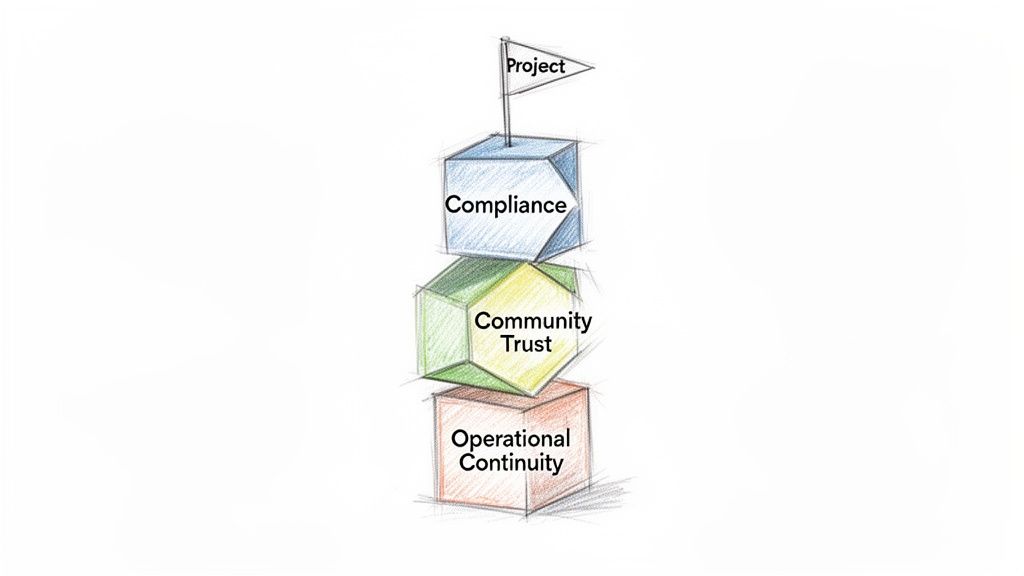
A well-handled announcement process helps you hit three core business goals: compliance, trust, and continuity.
This visual flow shows how these three elements are woven together in the environmental approval process.
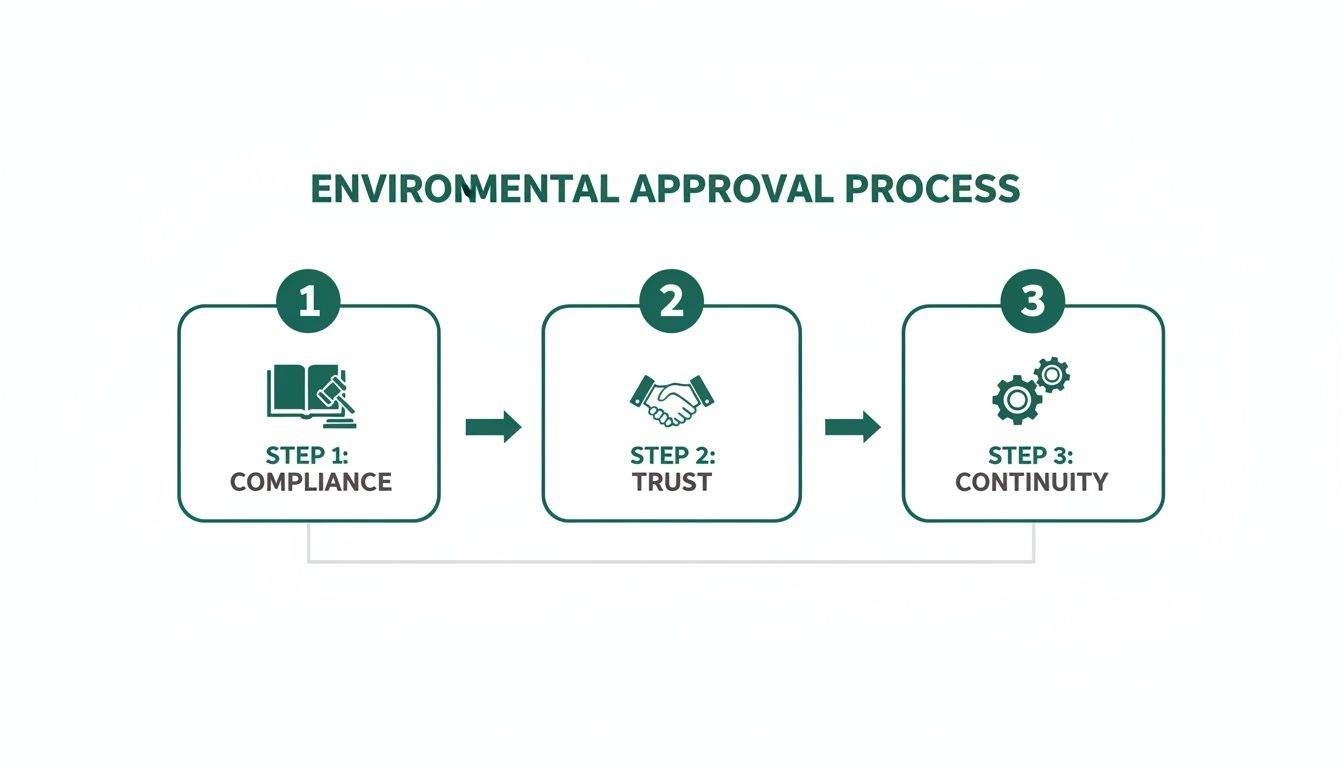
The takeaway here is simple. Compliance is the foundation, but building trust through open communication is what truly unlocks long-term operational continuity.
Before we dive into the "how-to," it's helpful to see where this step fits within the broader procedure. The public announcement is a key part of the initial classification and public consultation phase.
Key Stages of the Environmental Authorization Process
This table outlines the core phases of obtaining an environmental authorization in Romania, highlighting where the public announcement fits.
As you can see, the public announcement is not just a formality but an integral part of the decision-making process itself.
Securing Your Social Licence to Operate
Beyond the legal text, the announcement is your first real conversation with the local community, investors, and regulators. How do you want that conversation to begin? A clear, honest, and accessible announcement sets a collaborative tone. A vague or poorly published one just invites suspicion and opposition, which can quickly lead to formal complaints, public debates, and major delays.
In Romania, the anunț public autorizație de mediu is a critical gateway for new projects, ensuring community input under a strict, EU-aligned framework. With renewable energy projects growing significantly, the process has never been more visible. Navigating these announcements is vital; our team helps clients prepare solid documentation from the start, avoiding the setbacks that have historically plagued projects due to incomplete submissions. You can explore more on this regulatory environment in the UNECE findings on Romanian environmental performance.
Mitigating Project and Financial Risks
The costs of a poorly handled public announcement are tangible and can be severe.
- Project Delays: An incomplete or non-compliant announcement can cause the Environmental Protection Agency (APM) to suspend your application. This pushes your entire project timeline back by weeks, sometimes even months.
- Budget Overruns: Every day of delay adds up. You’re paying for team salaries, equipment rentals, and missed market opportunities.
- Reputational Damage: A difficult authorisation process can tarnish your brand's reputation, making future projects in the region harder and straining relationships with key stakeholders.
We see this across suppliers and in audits: a project with solid technicals gets stalled for months simply because the initial announcement was unclear or published in the wrong place. This is an entirely preventable risk.
By treating the announcement with the strategic weight it deserves, you turn it from a liability into an asset. A proactive, transparent approach shows good governance—a key factor for investors and partners. It signals that your company isn't just focused on short-term wins but is building a resilient, sustainable operation. That’s how a simple compliance task becomes a real competitive advantage.
Navigating the Legal Framework and Key Deadlines
Getting the legal details wrong on your public announcement isn't just a minor administrative hiccup—it can bring an entire project to a grinding halt. To stay compliant, you need to know exactly which laws matter and what deadlines you can't afford to miss when it comes to the anunț public autorizație de mediu.
This isn't about memorising abstract legal texts. It’s about understanding the specific rulebook the Environmental Protection Agency (Agenția pentru Protecția Mediului - APM) will use to judge your project.
The foundation of this process rests on Law no. 292/2018, which covers the environmental impact assessment for public and private projects. This is the law that syncs Romania with EU directives, defining which projects need an assessment and confirming the public’s right to be involved. It's your primary reference for understanding your core obligations. You can find a deeper dive into Law 292/2018 in our dedicated article.
The Central Role of Order No. 135/2010
If Law 292/2018 tells you what you need to do, Order of the Minister of Environment and Forests no. 135/2010 tells you exactly how to do it. This is the practical, methodological guide for the entire environmental impact assessment, including the nitty-gritty details of the public announcement.
This regulation spells out:
- Mandatory Content: The specific information your
anunț public autorizație de mediumust include, from project details to the channels for public feedback. - Publication Channels: Precisely where the announcement must be published, such as in a national or local newspaper and at the project site itself.
- Public Consultation Timelines: The exact duration for public feedback and all subsequent deadlines in the procedure.
From our experience, most compliance failures happen right here. Teams often underestimate the rigid timelines set by this Order, leading to procedural suspensions that can halt a project for weeks.
A classic misstep is miscalculating the public consultation period. The clock doesn't start until the announcement has appeared in all required channels, and getting that date wrong can invalidate the entire step, forcing a costly do-over.
Mapping Out the Key Deadlines
The environmental authorisation process is a chain of interconnected deadlines. Missing just one can set off a domino effect that puts your entire project timeline at risk. The question every team must ask is: do we have a clear, shared calendar for every single deadline in this process?
Here's a breakdown of the key moments related to your public announcement:
Initial Dossier & First Announcement: Right after you submit your initial notification to the APM, your first task is to publish a public announcement. This is how you inform the public you're officially starting the process to get an environmental authorisation.
APM's Classification Decision: The APM then has a legally defined window to analyse your documents and decide if a full Environmental Impact Assessment (EIA) is necessary. Their conclusion is issued as a classification decision.
The Second Announcement: You are legally required to publish this decision. This second
anunț publicopens a new window for the public to react, this time specifically to the APM's chosen assessment path.The Public Consultation Period: This is the critical window, typically 30 calendar days, for the public to send in written comments and suggestions. Remember, the clock starts ticking from the date the announcement appears in all mandatory publication channels.
Handling a Public Debate: If the project generates significant public interest or controversy, the APM might call for a public debate. This triggers its own set of strict notification deadlines and procedural rules that you must follow to the letter.
Another frequent point of failure is simply forgetting to attach the right documents. The presentation memorandum (memoriu de prezentare) is the technical and environmental backbone of your application. Submitting an application without it—or with a weak one—makes your public announcement look less credible and invites extra scrutiny from both the public and the authorities. The only way to keep your project timeline under control is to meet every single legal requirement, on time.
Crafting a Compliant Public Announcement
Getting the wording of your public announcement right is a critical step. A vague, jargon-filled, or incomplete text doesn’t just confuse the public—it invites suspicion and bureaucratic delays. Think of drafting your anunț public autorizație de mediu as an exercise in precision and transparency.
Your goal is to provide all legally required information in a way that builds trust, not raises red flags. A well-crafted notice shows you’re a professional who takes transparency seriously, setting a better tone for the entire public consultation.
The Anatomy of a Compliant Announcement
To be accepted by the Environmental Protection Agency (APM), your announcement must include a few non-negotiable details. Consider these the absolute essentials. If you miss even one, the APM will likely reject your publication, forcing you to start over and lose valuable time.
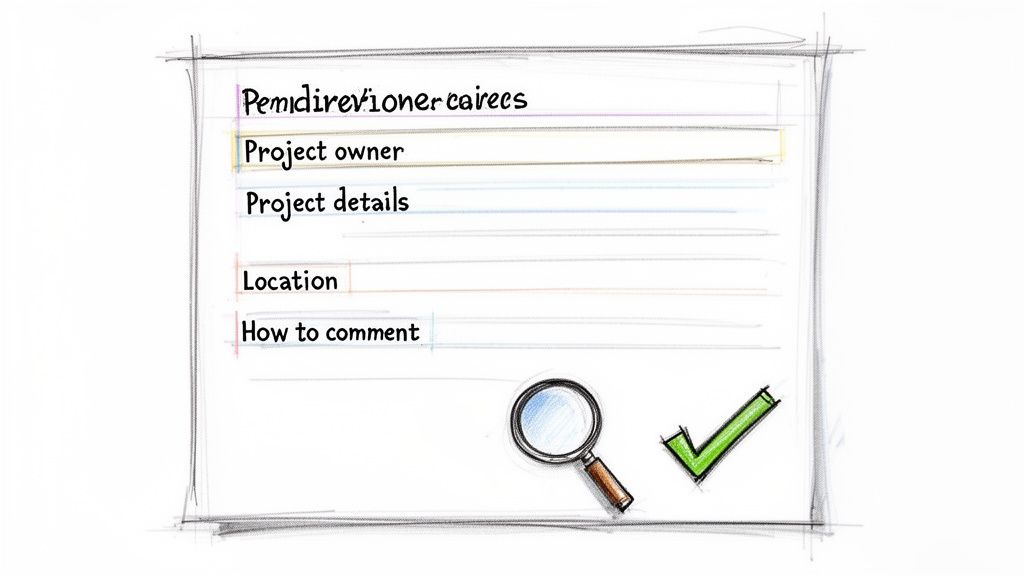
Based on legal mandates and our team's experience, every announcement has to clearly state:
- The Project Owner: The full legal name of your company and its registered address.
- The Project Title: Use the official name of the project exactly as it appears in the documents you submitted to the APM.
- The Proposed Activity: Be concise but specific. Instead of just saying “manufacturing,” write something like “manufacturing of corrugated cardboard packaging.”
- The Exact Location: The project's full site address, including the county (județ), city or commune (localitate), and street details.
- Public Consultation Instructions: Clear directions on where and how people can view the project details and submit their feedback. This must include the APM's address and contact info for sending written comments.
Crafting the Content: A Model Text and Practical Tips
Knowing what information to include is one thing, but piecing it together into a clear, trustworthy message is another. The key is to be direct and factual. Steer clear of marketing fluff or overly technical language, which can be mistaken for an attempt to hide something.
Here’s a basic text-model (model text) you can adapt. This structure ticks all the legal boxes and gives you a solid foundation.
ANUNȚ PUBLIC
[Full Company Name], with its headquarters in [City, Full Address], announces the submission of the request for the issuance of the environmental authorisation for the activity of [Brief, clear description of the activity, e.g., 'retail of non-food products'] to be carried out at the work point located in [City, Full Address, County].
Information regarding the proposed project can be consulted at the headquarters of the Environmental Protection Agency [County Name] located at [APM's Full Address] and at the applicant's headquarters in [City, Full Address], from Monday to Friday, between the hours of [Specify visiting hours, e.g., 9:00-14:00].
Comments and suggestions from the public regarding the proposed project can be submitted in writing to the headquarters of the Environmental Protection Agency [County Name] within 10 business days from the date of this announcement's publication.
This template is just the skeleton. The real value comes from the specific details you fill in. For example, if your project involves a new production line, "installation of a new line for biodegradable packaging" builds trust through specificity; "expansion of production capacity" creates uncertainty and questions.
The Role of Your Supporting Documents
Remember, your public announcement isn’t a standalone document. It’s backed by a crucial technical file: the presentation memorandum (memoriu de prezentare). This is where you provide the detailed evidence to support the claims made in your brief public notice.
The memorandum is the place for the nitty-gritty details, including:
- The project’s technical specifications.
- Potential pollution sources (noise, air emissions, waste).
- The mitigation measures you’ve planned to manage your impact.
When the APM and the public look at your announcement, they’ll check it against this memorandum. A well-prepared memorandum reinforces your credibility and shows you’ve done your homework. On the other hand, an incomplete or weak one will sink your entire application. Make sure these two documents are perfectly aligned before you publish a single word.
Managing Publication and Public Consultation
Once you’ve drafted a clear and compliant anunț public autorizație de mediu, the next step is getting it out there. Where you publish your announcement is just as important as what it says, and how you handle the public’s reaction can make or break your project's timeline.
Think of this as creating an official, documented paper trail. It’s your proof that you’ve done your due diligence in informing the community. One wrong move here, like picking the wrong newspaper, can invalidate the entire public consultation process and send you right back to the start.
Where to Publish: The Mandatory Channels
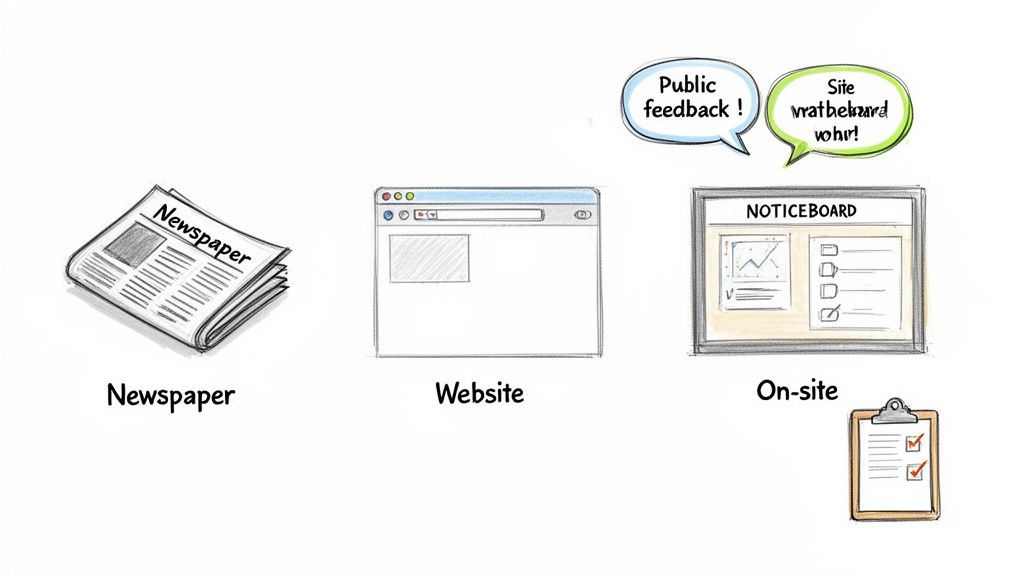
The law is crystal clear on this. Simply posting the announcement on your company website and calling it a day is a classic mistake that guarantees non-compliance. You must use multiple channels to ensure everyone who might be affected has a fair chance to see it.
These are the non-negotiable publication channels:
- A National or Local Newspaper: You must publish the full text in at least one widely read newspaper. Your local Environmental Protection Agency (APM) will often guide this choice based on project scale.
- On-Site Posting: A physical copy of the notice has to be displayed right where the project will be built. If that’s not possible, post it at your company's local headquarters. It must be in a visible spot.
- Your Company Website: The announcement needs a home on your official website. A dedicated section for public information or investor relations is the ideal place for it.
Beyond these minimum requirements, our team always advises clients to consider extra steps to show they’re serious about transparency. For projects with a big local impact, using direct mail services to reach households in the affected communities can be a powerful move. It shows a commitment that goes far beyond what’s legally required.
To help you decide, here’s a quick breakdown of your options.
Comparison of Publication Channels
Choosing the right mix of mandatory and recommended channels demonstrates a thorough and good-faith effort to engage the public.
How to Manage the Public Consultation Process
Publishing the announcement kicks off the formal public consultation period. This is when individuals, NGOs, and other groups can send in written comments, questions, or objections. How you manage this incoming feedback is absolutely critical.
A sloppy or defensive approach can poison the well. Here’s how to handle it constructively:
- Document everything. Log every single piece of feedback you receive. This log isn’t just good practice; it's a legal document you'll have to submit to the APM.
- Stick to the facts. When you respond, address valid concerns with clear, data-backed information from your technical documents. Don't get pulled into emotional debates.
- Stay professional. You will face criticism. Your responses must always be professional. A dismissive tone will only escalate tension and hurt your credibility with the public and the regulators.
We’ve seen tense situations completely defused simply because the company responded to the first few concerns quickly, respectfully, and with transparent data. It turns a potential public fight into a productive dialogue.
This public notice process is becoming more important as Romania aligns with EU-wide green policies, from the EU Taxonomy to the Carbon Border Adjustment Mechanism (CBAM). As the country moves toward a low-carbon economy, transparent procedures are key. This isn't just about compliance; it's about building a stronger business case in a changing Europe.
Compiling the Final Dossier for the APM
Once the consultation period is over, your job isn't done. You have to gather everything into a final dossier for the APM.
This file must include the original announcement, proof of publication from every channel (like a newspaper clipping or a time-stamped screenshot), all the public comments you received, and your official written responses. This package becomes the official record of your public engagement.
If your project was complex enough to need a full environmental impact study, you'll also likely have to prepare a comprehensive raport de mediu. For guidance on that, you might find our guide on how to structure an environmental report helpful.
Handled well, this entire process stops being a bureaucratic chore and becomes an opportunity. It’s a chance to build trust with the community and show regulators that you are a responsible operator.
A Practical Compliance Checklist for Your Project
Getting the environmental authorisation process right means being systematic. Without a clear plan, it's far too easy for critical steps for the anunț public autorizație de mediu to fall through the cracks, leading to delays. Think of this as an internal roadmap for your teams, from project managers to legal advisors.
We've structured it chronologically to walk you through each phase. Our team combines delivery with training so your teams become autonomous, and this checklist is a tool to make your team more autonomous. It covers everything from preparing documents, drafting the announcement, publishing it, managing the consultation, and finally, submitting the complete file to the Environmental Protection Agency (APM).
Use this framework in your kickoff meetings to assign roles and set clear deadlines. It ensures everyone knows exactly what they need to do and when.
Phase 1: Pre-Submission Preparation
Before you even consider publishing the announcement, your documentation has to be perfect. This is the foundation where projects either set themselves up for a smooth process or for failure.
Finalise the Presentation Memorandum (
Memoriu de Prezentare). This document is the technical core of your application. Ensure it’s complete, accurate, and aligned with the project's real-world plans. An incomplete memorandum invites immediate challenges.Verify All Applicant Details. This sounds simple, but it’s a common pitfall. Double-check that the company name, address, and project title are identical across every document. A small typo can trigger a procedural rejection, forcing you to start over.
Identify and Confirm Publication Channels. Decide which national or local newspaper you'll use. Well in advance, confirm their costs, submission deadlines, and publication dates. This simple step prevents a last-minute scramble.
Phase 2: Announcement Drafting and Publication
With your paperwork in order, the next step is to write and publish the public notice itself. Here, clarity and compliance are everything.
In our experience, the most effective announcements are simple, direct, and factual. Avoid marketing jargon; the goal is to inform, not to impress. This approach builds trust with both the public and regulators from day one.
Drafting the Anunț Public Autorizație de Mediu
- Make sure it includes all mandatory information: project owner, project title, specific activity, exact location, and clear instructions for public consultation.
- Use the correct APM details. The address for submitting feedback must be for the relevant county agency.
- Get an expert review. Have a legal advisor or consultant look over the text before you send it for publication.
Executing the Publication
- Publish across all required channels at the same time: the chosen newspaper, a visible spot at the project site, and your company's website.
- Secure proof of publication immediately. Get a physical copy of the newspaper, take time-stamped photos of the on-site notice, and save a PDF of the webpage. This evidence is non-negotiable.
Phase 3: Public Consultation and Final Submission
Once the announcement is live, the clock on the consultation period begins. Your job is to manage feedback professionally and prepare the final submission file.
You can streamline these compliance tasks by creating a custom quick reference guide template tailored to your project’s specific needs, ensuring no step is missed.
Establish a Feedback Log. Create a formal spreadsheet to log every comment you receive. Note the date, sender, and content. This log is a required legal document and shows you have an organised process.
Draft Formal Responses. Prepare written, fact-based answers to all relevant feedback. When addressing technical points, reference your presentation memorandum to support your responses.
Compile the Final Dossier. It's time to assemble everything for the APM. This includes all proofs of publication, the feedback log, and your company’s formal responses. A complete, well-organised dossier signals professionalism and helps make the APM's review process smoother.
By following this checklist, the anunț public autorizație de mediu stops being a daunting hurdle and becomes a structured, manageable process. For a deeper dive into the entire procedure, take a look at our comprehensive guide on the environmental authorisation.
Common Questions About the Authorisation Process
Navigating the environmental authorisation procedure often throws up specific, practical questions. Teams want to know the real-world consequences of their decisions. Based on our hands-on experience, we’ve put together answers to the most common questions we hear about the anunț public autorizație de mediu and what comes next.
Our team combines delivery with training so our clients' teams become autonomous. Answering these questions is a core part of that training process, turning uncertainty into actionable knowledge.
What Happens if We Miss the Deadline for the Public Announcement?
This is a scenario every project manager dreads. Missing the legally mandated deadline to publish the public announcement can stop your project cold.
The Environmental Protection Agency (APM) has the authority to suspend or even reject your entire authorisation request. This isn't just a slap on the wrist; it could mean restarting the entire procedure from the beginning. The business implications are severe:
- Significant delays to your project timeline.
- Serious cost overruns from paying for stalled resources.
- A complete loss of operational momentum.
Treat these deadlines as absolute business requirements, not flexible guidelines. A small administrative mistake here can cause a major business disruption that costs far more to fix than the initial cost of compliance.
While proactive communication with the APM is a good idea if you anticipate issues, the best strategy is prevention. Careful planning, using a tool like our compliance checklist, is the most effective way to protect your timeline.
How Should Our Company Respond to Negative Public Feedback?
Receiving negative feedback is a standard part of this process; it’s not a sign of failure. The crucial factor is how you manage it. Ignoring or mishandling comments is what creates real problems.
First, you must formally acknowledge all comments. Document every piece of feedback as required by law. The next step is to respond to valid concerns with factual, data-driven answers that explain your project's technical aspects and mitigation measures.
It is critical to avoid defensive or emotional language. If feedback is hostile, maintain a calm, professional tone. Your goal is not to win an argument but to demonstrate a commitment to transparent dialogue. We often find that organising a public meeting, mediated by a neutral expert, is a powerful way to de-escalate tensions and build trust with the community and regulators.
Is an Announcement Required for Modifying an Existing Activity?
In most situations, the answer is yes. The need for a new public announcement isn't limited to brand-new projects. Any substantial change to an already authorised activity will likely require you to go through the authorisation procedure again, including publishing a new anunț public.
What counts as a "substantial" change? Common examples include:
- Increasing your production capacity.
- Introducing a new technology or process.
- Expanding the physical footprint of your facility.
The final decision on whether a change is significant rests with the APM. A costly mistake we see is companies assuming small modifications don't require notification. This assumption can lead to serious non-compliance penalties. Our advice is simple: always consult the local APM before implementing any changes to your authorised activity. This proactive step keeps your operations compliant.
Can We Publish the Announcement Only on Our Website?
No, and attempting to do so is one of the most common compliance failures. The law is explicit that multi-channel publication is required to ensure the public has fair access to the information.
Relying solely on your website is not a substitute for the mandatory channels. Legal requirements demand publication in a national or local newspaper and physical posting at the project site or company headquarters. Your company website is an additional requirement, not the primary one.
Trying to cut corners here to save on publication fees will only result in your procedure being rejected. This causes delays that are far more expensive and damaging than the cost of the newspaper ad. View this publication cost as a necessary investment in your project's risk management.
At ECONOS 🌱, we help companies transform these complex regulatory requirements into opportunities for building trust and operational resilience. We combine delivery with training so your teams become autonomous in managing ESG compliance. If you need support navigating the environmental authorisation process, from carbon footprinting to audit-ready reporting, our team is here to help. Find out more at https://www.econos-esg.com.