
.png)

Navigating the Administrația Fondului pentru Mediu (AFM) used to mean paperwork. Now, the AFM online portal is the mandatory digital platform for everything from environmental compliance to accessing green funding. For Romanian companies, real progress comes from execution on this platform, not just understanding the regulations.
We see that many companies treat the AFM portal as just another administrative hurdle. This is a mistake. The businesses that succeed have reframed their thinking: the Administrația Fondului de Mediu online system is a strategic asset. Their struggle is often connecting the dots between this local compliance tool and broader EU demands like the Corporate Sustainability Reporting Directive (CSRD) and the Carbon Border Adjustment Mechanism (CBAM). How can you use this one portal to solve multiple business problems?
Here are three takeaways for leveraging the AFM online platform effectively:
- Frame it as a business tool, not a compliance burden. Your ability to master this portal is now directly tied to business outcomes: securing capital for green projects, managing regulatory risk, and strengthening your market position. The goal is operational progress, not just perfect reporting.
- Repurpose compliance data for funding applications. The data you gather for a strong energy efficiency grant application—like energy consumption and GHG emissions—is the same data you’ll need for your CSRD report. This work must be scalable and affordable.
- Build internal capability to ensure autonomy. The process requires precision, but it's repeatable. By training your team on the platform's logic, you build the internal capability to manage submissions autonomously, making sustainability efforts scalable and cost-effective over the long term.
This means companies must treat their AFM profile with the same diligence as a bank audit. Data for applications must be clear, auditable, and linked to business outcomes like cost reduction or risk management. Ownership of the process must be defined, with clear timelines and responsibilities. The portal is where your compliance duties and growth opportunities meet.
Ultimately, your success on the AFM platform depends on a practical, execution-first approach. We combine delivery with training so teams become autonomous.
Your Digital Gateway to Green Funding in Romania
This isn't just a simple switch to an online system. It’s a fundamental shift in how Romanian businesses must approach their environmental obligations and opportunities. The reality is, companies are no longer just dealing with local laws; they're being pulled into a much bigger arena shaped by demanding EU regulations.
Frameworks like the Corporate Sustainability Reporting Directive (CSRD) and the Carbon Border Adjustment Mechanism (CBAM) are putting unprecedented pressure on businesses. These aren't just about ticking boxes; they require detailed, verifiable data on your company's environmental footprint. Sustainability has officially moved from a "nice-to-have" PR-stunt to a core business function.
The question for any business leader in Romania is no longer if you should engage with sustainability, but how you can do it efficiently and use it to your advantage.
A Strategic Tool, Not Just Another Bureaucratic Hurdle
We see too many companies treat the AFM portal as just another administrative headache. That's a mistake. The businesses that are truly succeeding have reframed their thinking: the Administrația Fondului de Mediu online system is a strategic asset.
Your ability to master this portal is now directly tied to real business outcomes—securing capital for green projects, managing regulatory risk, and strengthening your position in the market.
Think of the AFM platform as a specialised digital gateway, much like a powerful customer self-service portal, but for environmental funding and compliance. It’s the single point where your compliance duties and growth opportunities meet.
Here’s a practical example: when you prepare a strong application for an energy efficiency grant through the AFM, you're not just chasing funding. The data you gather on energy consumption and GHG emissions is the exact same data you’ll need for your CSRD report. The work you do for one directly feeds the other, saving you time and resources.
This guide is designed to give you a practical, execution-first walkthrough of the AFM portal. Our team is focused on how to use the system to get tangible results, turning what feels like a compliance burden into a genuine source of business value.
Our entire approach is built on empowering your own people. We combine delivery with training so teams become autonomous. This builds lasting capability and makes your sustainability efforts both scalable and affordable.
Getting Your Company Ready for The AFM Platform
Before you can even think about applying for environmental funding in Romania, your company needs a solid digital presence on the Administrația Fondului pentru Mediu (AFM) online platform. It’s a foundational step that, from our experience, many businesses rush through or underestimate, leading to frustrating and completely avoidable delays.
Getting this right from the very beginning isn't just a technical task; it's the bedrock for every application, declaration, and interaction you'll have with the AFM. We’ve seen it all—incorrect document formats, misunderstood registration fields, or authentication errors that bring the whole process to a grinding halt. A clean, correct setup is non-negotiable.
Think of your company's profile on the Administrația Fondului de Mediu online portal as your first audit. It shows you’re organised and detail-oriented, setting a professional tone long before your first funding request is even submitted.
Building Your Company's Digital Identity
First things first: creating your company's account. Treat this with the same precision as opening a corporate bank account. Every single detail must perfectly match your official company records held at the trade registry.
The system will ask for key identifiers, like your company's unique fiscal identification code (CUI) and its official registered address. Any mismatch between what you enter and what the state has on file can trigger an instant rejection of your profile.
To navigate the platform effectively, you need to speak its language. Here are a few key terms you'll encounter constantly:
- Utilizator (User): This is the individual person—the legal representative authorised to act and sign on the company's behalf.
- Contribuabil (Taxpayer): This refers to the company itself, the legal entity registered on the platform that is responsible for all environmental declarations and payments.
- Declarație (Declaration): The official electronic form for reporting environmental obligations, like packaging waste or greenhouse gas emissions. A critical point: even if you have zero obligations for a reporting period, a "0" declaration is often still mandatory.
- Semnătură Electronică Calificată (Qualified Electronic Signature): This is the mandatory digital signature required to authenticate and legally validate every submission. Without it, you simply cannot finalise any application or declaration.
Getting these terms right isn't just semantics. It prevents miscommunication and ensures your team understands the authority's requirements, which is a core part of building the internal skills to manage this process on your own down the road.
Authentication and Configuring Your Profile
Once the basic account is created, you need to authenticate your identity. The AFM platform uses the national Ro e-ID system, a secure digital verification method. This is a crucial security layer to ensure that only authorised people can submit legally binding documents for your company.
After your identity is confirmed, it's time to configure the company profile. This is where you'll upload essential legal documents, most commonly the company’s registration certificate (Certificat de Înregistrare). Pay close attention to the required file specifications—usually PDF—and be mindful of any size limits. A blurry scan or the wrong document type is a classic mistake we see that stops an application in its tracks.
Getting this digital infrastructure right is your gateway to major funding opportunities. For example, Romania's National Recovery and Resilience Plan (NRRP) earmarks 41% of its funds for green transitions, making around €12 billion available for eligible projects between 2020-2026. These funds, accessible through the AFM portal, are designed for decarbonisation projects that align perfectly with services like organisational carbon footprinting across Scopes 1, 2, and 3. You can read more on how these funds are shaping the national economy on Romania-Insider.com.
A properly set-up profile isn't just about admin work. It's directly tied to your company's ability to access these funds and maintain compliance. If you're dealing with related compliance issues, our guide on obtaining an environmental permit (autorizație de mediu) might also be helpful.
At ECONOS, our approach is to combine this practical setup support with hands-on training. We make sure your team understands the "why" behind each step, empowering them to confidently manage your company's AFM presence for future funding cycles and compliance reports.
Getting Your Application Ready for Key Funding Programmes
Alright, so you’ve set up your company’s account on the Administrația Fondului de Mediu (AFM) online portal. Now comes the real work: building and submitting an application that actually gets funded. This is where the paperwork and planning pay off. From what our team has seen, successful applications aren’t about luck; they’re about meticulous preparation and a deep understanding of what the AFM is looking for.
This part of the process can seem daunting, but it’s entirely doable if you treat it like any other critical business project. The companies that succeed are the ones that assign clear responsibilities and deadlines. Your goal is to build such a compelling case that your project becomes an obvious fit for the funding authority's goals.
Before you even think about a specific programme, you need to have your foundational account setup flawless. The process is straightforward, but every step builds on the last.
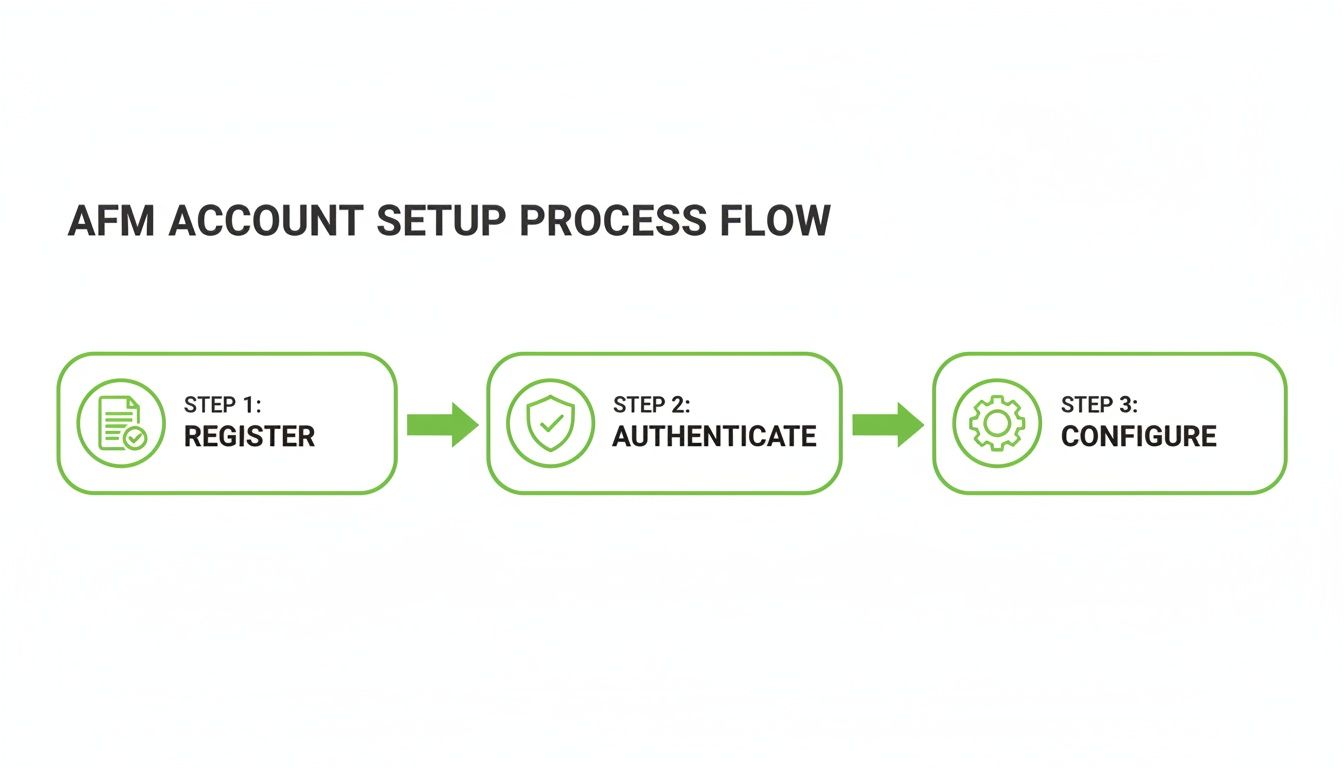
The key takeaway here is simple: a solid, error-free setup is the non-negotiable starting point for any application you plan to submit. Get this wrong, and you’re creating problems for yourself before you’ve even begun.
Assembling Your Documents for Specific Programmes
Let's walk through two of the most common scenarios we handle: applying for a grant to boost a factory’s energy efficiency, and seeking funds to switch a corporate fleet to electric vehicles. The specific programmes are different, but the logic behind the required documentation is the same. You have to prove your project is viable, has a measurable impact, and will be managed properly.
For an energy efficiency project, your documentation package needs to be concrete. This typically includes:
- Rock-Solid Technical Specs: We’re talking detailed plans of the upgrades you’re proposing, whether it’s new insulation, a modernised HVAC system, or a full LED lighting conversion. You need to be specific—include equipment models and performance data.
- Airtight Financials: This means a clear breakdown of project costs, the exact funding amount you’re requesting, and a solid projection of your return on investment through future energy savings.
- The Environmental Impact Case: This is absolutely critical. You must quantify the expected drop in energy consumption (in MWh) and the corresponding reduction in greenhouse gas emissions (in tCO2e).
If you’re planning a transition to an electric vehicle (EV) fleet, your documentation will look a little different:
- Official Vehicle Quotes: You’ll need formal offers for the specific EV models you plan to buy.
- A Credible Charging Plan: A proposal for installing charging stations at your business sites is a must. This should include costs, locations, and technical details.
- Emissions Reduction Analysis: A straightforward calculation showing the drop in Scope 1 emissions you’ll achieve by swapping out internal combustion engines for EVs.
Here's a mistake we see all the time: submitting vague or incomplete documents. An application for an EV fleet, for instance, is dead in the water if it doesn’t include a believable plan for charging infrastructure. The AFM needs to see a complete, end-to-end solution, not just a wish list.
The Online Submission Workflow
The entire game is played on the Administrația Fondului de Mediu online platform, so you need to know its quirks.
You’ll be uploading all your supporting documents, usually as PDFs. Pay close attention to file size limits. Large files like technical drawings or complex financial models might need to be compressed or split, but make sure they stay perfectly legible. A corrupted or unreadable file is an easy reason for rejection.
The final, and most crucial, step is the electronic signature. Your company’s legal representative must sign the application with a qualified electronic signature certificate. This isn't just a click-through; it's the digital equivalent of a legally binding wet-ink signature. If you use an expired certificate or fail to sign it correctly, your application will be instantly invalid.
Before you dare hit that final submit button, use the platform’s review function. Go over every single field and uploaded file one last time. Is every mandatory field complete? Is every document the correct and final version? This last-minute check can be the difference between getting funded and an immediate rejection. While the AFM has its own unique process, understanding general best practices on how to bid for government contracts can give you a strategic edge in your preparation.
Now, let's talk about making sure your application is as strong as it can be. Here’s a checklist we use with our clients to double-check everything before submission.
AFM Funding Program Application Checklist
Before you submit your application for programmes like energy efficiency or electric vehicles, run through this checklist. It’s designed to catch common errors and ensure your submission is complete and professional.
Using a structured checklist like this turns a stressful process into a manageable workflow. It ensures that no small detail, which could potentially disqualify your entire application, is overlooked.
Our approach at ECONOS is to not only manage these submissions for you but to also provide hands-on training. The goal is for your team to build the in-house skills to handle these processes on their own in the future. This approach builds long-term capability, making your sustainability efforts more scalable and cost-effective.
From Submission to Approval: How to Track Your Dossier
Hitting ‘submit’ on your application to the Administrația Fondului de Mediu feels like a huge win, but the work isn’t over. In fact, what comes next is often just as critical. This is the stage where proactive monitoring and quick, precise responses to requests from the Administrația Fondului pentru Mediu (AFM) can be the difference between success and failure.
Many companies fall into a passive "wait and see" mode after submitting. From our experience, that's a serious mistake. The portal is a live communication channel, not just a dropbox. Knowing how to read the signals—the status updates—and react instantly is the key to managing this part of the process.
The most common reason we see projects fail isn’t the quality of the project itself. It’s the company’s failure to respond properly or on time to an AFM request for clarification. It’s an unforced error that can put your entire application at risk.
Decoding Your Dossier Status
Once your dossier is in the system, it will pass through several distinct stages. Think of each status update as a direct signal from the AFM that requires your attention and, in some cases, immediate action. Active management, not passive waiting, is your best strategy.
It's also worth remembering the bigger picture here. The AFM's online platform is the digital backbone for Romania's green fiscal framework, which is expanding as environmental taxes rise in 2024. With NRRP green spending targeting €12 billion in assets by 2026—that’s 41% of the plan—this system is more important than ever. The platform's real-time tracking, which has already helped digitise over 70% of submissions since 2020, is essential for companies navigating the complexities of the EU Taxonomy and preparing for CBAM. You can read more on Romania's economic forecast on economy-finance.ec.europa.eu to understand the context.
Here’s what the common status updates actually mean for your business:
- Depus (Submitted): Your application is officially in the system. This is a technical handshake, confirming receipt. Nothing more.
- În evaluare (Under Evaluation): An AFM analyst is now actively reviewing your file. You don’t need to do anything, but this is a good time to keep a close eye on the portal for any changes.
- În completare/clarificare (Pending Clarification): This is the most critical status you can receive. The AFM needs more information or has a question. You will get a notification in your account with a very strict deadline—often just 5-10 working days.
- Aprobat (Approved): Congratulations are in order. Your funding is approved, and you'll receive official communication about the next steps, like signing the financing contract.
- Respins (Rejected): Unfortunately, your application didn't make it. The portal should provide a reason for the rejection. Treat this as invaluable feedback for your next attempt.
How to Handle a Clarification Request
If your status changes to 'În completare/clarificare,' don't panic. This isn't a rejection; it's an opportunity. The AFM is giving you a chance to make your application stronger.
First, take a breath and read the request very carefully. What are they really asking for? Is it a simple missing document? A query about a specific number in your budget? Or something more complex about the technical side of your project?
Next, prepare a direct and concise response. Answer only the question asked. Resist the urge to add extra marketing fluff or details that weren't requested. If they ask for a financial projection, give them a clear table or document without a lengthy narrative.
Finally, submit the new documents correctly through the portal. Double-check that they are in the right format and uploaded to the proper section. A procedural error at this stage can be incredibly frustrating. A prompt, precise, and professional response shows the AFM you're an organised and reliable partner worth funding.
How ESG Can Make or Break Your Next Funding Application

Getting a project funded through the Administrația Fondului pentru Mediu (AFM) online platform used to be a matter of filling out the forms correctly. Those days are over. Now, the evaluation criteria are much sharper, and a credible commitment to sustainability is the one thing that can set your application apart from the rest.
This means your funding request can no longer exist in a vacuum. From our team's experience, applications that are clearly tied to a company's wider Environmental, Social, and Governance (ESG) strategy perform significantly better. The AFM is under pressure to finance projects with a measurable environmental return, projects that directly help Romania meet its national and EU climate targets.
Think about it: is your project just a standalone initiative, or is it a crucial step in your company’s long-term decarbonisation plan? How you frame this changes everything.
Turn Your ESG Compliance Work into a Funding Asset
The good news is that the data you're already gathering for compliance and strategic planning can be repurposed to build a winning funding proposal. It's about working smarter, not harder.
A properly documented carbon footprint, calculated using the GHG Protocol for Scopes 1, 2, and 3, gives you a solid baseline. It shows the AFM evaluation committee exactly where your project fits. When you ask for money to upgrade your factory's lighting, you can state with confidence that it will cut your Scope 2 emissions by a specific, verifiable amount.
This proactive approach doesn’t just strengthen your case. It makes sure the project you get funded serves a dual purpose, helping you secure capital while also moving you closer to compliance with regulations like the Corporate Sustainability Reporting Directive (CSRD) and the EU Taxonomy. If you need a starting point for these foundational reports, our guide on how to structure a sustainability report can be a useful resource.
From Carbon Footprints to Bankable Projects
To really stand out, you need to go beyond the basics. Advanced ESG assessments provide the kind of hard evidence that makes an application undeniable.
Decarbonisation Roadmap: A clear, science-aligned roadmap proves you have a long-term plan. It frames your funding request as a strategic investment, not just a one-off expense.
Life Cycle Assessments (LCA): For a manufacturing company, an LCA is powerful. It can demonstrate exactly how a change in materials or processes—funded by the AFM—will reduce a product's environmental impact from cradle to grave.
Double Materiality Assessment: This helps you articulate not only why the project is good for the planet (impact materiality) but also why it's critical for your company’s bottom line and risk management (financial materiality).
This shift towards data-driven applications is part of a much bigger story. Romania's digital infrastructure, including the Administrația Fondului de Mediu online platform, has been a major factor in the country's environmental progress. By 2019, GHG emissions had already dropped by 62% from 1990 levels, and these digital upgrades have cut application processing times by 30-50%. This is streamlining access to the €12 billion in green bond-eligible projects planned for 2020-2026, as detailed in Romania's ESG Investor Presentation.
The table below shows exactly how you can map your existing ESG data to specific parts of the AFM application to build a stronger case.
Integrating ESG Data into Your AFM Application
This table shows how specific ESG reporting elements can be repurposed to strengthen different sections of an AFM funding application.
This is precisely where our approach at ECONOS makes a difference. We combine delivery with training so teams become autonomous. We make sure your team knows how to use that data to build a compelling business case for funding. Our goal is to build your internal capability so that your sustainability work becomes a scalable, autonomous engine for growth.
Your AFM Portal Questions, Answered
Working with the Administrația Fondului de Mediu online portal can be tricky the first few times. After guiding hundreds of clients through the process, our team has seen the same questions and roadblocks come up again and again.
Here are our direct answers to the most common challenges. This isn't theory—it's practical advice based on years of real-world submissions, designed to help you avoid the pitfalls that stall applications.
What Is the Most Common Reason for Application Rejection?
Based on our direct experience, the vast majority of initial rejections aren’t about the project's quality. They’re about simple, avoidable administrative mistakes.
These procedural errors trip up even the most prepared companies. Common issues include:
- Submitting documentation that's incomplete or out of date.
- The electronic signature failing verification.
- Uploading a financial statement from the wrong fiscal year.
- A technical plan missing a required expert certification.
The key takeaway? Treat the documentation phase like a financial audit. An internal review, with a fresh set of eyes checking every document before you hit ‘submit,’ is the single best way to catch these simple yet costly errors.
How Can We Prove Our Project's Environmental Impact?
To prove your project’s impact, you have to move past vague promises and present hard, quantifiable data. The strongest applications we’ve seen are built on numbers from a formal carbon footprint assessment (following the GHG Protocol) or a product Life Cycle Assessment (LCA).
For an energy efficiency project, this means you must calculate and clearly state the projected annual reduction in tCO2e (tonnes of carbon dioxide equivalent). If you’re switching your fleet to electric vehicles, you need to show the exact drop in your company’s Scope 1 emissions.
Ultimately, you have to link your project to specific KPIs that fit into your company's bigger decarbonisation strategy. This shows the AFM your project is a strategic move, not just a one-off initiative.
Our Application Status Is 'Pending Clarification.' What Should We Do?
A ‘Pending Clarification’ status is a critical moment, but don't panic. It’s an opportunity, not a rejection. The AFM is asking for more information to help move your file forward.
First, log into the Administrația Fondului de Mediu online portal immediately and read their request. What exactly do they need? Is it a technical detail, a financial question, or a missing document?
Next, act fast. There’s almost always a strict deadline, often just 5 to 10 working days. If you miss that window, your application will likely be rejected automatically.
Finally, give them a direct and complete answer. If they ask for a specific calculation, provide it clearly and concisely. Don't add extra information. Treat it like a formal audit request where precision is everything. A prompt, accurate response shows you’re a professional and reliable partner.
Can SMEs Realistically Compete for AFM Funding Against Large Corporations?
Yes, absolutely. Many AFM funding lines are built specifically for Small and Medium-sized Enterprises (SMEs), some with dedicated budgets or simpler criteria to level the playing field.
While the online platform can seem complex, it standardises the application for everyone. The key for an SME is to use its natural advantages: agility and focus.
A well-prepared SME with a high-impact, clearly defined project can be far more compelling than a large corporation with a vague proposal. Success comes down to the quality and clarity of the application, not the size of the company. Partnering with the right experts can also help SMEs close any resource gaps and submit a data-driven proposal that truly stands out.
Navigating ESG regulations to secure green funding is a complex but vital task. At ECONOS, our team doesn't just deliver projects; we provide training to build your team's internal capability. Our goal is to empower you to manage these processes on your own and turn compliance into a competitive advantage. If you're ready to strengthen your next application, explore how our services can help.