
.png)
For many Romanian businesses, the ‘Administrația Fondului pentru Mediu (AFM) online’ portal is seen as just another compliance headache. Our team sees a different reality: it’s the primary channel for turning mandatory environmental contributions into strategic investments. The goal is to get that money back by funding operational progress.
We see companies across sectors struggling to bridge the gap between their environmental obligations and their business strategy. They pay their green taxes but fail to access the grants available for projects that cut costs and build resilience. Why? The process seems complex, and the connection to business value isn't always clear. The real challenge is moving from reactive compliance to proactive investment.
Here are three key takeaways for using the AFM portal effectively:
Frame it as a Business Decision, Not Just a Tax. The core principle of the AFM is "the polluter pays," but the system is designed to reward companies that invest in solutions. The funds you access for energy efficiency or renewable energy projects directly lower operational costs and mitigate future risks. It’s about securing a return on your environmental spend.
Preparation is 90% of Success. A successful application is won before you log in. Our experience shows that rejections are almost always due to administrative errors—mismatched data, expired certificates, or incomplete technical plans. A rigorous pre-submission checklist is the most effective tool for preventing delays and ensuring your application is approved on the first attempt.
Connect Project Data to Your ESG Story. An AFM-funded project is more than a financial grant; it's auditable proof of your commitment to sustainability. The data from a solar panel installation (Scope 2 emissions reduction) or an EV fleet upgrade (Scope 1 reduction) is exactly what you need for credible ESG reporting to investors, banks, and major clients.
This means companies must treat AFM engagement as a strategic function, with clear ownership, a defined timeline, and a budget for proper preparation. Our approach combines delivery with training so client teams become autonomous in managing these processes over time.
Ultimately, mastering the AFM online portal is about building internal capability to transform a regulatory burden into a source of competitive advantage.
Your Access to Environmental Funding in Romania

Think of the Administrația Fondului pentru Mediu (AFM) as the engine behind Romania's green transition, operating on a simple but powerful principle: "the polluter pays." It collects environmental taxes and redirects that capital into grants for projects that actively reduce pollution and promote sustainability.
For any company, the AFM online portal is the critical access point to these funds. From our experience helping businesses navigate it, we see it as much more than a compliance tool. It’s a mechanism to convert mandatory environmental costs into future-proof investments with real financial returns.
From Compliance Cost to Business Strategy
The smartest companies don't see AFM contributions as just another tax. They see the portal as an opportunity to get that money back—and more—by funding operational upgrades.
The real question isn't if you should engage with the AFM, but how you can use its programmes to gain a competitive edge? A successful project does more than just tick a box; it creates tangible value. Of course, this all starts with having your core compliance in order. Obtaining the necessary permits, for example, is the first step. You can read more on that in our guide on the https://www.econos-esg.com/bloguri/autorizatie-de-mediu.
Key Funding Programmes for Businesses
The AFM portal is the gateway to several high-impact financing programmes designed to support Romania’s move to a green economy. These programmes offer direct financial support that can be linked directly to your company's operational and sustainability goals.
The table below summarises the main funding streams available and how they align with modern business needs.
These programmes are not just about receiving a grant. They are practical tools for building a more resilient, efficient, and respected business.
By accessing these funds, you are not just getting financial aid. You are actively investing in resilience, lowering long-term operational risks, and building a stronger, more sustainable business model. This is the practical path from simple compliance to market leadership.
The strategic importance of the AFM is clear. National spending on environmental protection in Romania grew from 1.7% of GDP in 2014 to 2.7% of GDP in 2022. Looking ahead, the government’s plan to achieve climate neutrality by 2050 requires an estimated investment of EUR 2,000 billion. The AFM is positioned as a key financier in this massive transition, and as you can see from long-term environmental strategies from the European Environment Agency, this trend is only accelerating.
Setting Up Your Account and Digital Signature
Getting started with the Administrația Fondului de Mediu online portal can feel like a hurdle, but once you understand the logic, it's a straightforward process. Think of it as creating your company's official digital identity for all environmental funding and reporting. Getting this first step right is crucial for smooth execution later on.
The system is built on security and legal validity, which is why every action requires authentication. This isn't just bureaucracy; it’s the mechanism that protects your company’s data and makes your submissions legally binding.
Registering Your Company on the AFM Portal
First, you need to register your company. This happens entirely online through the official AFM portal, where you’ll be asked for your company’s key identification details.
Typically, you'll need to provide:
- Company Name: Exactly as it appears on your official registration documents.
- Fiscal Identification Code (CUI): Your company's unique tax ID.
- Contact Information: For the company's legal representative or a formally appointed delegate who will manage the account.
It is vital that the information you enter here is a perfect match for your official records. Our team often sees frustrating delays caused by simple typos—a mismatched address or an incorrect CUI. A quick double-check here can save significant time down the road.
A common pitfall we see is assuming any employee can create the account. The registration is tied to the company's legal identity, so it must be done by the legal representative or someone with a formal power of attorney. This should be sorted out internally before you start.
The Role of the Qualified Electronic Signature
Once you've filled out the initial form, the real cornerstone of the Administrația Fondului de Mediu online platform is the qualified electronic signature (semnătură electronică calificată). Without it, you cannot submit any declarations or funding applications.
This digital signature has the same legal weight as a handwritten one. It confirms who is signing and guarantees that the document's content hasn't been tampered with.
Before starting the AFM account process, make sure your company's legal representative has a valid, active qualified digital certificate from an accredited Romanian provider. If their certificate is expired or they don't have one, this becomes your top priority. The process can take a few days, so it's important to plan ahead.
You’ll download a declaration form from the portal, sign it offline with your digital certificate software, and then upload it back. The system then authenticates the signature. If you're running into trouble with submissions, our guide on navigating the ANPM reporting and authentication process has some extra insights that might help.
Handling Common Validation and Login Issues
Even with perfect preparation, validation errors can occur. Most of the time, they're related to your electronic signature or browser settings.
Here’s a quick troubleshooting checklist based on the issues our clients face most often:
- Check Certificate Validity: First, confirm the digital certificate hasn't expired and is properly installed on your computer.
- Use the Correct Signatory: The person signing the document must be the exact individual registered in the AFM system as the legal representative. The platform cross-checks this.
- Update Your Software: Make sure the software from your digital certificate provider is up to date. Outdated tools are a frequent cause of signing failures.
- Browser Compatibility: Sometimes, certain browsers create conflicts. If you keep getting errors, try clearing your browser's cache or switching to a different one.
Nailing the account setup is the one-time task that opens the door to funding and ensures your environmental reporting is compliant. Getting it right ensures a reliable channel to the AFM for years to come.
How to Prepare a Winning Funding Application
Submitting an application through the Administrația Fondului de Mediu online portal isn’t just about filling in forms. Our team has seen enough successful and failed applications to know it's a strategic exercise. The companies that get funded are the ones that treat the preparation phase with the same discipline as the project itself.
Your goal should be a clean, one-shot submission. Every time the AFM sends a request for clarification, you lose weeks, sometimes months. A rejection over a simple administrative mistake sends you right back to the start, and you could miss the funding window completely.
Assembling Your Core Documentation
Before logging into the portal, your first task is to gather all necessary documents. While specific requirements change between programmes, a core set of paperwork is almost always mandatory. This is your foundational application kit.
For programmes like upgrading building energy efficiency or installing EV charging stations, you will almost certainly need:
- Financial Statements: Your most recent balance sheets and profit and loss accounts, up-to-date and officially signed.
- Fiscal Certificate (Certificat de Atestare Fiscală): Proof of having no outstanding debts to the state budget. This document has a short validity period, so timing is key.
- Company Legal Documents: Your company’s registration certificate (CUI) and articles of association (Act Constitutiv).
- Technical Project Plan: A detailed breakdown of your project, covering its objectives, technology, a realistic implementation timeline, and a clear budget.
- Energy Audit (for efficiency projects): A non-negotiable report from an accredited auditor for any energy efficiency project. It validates the technical basis by quantifying potential savings.
When you’re pulling together this much paperwork, keeping the data organised and accurate is a major challenge. For those handling complex files, it’s worth looking into how Intelligent Document Processing (IDP) can help extract and organise everything without errors.
The Pre-Submission Validation Checklist
Our team uses a strict internal checklist to validate every document before beginning the online submission. This proactive step is the single most effective way to prevent rejections. It transforms a stressful, reactive process into a controlled, predictable one.
A classic mistake we see is mismatched figures. A project cost in the online form that differs even slightly from the technical proposal PDF is enough to get your application flagged. A tiny discrepancy can trigger an administrative rejection.
This simple flow chart shows the key gates you need to pass just to get your account ready for submission.
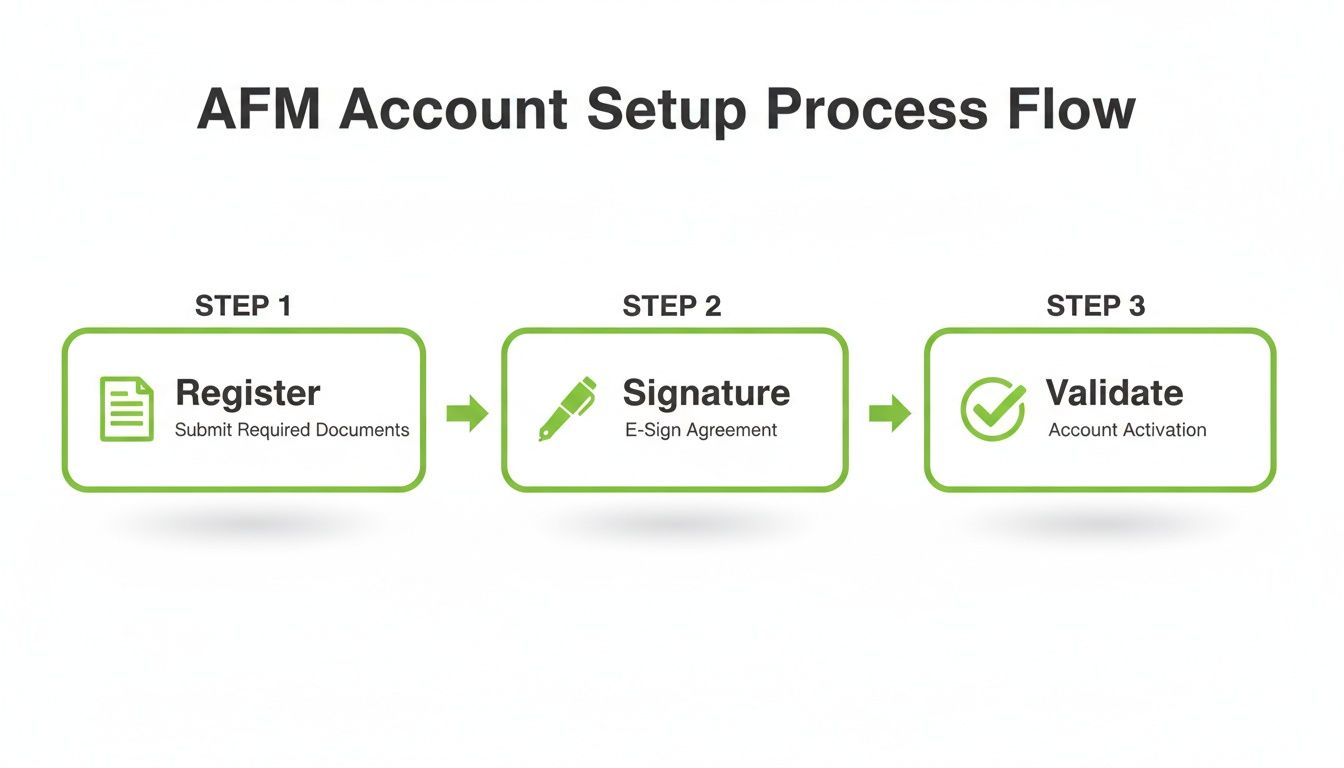
Think of it this way: registration, digital signature setup, and final validation aren't just steps; they are critical checkpoints. Fail one, and you cannot proceed.
Avoiding Common Application Pitfalls
Beyond mismatched numbers, a few other common tripwires can derail a solid application. Knowing them ahead of time helps you build a much stronger submission.
- Expired Certificates: Submitting an application with an expired fiscal certificate or an invalid digital signature is an instant rejection. Double-checking validity dates should be the last thing you do before hitting 'submit'.
- Incomplete Technical Justification: The AFM evaluators are experts. Your technical plan must be robust, realistic, and aligned with the programme's goals. Vague descriptions or flimsy claims about environmental benefits won't cut it.
- Incorrect Programme Selection: Ensure your project is a perfect match for the funding programme. Applying for a renewable energy grant with a project that's really about energy efficiency creates confusion and almost always ends in rejection.
Ultimately, a well-prepared application doesn’t just meet the requirements. It anticipates the evaluators' questions and provides clear, consistent, and verifiable answers from the start.
Tracking Your Application Status and Next Steps
Hitting ‘submit’ on the Administrația Fondului de Mediu online portal feels like the finish line, but it’s really the start of the next phase. From our team's experience managing applications, what happens after you submit is where proactive monitoring and quick responses can make or break your chances.
Once your application is in, it enters the AFM's evaluation queue. You can follow its progress directly from your account dashboard—this is your single source of truth. Success at this stage means understanding the different statuses and being ready to act the second they change.
Understanding the Application Statuses
The portal uses specific terms to show where your project stands. Knowing how to interpret these statuses is key to managing expectations and planning your next move.
Here are the most common statuses you’ll see:
- Depus (Submitted): A simple confirmation that the AFM system has received your application and assigned it a registration number.
- În analiză (In analysis): An evaluator has picked up your file and is starting the administrative and technical checks. Expect this to be the longest phase.
- Solicitare clarificări (Clarifications requested): A critical moment. The evaluator found something incomplete or unclear and needs more information.
- Aprobat (Approved): The outcome you’ve been working for. Your project has passed all checks and is eligible for funding.
- Respins (Rejected): Your application failed to meet the programme’s requirements and has been denied.
Keeping a close watch on the "Istoric declarații" (application history) section is non-negotiable. Check it daily so you can react the moment a status changes. Time is of the essence.
The Art of Responding to Clarification Requests
A "Solicitare clarificări" isn't a rejection; it's an opportunity to strengthen your application. Unfortunately, many applications get stuck here because of slow or incomplete answers. The key is to be swift, precise, and thorough.
When a request for clarification arrives, the clock starts ticking. You will have a specific—and often short—deadline to respond. We treat these requests as our highest priority. We first analyse exactly what the evaluator is asking for and provide just that—nothing more, nothing less. Sending extra documents they didn't ask for just creates more work and potential confusion.
The most common clarification requests we see involve mismatched financial figures, a need for more detail on the technical project plan, or questions about whether certain expenses are eligible. A clear, concise, and well-documented response is the best tool to get your file moving again.
After Approval: What Happens Next
Seeing that "Aprobat" status is a huge win, but the work isn't over. Approval unlocks the final phase: contracting and the official start of your project.
The next steps almost always follow this path:
- Contract Signing: The financing contract will become available to sign, usually through the Administrația Fondului de Mediu online portal with your qualified electronic signature. Review the terms carefully before signing.
- Project Implementation: You can now officially begin work, following the technical plan and timeline you submitted.
- Reporting and Reimbursement: As you carry out the project, you’ll need to submit progress reports and reimbursement requests to the AFM. This requires meticulous documentation of every expense and activity.
Managing the post-approval phase is just as crucial as submitting a winning application. It's what ensures you receive the funds on time and stay fully compliant with the programme's rules.
Linking AFM Success to Your ESG Reporting
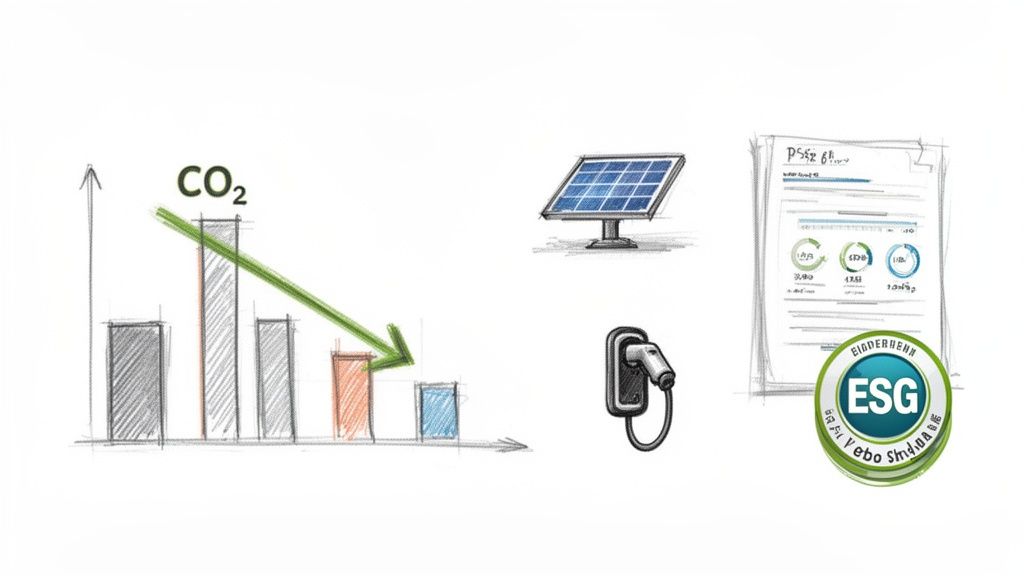
When you secure a grant from the Administrația Fondului de Mediu online portal, don't just see it as a financial victory. Our team advises clients to treat AFM-funded projects as high-quality fuel for their Environmental, Social, and Governance (ESG) reporting.
That successful application is tangible proof of your company's commitment to decarbonisation. This simple shift in perspective turns a compliance task into a compelling story about your operational progress—a story that gets the attention of investors, customers, and regulators.
From Project Data to Reporting Metrics
Every successful AFM project—whether for energy efficiency or electric vehicles—generates hard, quantifiable data. A solar panel installation funded by the AFM doesn't just lower your electricity bill; it creates a verifiable reduction in your carbon footprint. This is precisely the kind of data needed for credible ESG disclosures.
How do you translate that project into reporting value? Connect your operational changes to the metrics that matter. For instance, the energy saved from a building insulation project directly reduces your Scope 2 emissions, which is a key performance indicator (KPI) under frameworks like the Corporate Sustainability Reporting Directive (CSRD).
The secret is to stop treating funding and reporting as separate tasks. The data from your AFM project is the evidence that proves your ESG strategy is more than just words on a page. It's measurable, auditable proof of action.
This approach gives your sustainability narrative real weight. You’re not just saying you're committed to the environment; you're showing exactly how you're investing in it, with the financial backing of a national authority.
Strengthening Your Position in the Supply Chain
In today's market, a strong ESG profile is a serious competitive advantage. Major buyers are increasingly scrutinising their suppliers' environmental performance to meet their own Scope 3 emissions targets. A documented, AFM-funded project instantly makes your company a more attractive partner.
Presenting a case study on your new EV charging stations or upgraded machinery shows you’re proactively managing climate risk and building long-term resilience. This builds trust and can be the deciding factor in winning new contracts. It also directly boosts your scores on supply chain assessment platforms like EcoVadis.
For more on how to integrate different compliance systems, our article on the Integrated Environmental System offers a wider view.
ESG Reporting Impact of AFM-Funded Projects
To truly get the most out of your AFM project, you need to map its outcomes to specific ESG metrics right from the start. This ensures you’re collecting the right data from day one.
The table below gives you a clear idea of how typical AFM-funded initiatives can be translated directly into valuable reporting content for frameworks like CSRD or platforms like EcoVadis.
By strategically linking your activities on the Administrația Fondului de Mediu online portal to your ESG reporting calendar, you create a powerful cycle. The funding drives real progress, and that progress delivers the credible data you need to build stakeholder trust and secure your position as a responsible market leader.
Common Questions About the AFM Online Portal
When it comes to the Administrația Fondului de Mediu online portal, a few key questions come up every time. From our experience guiding companies through funding applications, we have learned that getting direct answers to these common queries is the best way to avoid frustrating delays and simple mistakes.
Building a clear FAQ is one of the core knowledge base best practices. With that in mind, here are the most frequent questions our clients ask, along with field-tested answers.
What Is the Most Common Reason for Application Rejection?
Based on what our team sees in practice, the number one reason for rejection is not a project's quality. It’s almost always an incomplete or non-compliant file.
These are simple administrative errors. The most common ones include:
- Missing documents, like a technical plan or proof of property ownership.
- An expired fiscal certificate (certificat de atestare fiscală), which is needed to prove you have no outstanding public debts.
- Mismatched information between the data entered in the online forms and what’s in the supporting PDFs.
For example, the project value in the application might differ slightly from the budget in your technical proposal. Another critical point of failure is submitting without a valid qualified electronic signature. A detailed pre-submission checklist is the best way to prevent these avoidable rejections.
How Long Does the AFM Approval Process Take?
There’s no single, simple answer. The approval process can vary dramatically depending on the specific programme, the number of applications submitted, and the complexity of your file.
In our experience, the entire process can take anywhere from several months to over a year.
After submission, your file goes through several stages: administrative checks, then technical and financial evaluations. The status in your Administrația Fondului de Mediu online account is your best guide. If the AFM sends a request for clarification, a fast and thorough response is critical to keep things moving. You can’t speed up the queue, but your preparation directly impacts the final timeline.
Can I Edit My Application After Submitting It?
No. Once your application is submitted and has a registration number, it’s locked. It is considered final and cannot be edited.
This is why the final check before you hit 'submit' is so important. If you find a major error afterwards, your only option is to wait for the AFM evaluator to issue a "solicitare clarificări" (clarification request). This request opens a brief window for you to upload corrected documents or information. You cannot initiate this process yourself.
What Is a Rectifying Declaration Used For?
This is a common point of confusion. A rectifying declaration (declarație rectificativă) is used to correct errors in your routine environmental contribution reports—not for initial funding applications.
You would file a rectifying declaration if, for instance, you found a mistake in a monthly or annual report on your environmental obligations (like packaging waste). It completely replaces the original declaration for that specific period. It cannot be used to change a funding application that’s already under evaluation.
Understanding this difference is key. For funding applications, accuracy at the moment of submission is everything, because there is no 'edit' button later.
At ECONOS 🌱, we help companies turn these complex administrative hurdles into a strategic edge. Our team’s regulatory knowledge and hands-on experience ensure your applications are submission-ready and that your successful projects become a core part of your ESG reporting.
If you need support navigating the AFM portal or connecting your environmental projects to your company’s sustainability goals, explore our services at https://www.econos-esg.com.