
.png)

Navigating the rules from the Administrația Fondului pentru Mediu (AFM) often feels complex, but the core idea is simple: accountability. If your business introduces products or packaging to the Romanian market, you are responsible for their environmental impact. This is the ‘polluter pays’ principle in action—a cornerstone of environmental law that links market activity directly to stewardship.
Our team sees many companies struggling with these obligations, often right before the deadline. The real challenge isn't just filing a form; it's building a reliable data system that stands up to scrutiny. How can a business move from last-minute compliance scrambles to a state of being audit-ready by design?
Here are three takeaways for managing your administrația fondului de mediu declarații (Environmental Fund Administration declarations) effectively:
1. Focus on Data Quality, Not Just the Final Report. A successful AFM submission is built on solid data collected throughout the year. Auditors need a clear trail from source documents—like import records (DVI, CMR), supplier invoices, and technical specs—to the final numbers you declare. The most critical question is always, "How did you calculate this figure?" Your documentation must provide the answer.
2. Clarify Internal Ownership of the Process. The legal responsibility for declarations almost always falls on the company that first places a product on the Romanian market—even if a 3PL partner handles logistics. Accountability cannot be fully outsourced. To ensure accuracy, you must assign clear ownership within your team for collecting data, performing calculations, and managing submission deadlines.
3. Build an Autonomous, Proactive System. The goal is operational progress, not perfect reporting on day one. Start by creating a simple, internal process to capture packaging, electronics (WEEE), and battery data as goods arrive. Waiting until the 25th of the month to start is a recipe for errors and risk. We combine delivery with training so teams become autonomous, turning compliance from a reactive task into a predictable business function.
What this means for companies is that administrația fondului de mediu declarații should be treated as a core business process, not an afterthought. This requires clear decisions on data ownership, a realistic timeline for gathering information, and the right tools to ensure accuracy. Proper management mitigates financial risk from penalties, builds trust with authorities, and reinforces your company’s license to operate.
Ultimately, mastering AFM reporting is a practical step toward operational resilience and demonstrates a tangible commitment to corporate responsibility.
Understanding Your AFM Declaration Obligations
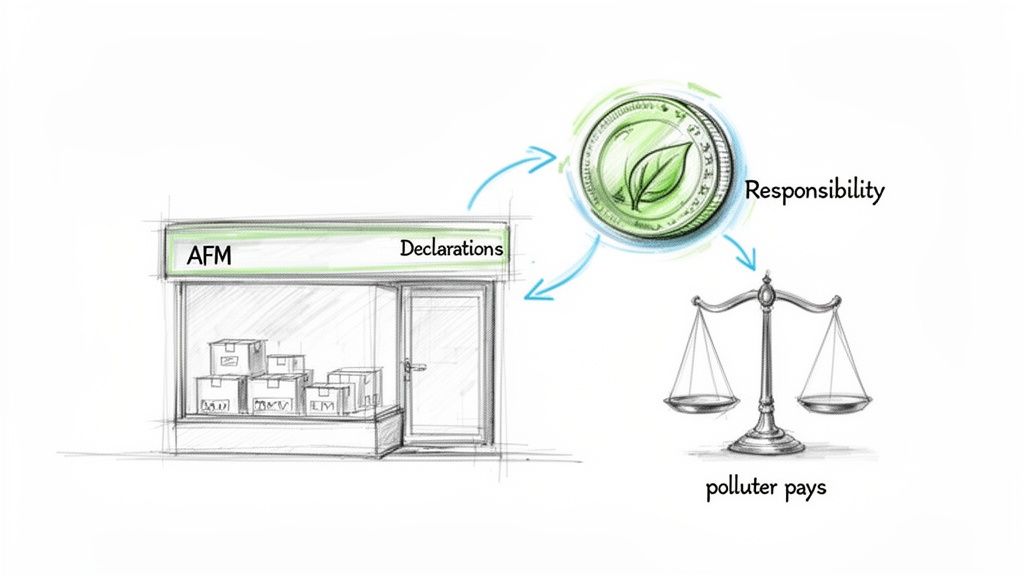
The administrația fondului de mediu declarații are the official reports companies file to declare the taxes and contributions owed based on their environmental footprint. This is not just a bureaucratic task; it's a critical business function that directly funds Romania's environmental projects.
The AFM acts as a specialized public fund, collecting these resources and channeling them into initiatives that protect and restore the environment. The funds support everything from reforestation and waste management infrastructure to programs promoting renewable energy and the circular economy.
Who Needs to File Declarations?
The duty to declare is triggered by specific business activities. Your company almost certainly has to report to the AFM if it:
- Manufactures or imports products in packaging that are sold on the national market.
- Sells electronic equipment, batteries, or car batteries.
- Introduces tyres, mineral oils, or synthetic oils into Romania.
- Sells single-use plastic carrier bags directly to consumers.
- Owns or operates landfills where waste is deposited.
At its heart, an AFM declaration is the mechanism that turns the 'polluter pays' principle from a concept into a concrete financial contribution. It makes sure that the companies profiting from market activities also shoulder the responsibility for managing the environmental consequences.
A Centralised System for Accountability
This reporting system creates a nationwide overview of all products and materials with a potential environmental impact. To better understand how these obligations connect, you can also read about the integrated environmental system and its role in national compliance.
Ultimately, these declarations are more than just a tax; they are a fundamental part of your company's license to operate. Approaching them with diligence is not just about avoiding penalties; it's about demonstrating corporate responsibility and contributing to a sustainable economy.
Figuring Out Your Exact AFM Reporting Duties
Not all companies file the same administrația fondului de mediu declarații. Your specific duties depend entirely on your business operations. The first step is to audit your activities against Romania's environmental laws.
We often see a misconception that these declarations are only for large manufacturers. This isn't true. In practice, any business that introduces certain products or materials to the Romanian market for the first time is obligated. This includes importers, online retailers, distributors, and even companies that re-package goods. The trigger isn't your company's size; it's your role in a product's journey to the customer.
Start with a Quick Audit of Your Business Activities
To get a clear picture of what you need to declare, ask a few straightforward questions about your daily operations. Think of this as a simple internal check-up—it’s the most practical way to move from uncertainty to a clear compliance plan.
- Do you import or make products that come in packaging? This is the most common obligation. If you place any packaged item on the market, you must declare the packaging materials like plastic, cardboard, and glass.
- Do you sell any electronics or electrical equipment? If so, the rules for Waste Electrical and Electronic Equipment (WEEE) apply. This covers a huge range of products, from laptops and servers to kitchen appliances.
- Do you sell batteries or accumulators? This obligation applies whether you sell them alone or they are inside another product, like a remote control or a car.
- Do you place tyres, mineral oils, or other hazardous substances on the market? Each category has its own specific reporting rules and forms.
Answering these questions provides a concrete, actionable list of your company’s AFM responsibilities.
Common AFM Declaration Types and Affected Businesses
Your reporting obligations are tied directly to the kinds of products you handle. Here’s a quick overview of common declarations and the business activities that trigger them.
Remember, the legal responsibility almost always lands on the company that first places the product on the Romanian market. Even if you use a logistics partner to handle imports, the final accountability for the
administrația fondului de mediu declaratiistays with you.
The table below breaks down the main declaration types.
Getting these distinctions right is crucial. For example, an IT company importing laptops must report on three fronts: the cardboard and plastic packaging, the electronic equipment itself (WEEE), and the lithium-ion batteries inside. Each requires a different calculation and declaration, all within the same consolidated AFM form.
Gathering Audit-Ready Data for Your AFM Filing
A successful AFM submission (administrația fondului de mediu declarații) depends on the quality of the data you gather all year. The real work is in day-to-day tracking, not a last-minute scramble. Solid data management is your best defense in an AFM audit, as it provides a clear trail from source documents to your final declared numbers.
This decision tree can help you figure out which reporting streams apply to your specific business activities.
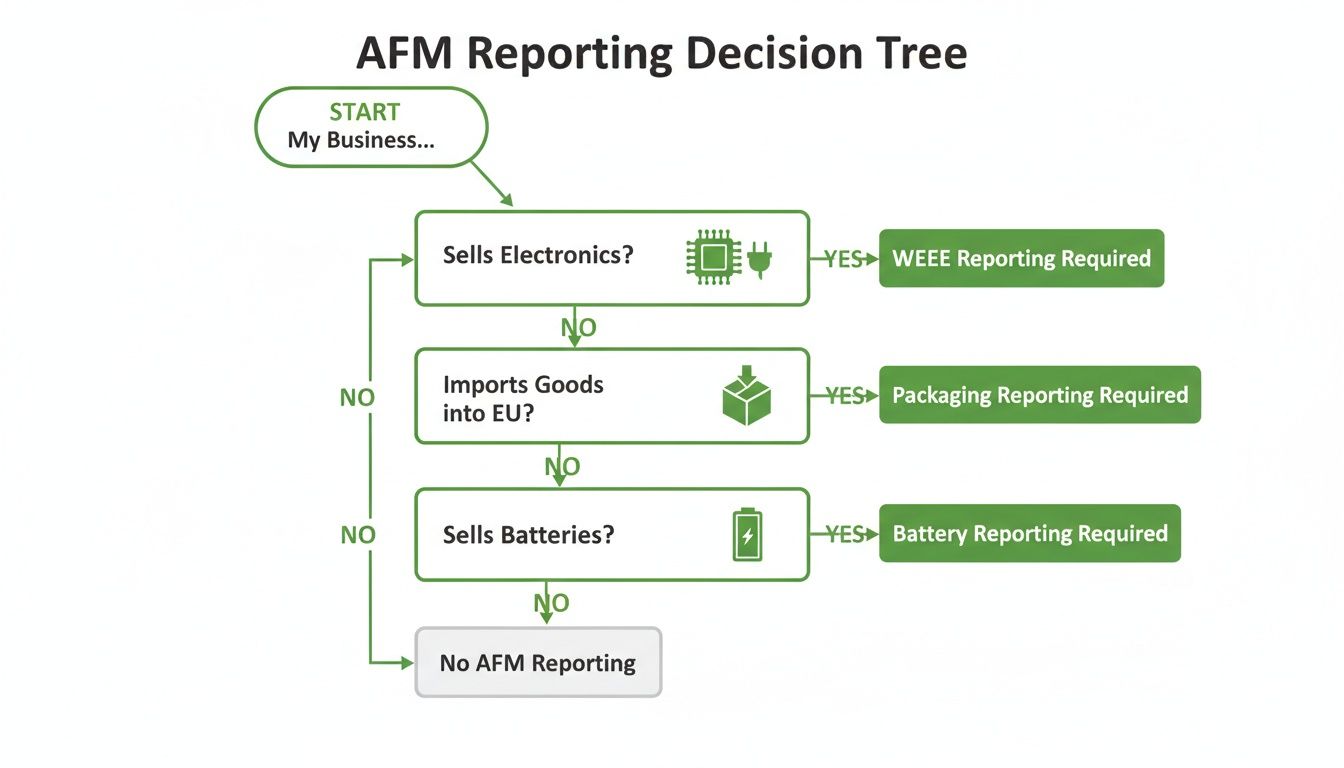
As you can see, different activities trigger different obligations, and each demands its own set of specific data points.
The Documents an Auditor Will Actually Ask For
To prepare a submission that can withstand scrutiny, your team needs to collect documents that prove the quantity and type of materials you’ve placed on the market.
Here’s a practical list of documents our team advises clients to have ready:
- Import Records: Customs declarations (DVI), CMRs, and Air Waybills (AWBs). These are non-negotiable for proving when products entered the country.
- Supplier Invoices & Packing Lists: These often contain the detailed breakdown of products and packaging components within a shipment.
- Technical Specifications: For complex products, official spec sheets from the manufacturer provide the product's exact net weight and a precise breakdown of its packaging.
- Contracts with OTRs: If you transfer responsibility to a waste management organization (OTR), you must have a valid, signed contract covering the entire reporting period.
The single most important question an auditor will ask is, "How did you arrive at this number?" Your goal is to have a clear, documented answer for every kilogram you declare, linking it directly back to one of these source documents.
Stop Scrambling: How to Build a Proactive Data System
A common mistake we see is companies waiting until the deadline to calculate packaging weights. A better approach is to build an internal process that captures this information as it arrives, such as a central spreadsheet where your logistics team logs packaging details for every new product.
To ensure your data is both accurate and audit-proof, you can leverage specialized data extraction tools to automatically pull information from source documents, reducing manual errors. A well-managed system for your waste management records is also fundamental to overall compliance. While finding detailed institutional data can be tough, official reports from the AFM are your most reliable sources. You can discover more insights about Romania's investment climate on trade.gov.
Ultimately, a robust internal data system allows you to report to the AFM with confidence.
How to Complete and Submit Your AFM Declaration
Once you have audit-ready data, the final step is submitting your administrația fondului de mediu declaratii. This happens online, but precision is everything. Errors can lead to rejections or follow-up questions from authorities. We see companies stumble here, so think of this as a hands-on walkthrough for navigating the official portal and building your team's confidence.
Navigating the AFM Online Portal
All declarations must be filed through the AFM's online platform. Before submitting, ensure your company is registered and you have a qualified digital certificate for the electronic signature. This is a non-negotiable first step.
When you log in, select the correct reporting period and find the sections for each of your obligations—packaging, WEEE, or batteries. This is where you’ll input the kilograms you calculated.
This is what the online portal interface looks like. It’s the central hub for all your environmental submissions.
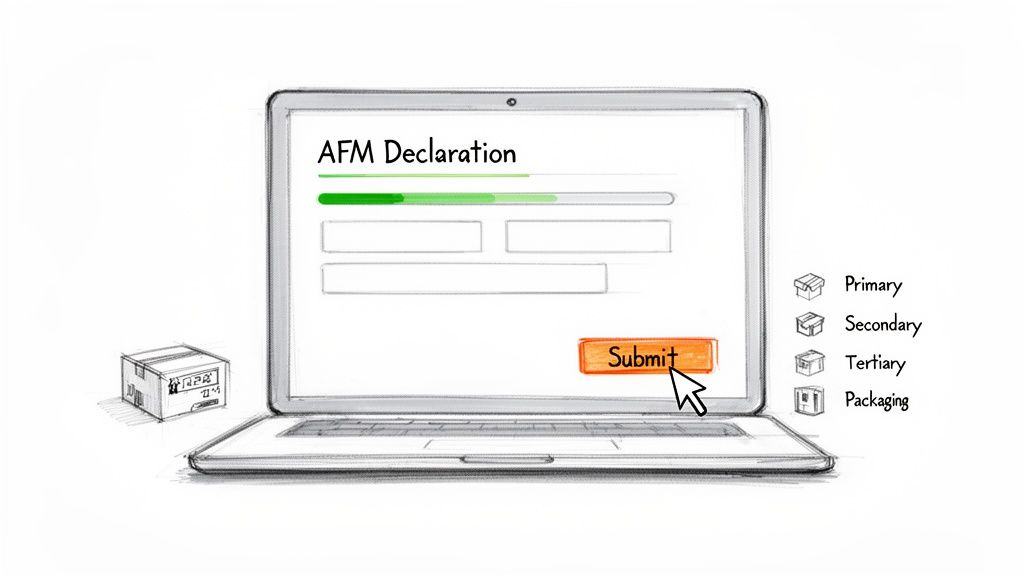
The system is designed to consolidate all your environmental duties into a single monthly declaration. The responsibility for accuracy is entirely on you.
Common Pitfalls and How to Avoid Them
Based on our experience, these are the most frequent submission errors:
- Misclassifying Packaging Materials: A classic mistake is lumping a product's direct container (primary packaging) with the transport box (tertiary packaging). This skews your data and is a red flag for auditors.
- Simple Calculation Errors: Arithmetic mistakes can slip through. Always double-check your final figures against your raw data before entering them into the portal.
- Forgetting "Zero" Declarations: If your company is registered as obligated but had no activity in a given month, you must still submit a declaration with "0" in the relevant fields. Failing to do so is treated as a missed submission.
A critical point to remember: you submit one single, consolidated declaration that includes all your obligations for that period. You do not file separate forms for packaging, WEEE, and batteries.
Finalising and Submitting Your Declaration
After entering the data, save the form, download the generated PDF, and apply your qualified electronic signature. That signed document is then uploaded back to the platform. Initially, your declaration will have a "Depus" (Submitted) status. Once reviewed, it will change to "Aprobată" (Approved). For a more detailed look at authentication, our guide on ANPM reporting and authentication covers a similar process.
Navigating AFM Deadlines, Penalties, and Audits
Filing your administrația fondului de mediu declarații is only the first step. True compliance means being timely and always audit-ready—realities that directly impact your company's bottom line. Missing a deadline comes with immediate financial penalties. The AFM is notoriously strict, so understanding these risks is key to justifying a robust, proactive compliance system.
Your Calendar of Critical AFM Deadlines
To avoid penalties, maintain a clear calendar of deadlines. The most common reporting rhythm is monthly.
- Monthly Declarations: Most obligations must be declared by the 25th of the month following the reporting period.
- Annual Declarations: These are for calculating the difference between your legal recovery targets and what your company achieved. The deadline is typically January 25th of the following year.
- Other Frequencies: Certain contributions, like the ecotax on plastic bags, operate on a quarterly schedule.
Always double-check the exact deadline for each of your specific obligations.
The Real-World Cost of Getting It Wrong
Failing to meet deadlines or submitting inaccurate data carries significant financial penalties. These sanctions are not a mere slap on the wrist; they are structured to enforce compliance strictly.
The core principle is brutally simple: penalties are calculated for each day of delay. This means the cost of an oversight grows daily, which is why a proactive, calendar-driven approach is the only reliable strategy.
Beyond late fees, incorrect declarations can trigger a formal AFM audit, where your data management and record-keeping are put to the test.
How to Prepare for a Potential AFM Audit
An AFM audit is usually triggered by red flags in your administrația fondului de mediu declarații, such as major fluctuations in declared quantities or discrepancies with past reports.
When inspectors arrive, they will look for a clear paper trail, including invoices, import records, technical specifications, and waste management contracts. Your ability to produce this documentation quickly is your single best defense. While national reports on Romania's national green financing instruments on mfinante.gov.ro provide context, an audit is about your numbers and your internal documentation.
The goal is to shift your company’s posture from reactive to proactive, ensuring you are always audit-ready by maintaining meticulous records all year round.
Your Top Questions About AFM Declarations, Answered
Even with a detailed guide, some questions always come up. Our team has heard them all, so let’s tackle the most common ones we get from businesses navigating their administrația fondului de mediu declarații.
Here are the direct, practical answers you need.
What Happens If I Miss the Submission Deadline?
Missing an AFM deadline means automatic financial penalties. There is no grace period. The authorities will issue a fine and charge interest for every day your contribution remains unpaid. Communicating an anticipated delay rarely waives the penalty. Your only defense is a rock-solid internal compliance calendar with proactive reminders.
Is My 3PL Partner Responsible for Declaring Packaging?
Almost always, the answer is no. Legal responsibility rests with the company that first places the packaged product on the Romanian market. If you are the manufacturer or importer, that’s you. You can have a contract with your third-party logistics (3PL) partner defining who provides what data, but the AFM will hold you, the economic operator, accountable for the accuracy of the numbers.
The core takeaway is that responsibility cannot be fully outsourced. You can delegate the task, but not the legal accountability. You are ultimately the one signing off on the declaration.
Can I Fix a Mistake in a Submitted Declaration?
Yes, and you should. If you find a mistake after filing, submit a corrective declaration, known officially as a "declarație rectificativă." Taking this step quickly shows good faith and can help you avoid or reduce penalties, especially if you correct the error before an audit. The revised declaration replaces the original one for that period. Be ready to explain and justify the changes.
Do I Still Need to Declare If My Quantities Are Very Small?
Yes. For most AFM obligations, especially packaging, there is no "de minimis" threshold. If your business places even a single packaged item on the market, you are legally required to declare it. Even if you have no activity, you may still need to file a "zero" declaration if your company is registered as an obligated entity. When in doubt, assume you must file a report.
At ECONOS 🌱, we help companies transform these complex compliance requirements into manageable, streamlined processes. We combine deep regulatory expertise with practical delivery, ensuring your team becomes autonomous and your reporting is always audit-ready.
Find out how we can support your ESG and environmental compliance journey at https://www.econos-esg.com.